

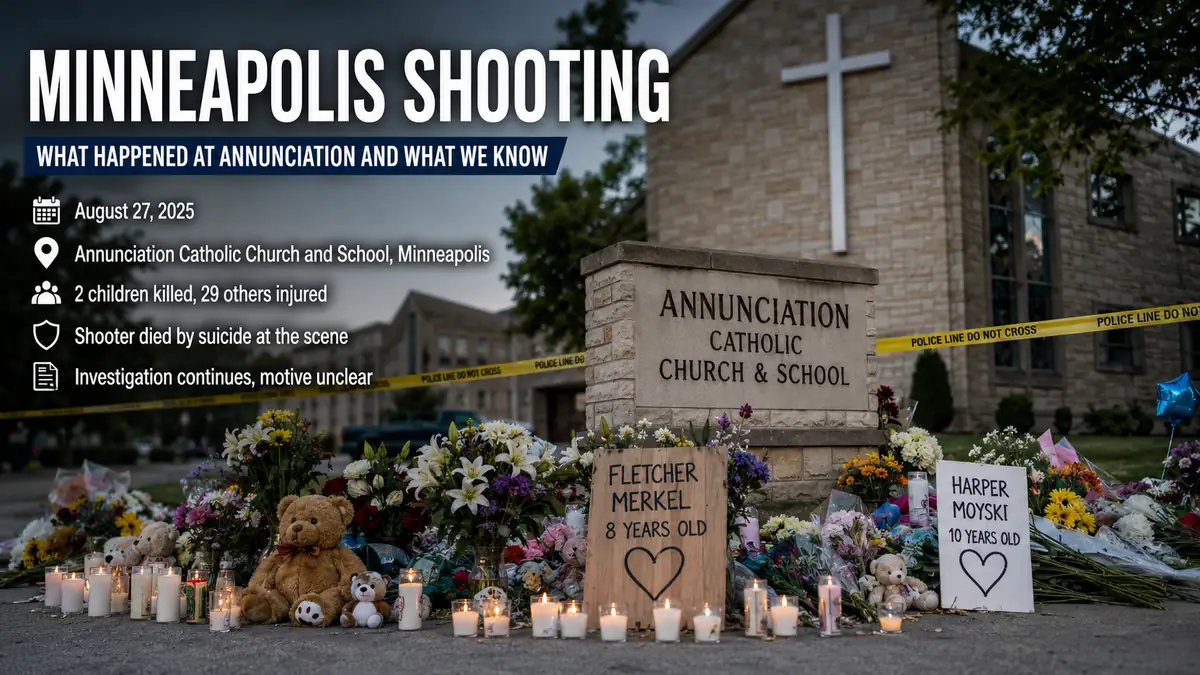
The minneapolis shooting at Annunciation Catholic Church and School became one of Minnesota’s most devastating recent acts of school-related violence. On August 27, 2025, gunfire struck an all-school Mass in south Minneapolis, killing two children and injuring dozens of students and adults.
A year later, newly released investigative records have provided a much clearer picture of the emergency response and evidence collected after the attack. They have not, however, produced a simple explanation for why it happened.
Quick answer: The minneapolis shooting occurred on August 27, 2025, at Annunciation Catholic Church during a school Mass. Eight-year-old Fletcher Merkel and 10-year-old Harper Moyski were killed. Minneapolis now reports 29 people injured by gunfire. The 23-year-old shooter died at the scene from a self-inflicted gunshot wound.
What Happened in the minneapolis shooting?
The attack took place at the Church of the Annunciation, connected to Annunciation Catholic School in south Minneapolis. Students, teachers and parishioners had gathered for an all-school Mass during the first week of the academic year.
Shortly before 8:30 a.m., a shooter outside the church opened fire through its windows toward people gathered inside. Students were sitting in the pews when the attack began. Early reports described shattered stained-glass windows and children taking cover as teachers and other adults tried to protect them.
Police and other emergency personnel rushed to Annunciation. The shooter was subsequently found dead from a self-inflicted gunshot wound. Authorities said no officers fired their weapons during the encounter.
Key facts at a glance
| Detail | Confirmed information |
|---|---|
| Date | August 27, 2025 |
| Location | Annunciation Catholic Church and School, Minneapolis, Minnesota |
| Setting | All-school Mass during the first week of school |
| Children killed | Fletcher Merkel, 8, and Harper Moyski, 10 |
| Gunshot injuries | 26 children and 3 adults, according to the City of Minneapolis’ updated count |
| Shooter | 23-year-old Robin Westman |
| Shooter’s fate | Died from a self-inflicted gunshot wound |
| Latest status | Extensive investigative records released; precise motive remains unclear |
The City of Minneapolis now lists 31 victims overall: two children killed by gunfire, 26 children injured by gunfire, three adults injured by gunfire, and one additional person with an injury unrelated to gunfire.
That updated figure is important because early breaking-news coverage reported substantially fewer injuries. Initial reports commonly stated that 17 people had been wounded. Later official information expanded the number as authorities established a more complete accounting of those affected.
Who Were the Victims of the Minneapolis School Shooting?
The two children killed were Fletcher Merkel, 8, and Harper Moyski, 10.
They had been attending Mass with fellow students when the shooting began. Their deaths became the central focus of memorials, vigils and remembrance activities across the Minneapolis community.
Many other children suffered gunshot wounds. The City’s updated figures state that 26 children and three adults were injured by gunfire.
The physical injuries tell only part of the story. Students who escaped without gunshot wounds still witnessed an extraordinarily traumatic event. Parents experienced hours of fear and uncertainty, while teachers, church staff, medical workers and first responders were confronted with the immediate consequences of a mass-casualty incident.
Survivors have continued dealing with those effects well beyond the day of the shooting.
Who Was the Minneapolis Shooter?
Authorities identified the shooter as Robin Westman, 23.
Investigators determined that Westman acted alone in carrying out the attack. The shooter died by suicide at the scene after firing into the church.
Subsequent reporting and investigative records examined writings, videos, firearms and other evidence connected with Westman. Investigators found material containing violent themes, hostility and references to previous mass killers.
Understanding those materials, however, is different from establishing a single definitive motive.
Did the shooter attend Annunciation Catholic School?
Authorities established a previous connection between Westman and Annunciation. Investigators examined that history, along with school experiences and personal writings, while trying to understand why the church and school were targeted.
People who knew Westman described a socially isolated individual, and investigators learned of previous suicidal thoughts. But the records released by the first anniversary still did not establish a straightforward chain of events explaining the decision to attack the church.
That distinction matters. A collection of disturbing writings can provide evidence about a person’s state of mind without necessarily proving a precise motive for a specific attack.
What Did the Minneapolis Shooting Investigation Find?
One year after the attack, investigators released thousands of pages of material documenting what happened before, during and after the shooting.
CBS Minnesota reported in August 2026 that the released investigative material totaled roughly 2,600 pages. The records include material from the Minneapolis Police Department and the Minnesota Bureau of Criminal Apprehension, along with information from other responding agencies.
The Minneapolis police portion alone runs hundreds of pages and documents witness interviews, crime laboratory reports, evidence and the movements of emergency personnel.
More than 150 first responders were involved in the response described in the investigative records.
What investigators learned about the response
The newly released records show how quickly the situation shifted from an active shooting to a large-scale rescue and medical operation.
Police officers arriving at Annunciation had to locate the attacker, determine whether additional threats existed, clear areas of the property, assist injured people and help establish safe locations for students and staff.
Medical triage began rapidly.
Some officers and other first responders provided immediate treatment while victims were being prepared for transportation to hospitals. Newly released documents describe an officer using a tourniquet in an intervention credited with helping save a woman’s life.
The crime scene was also larger than the interior of the church. Evidence and damage were documented around the church, playground and neighboring properties.
Why is the shooter’s motive still unclear?
This remains one of the biggest unanswered questions.
Investigators recovered writings and other materials showing an interest in mass shootings and expressions of hatred. They also examined the shooter’s personal history and interviewed people who had known Westman.
Yet the records released by August 2026 did not reveal a single, verified motive explaining the attack.
The Associated Press reported that the newly available documents provided extensive information about the police response while offering comparatively little new clarity about motive.
That means claims online presenting one specific motive as definitively established should be treated cautiously unless supported by investigators or documented evidence.
How Did Students and Teachers Respond During the Attack?
Accounts from inside Annunciation describe children hiding beneath pews and adults trying to shield students as gunfire entered the church.
Some students helped one another.
Reuters reported after the shooting that a 10-year-old protected a younger schoolmate while another student prayed while sheltering beneath a pew. Such accounts became part of a broader picture of children responding instinctively to an extreme emergency.
Teachers and school staff also had to make rapid decisions with incomplete information.
The later investigation documented educators barricading classrooms and trying to keep students protected while law enforcement searched and secured the property.
Parents faced a different crisis outside.
Some rushed toward Annunciation after receiving messages or hearing reports of an active shooter, only to encounter emergency vehicles, police barriers and uncertainty about where their children were. Contemporary accounts described parents searching for children while first responders treated victims nearby.
These details help explain why recovery has involved far more than repairing physical damage to the church.
How Did Minneapolis Respond to the Shooting?
The immediate response involved the Minneapolis Police Department, firefighters, emergency medical personnel, the Minnesota Bureau of Criminal Apprehension, federal authorities and other agencies.
Hospitals prepared for a mass-casualty event as injured children and adults arrived for emergency treatment.
The shooting also triggered an enormous community response.
Vigils brought together families, residents, religious leaders and public officials. People placed flowers, ribbons and other memorials around the area. Religious leaders emphasized prayer and healing, while political leaders renewed debates over preventing gun violence.
Minneapolis Mayor Jacob Frey and Minnesota Gov. Tim Walz were among the officials who responded publicly after the attack. The tragedy also prompted renewed discussion of assault-style firearms, high-capacity magazines, school security and state gun laws.
Those policy discussions have continued alongside the community’s recovery.
Minneapolis Shooting One Year Later: What Has Changed?
August 27, 2026, marked the first anniversary of the Annunciation shooting.
For Minneapolis, the anniversary was not treated simply as another date on the calendar. The city designated it as Annunciation Remembrance Day, focusing attention on the victims, survivors, families, school community and people involved in the emergency response.
The anniversary included remembrance, prayer, community service and gatherings intended to honor Harper and Fletcher.
The Minneapolis City Council also planned an honorary resolution recognizing the resilience of the Annunciation community.
Students are continuing their education
The long-term effects are especially visible among students who survived.
One year after the shooting, some members of the Annunciation community were preparing to move into high school. Survivors and their families described living with memories of the attack while trying to move forward academically and personally.
Annunciation itself has spent the year rebuilding students’ sense of security.
School staff have emphasized mental-health support as children process grief, anxiety and memories of the attack. That work illustrates a reality often overlooked in the immediate coverage of mass shootings: recovery can continue for years after physical wounds have healed.
Memorials honor Fletcher and Harper
Permanent memorials have also become part of the city’s landscape.
Community memorial benches honor the two children, creating places where relatives, friends and neighbors can remember their lives rather than allowing the circumstances of their deaths to define their entire stories.
MPR News reported in August 2026 on a memorial bench for Fletcher Merkel at Grass Lake, a place connected with his life and interests.
Similar acts of remembrance have helped survivors and families maintain connections while processing grief.
How Has the Shooting Affected the Gun-Violence Debate?
The Annunciation attack quickly became part of Minnesota’s broader debate over gun laws and school safety.
Parents affected by the shooting became involved in advocacy, including efforts connected with preventing gun violence. Some Annunciation families found support and guidance from parents affected by the Sandy Hook Elementary School shooting more than a decade earlier.
Among the policy issues discussed in Minnesota have been restrictions on assault-style weapons and high-capacity magazines.
The City of Minneapolis has publicly highlighted calls for legislative action addressing those areas, along with debate over Minnesota law limiting the ability of cities to enact their own gun regulations.
These proposals remain political and policy questions rather than settled conclusions about how any single measure would have changed the Annunciation attack.
For families directly affected, advocacy has also become one way of turning grief into efforts aimed at preventing similar violence.
School and Church Security After the Minneapolis Shooting
The attack raised a particularly difficult security issue because Annunciation functions as both a Catholic parish and a school community.
Schools generally have controlled entry procedures during regular classroom hours. Churches, meanwhile, traditionally emphasize accessibility to worshippers and visitors. When students gather for Mass in a church building, those two environments overlap.
The Annunciation shooting demonstrated how attackers may exploit exterior access and windows rather than attempting to enter through a monitored school entrance.
That has increased attention on layered security rather than relying on one locked door.
Practical school and church safety planning can include:
- Reviewing exterior doors, windows and lines of sight.
- Establishing rapid methods for reporting suspicious activity.
- Training staff for evacuation, sheltering and lockdown decisions.
- Coordinating emergency plans between schools and attached religious facilities.
- Ensuring police, fire departments and emergency medical teams understand building layouts.
- Maintaining reliable family reunification procedures.
- Providing trauma-informed mental-health support after emergencies.
No security system can promise complete protection. The more realistic objective is to reduce vulnerabilities, improve warning and communication, and shorten the time needed to protect and treat people when an emergency occurs.
Why Are Different Minneapolis Shooting Victim Numbers Reported?
Anyone researching the attack may encounter apparently conflicting numbers.
This largely reflects how information changed after the initial emergency.
On August 27, 2025, Minneapolis Police Chief Brian O’Hara reported two children killed and 17 other people injured. Fourteen of the initially reported injured victims were children between ages 6 and 15, while three were adult parishioners.
Later records produced a larger official count.
The City of Minneapolis’ current Annunciation information page states that the incident involved 31 victims: two children killed by gunfire, 26 children injured by gunfire, three adults injured by gunfire, and one person whose injury was unrelated to gunfire.
For current reference, the City’s updated figures are therefore preferable to casualty totals published during the first hours of breaking-news coverage.
Was There a New Annunciation Shooting in August 2026?
No. The renewed coverage around August 27, 2026, concerned the one-year anniversary of the August 27, 2025 attack, not a new shooting at Annunciation Catholic Church and School.
This distinction matters because searches for minneapolis shooting can surface several unrelated incidents.
Minneapolis has experienced other shootings before and after Annunciation, including separate incidents in 2026. Those cases should not be confused with the school and church attack being commemorated on its anniversary. Recent local reporting, for example, has covered unrelated shootings elsewhere in south Minneapolis, the North Loop and other parts of the city.
The anniversary coverage appearing in late August 2026 primarily reflects new investigative documents, survivor stories, memorial activities and assessments of the community’s recovery.
What We Still Don’t Know About the Minneapolis Shooting
Despite thousands of pages of investigative records, not every question has been answered.
The biggest unresolved issue is motive.
Authorities established who carried out the attack, reconstructed much of what happened, collected physical and digital evidence, examined the shooter’s writings and interviewed numerous witnesses and acquaintances. But investigators have not identified one simple explanation that fully accounts for the decision to attack Annunciation.
Some investigative material has also been redacted to protect victims and sensitive personal information. Additional information could become public as records are reviewed or released.
This is why verified reporting remains especially important. Mass shootings often generate speculation, manipulated imagery and incorrect identification of people online. Similar misinformation has circulated after other Minneapolis shootings, demonstrating how quickly inaccurate material can spread during major breaking-news events.
The Lasting Impact of the minneapolis shooting
A year after the minneapolis shooting, the basic facts are clearer than they were during the chaotic first hours of August 27, 2025.
The attack occurred during an all-school Mass at Annunciation Catholic Church. Fletcher Merkel and Harper Moyski were killed. The City’s updated records count 29 other people injured by gunfire, most of them children. Investigators reconstructed an extensive picture of the attack and emergency response, yet the shooter’s precise motive remains unresolved.
The story now extends beyond the investigation.
Students are progressing to new schools. Teachers and parents continue helping children rebuild a sense of safety. Memorials preserve the identities and lives of Harper and Fletcher. Families have become involved in discussions about gun violence and prevention, while Annunciation and the wider Minneapolis community continue the slower work of recovery.
The most useful way to follow future developments is to distinguish new investigative findings from anniversary coverage and unrelated Minneapolis shootings, and to rely on updated information from authorities and established local and national reporting.
