

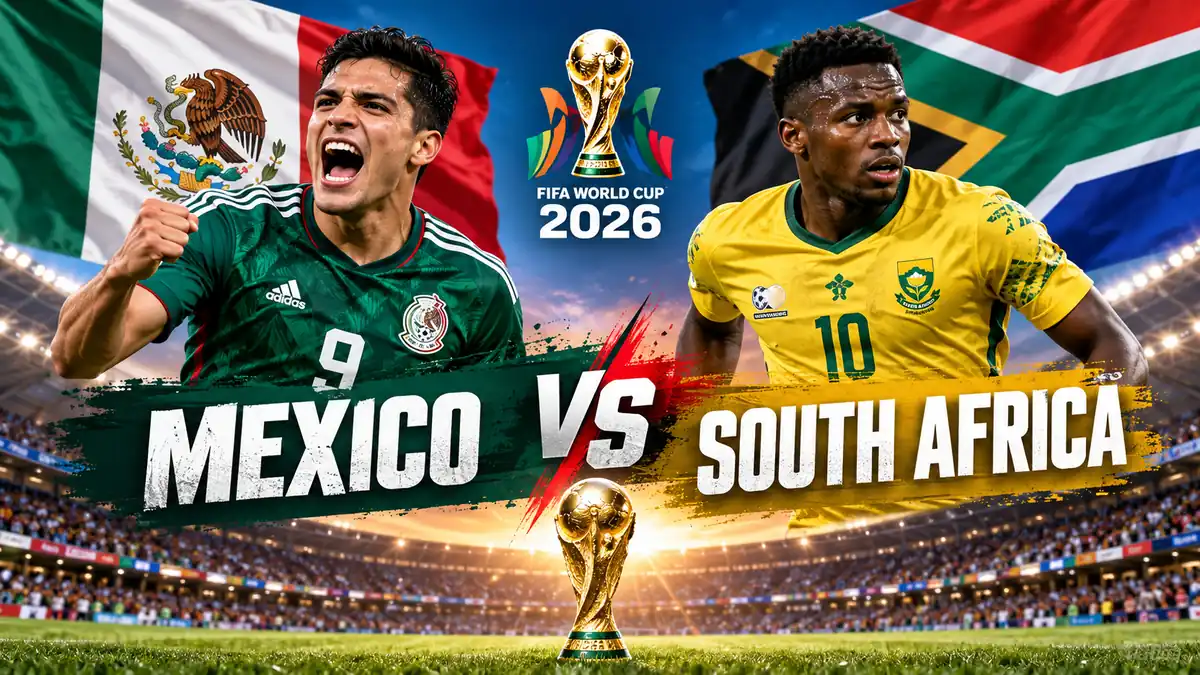
Sixteen years after opening the 2010 FIFA World Cup with a memorable draw, Mexico and South Africa met again in the opening match of the 2026 tournament. This time, Mexico had home advantage, and the result was very different.
The latest mexico vs south africa match ended in a 2-0 victory for Mexico on June 11, 2026, at Estadio Azteca in Mexico City. Julián Quiñones and Raúl Jiménez scored the goals, while South Africa finished with nine players following two red cards. The result extended Mexico’s historical advantage in this international football rivalry.
mexico vs south africa: 2026 World Cup Match Summary

Mexico
2 – 0
Full time

South Africa
Competition
2026 FIFA World Cup, Group A
Date
June 11, 2026
Venue
Estadio Azteca, Mexico City
Attendance
80,824
Goalscorers
Quiñones (9′), Jiménez (67′)
The match carried historical significance beyond the final score. Mexico became the first nation to host the men’s FIFA World Cup three times, following the tournaments of 1970 and 1986. South Africa, meanwhile, returned to the World Cup for the first time since hosting the competition in 2010.
First Half: Mexico Takes an Early Lead
Mexico started aggressively, applying pressure to South Africa’s defensive line and looking to capitalize on mistakes in possession.
In the ninth minute, South African midfielder Sphephelo Sithole lost possession while attempting to build an attack from the back. Julián Quiñones reacted quickly and converted the opportunity, giving Mexico a 1-0 lead.
South Africa gradually became more comfortable in possession, but its attacking movements rarely threatened the Mexican defense. Mexico maintained its narrow advantage until halftime.
Second Half: Red Cards Change the Match
South Africa’s chances of recovering became considerably more difficult shortly after the restart.
Four minutes into the second half, Sithole received a straight red card after bringing down Brian Gutiérrez as the Mexican attacker advanced toward goal.
With a numerical advantage, Mexico gained greater control of the contest.
Raúl Jiménez doubled the lead in the 67th minute, scoring with a header and giving the home supporters another reason to celebrate.
South Africa’s situation deteriorated further when Themba Zwane was dismissed following a VAR review late in the match.
Mexico also finished with ten players after César Montes received a red card in stoppage time.
Despite the disciplinary incidents, Mexico protected its two-goal advantage and secured three points in its opening Group A fixture.

Confédération Africaine de Football
+1
mexico vs south africa Head-to-Head Record
Mexico holds the stronger historical record in meetings between the two men’s national football teams.
Across five recorded senior international matches through June 2026, Mexico has won three times, South Africa has won once, and one match has ended in a draw.
3
Mexico wins
1
Draws
1
South Africa wins
Goals scored in five meetings
0481216MexicoSouth Africa
The complete historical record is as follows:
| Date | Competition | Result |
|---|---|---|
| Oct. 6, 1993 | International friendly | Mexico 4–0 South Africa |
| June 7, 2000 | International friendly | Mexico 4–2 South Africa |
| July 8, 2005 | CONCACAF Gold Cup | South Africa 2–1 Mexico |
| June 11, 2010 | FIFA World Cup | South Africa 1–1 Mexico |
| June 11, 2026 | FIFA World Cup | Mexico 2–0 South Africa |
These five encounters have produced 17 goals: 12 for Mexico and five for South Africa.
11v11
+1
Which Team Has Won More Matches?
Mexico leads with three victories compared with South Africa’s one.
Mexico won the first two meetings in 1993 and 2000, both by scoring four goals. South Africa recorded its only victory in the 2005 CONCACAF Gold Cup, while the 2010 World Cup meeting ended in a draw.
Mexico’s 2026 victory further strengthened its overall record.
Has South Africa Ever Beaten Mexico?
Yes. South Africa defeated Mexico 2-1 on July 8, 2005, during the CONCACAF Gold Cup.
That victory remains South Africa’s only win against Mexico in their five recorded senior international encounters.
The Gold Cup is primarily contested by national teams from North America, Central America, and the Caribbean, although invited teams from other confederations have participated in certain editions.
South Africa’s involvement in the 2005 tournament provided an unusual competitive meeting between the African and North American sides.
Mexico vs South Africa 2010 World Cup: The Historic 1-1 Draw


10
The most famous meeting between Mexico and South Africa before 2026 took place on June 11, 2010, at Soccer City in Johannesburg.
It was the opening match of the first FIFA World Cup hosted on African soil, creating enormous expectations for the South African national team, popularly known as Bafana Bafana.
The game ended 1-1, but its significance extended well beyond the result.
Siphiwe Tshabalala’s Famous Opening Goal
South Africa broke the deadlock in the 55th minute.
Siphiwe Tshabalala received a pass from Kagiso Dikgacoi and produced a powerful left-footed finish, sending the ball into the Mexican net.
The goal became one of the defining moments of the 2010 tournament.
It was particularly meaningful because South Africa was hosting the World Cup for the first time, and the strike produced an extraordinary reaction from the home crowd.
Rafael Márquez Equalizes for Mexico
Mexico responded in the 79th minute through Rafael Márquez.
The experienced defender scored after receiving the ball from Andrés Guardado, restoring parity and preventing South Africa from securing an opening-match victory.
Neither team found another goal, and the match ended 1-1.
What Happened to Both Teams After the 2010 Draw?
The opening result contributed to a tightly contested Group A, which also included Uruguay and France.
Mexico eventually advanced to the knockout stage, while South Africa was eliminated on goal difference despite finishing level on points with Mexico.
South Africa became the first World Cup host nation to be eliminated during the group stage.
For Mexico, the tournament ended in the round of 16 against Argentina.
The contrast between the two teams’ tournament outcomes illustrates why their opening draw was only one part of a much larger group-stage battle.
2010 vs 2026: How the Two World Cup Meetings Compare
The most unusual aspect of this rivalry is that Mexico and South Africa opened two different FIFA World Cups exactly 16 years apart.
In 2010, South Africa was the host. In 2026, Mexico assumed that role.
| Feature | 2010 World Cup | 2026 World Cup |
|---|---|---|
| Host country | South Africa | Mexico, alongside USA and Canada |
| Stadium | Soccer City, Johannesburg | Estadio Azteca, Mexico City |
| Match date | June 11, 2010 | June 11, 2026 |
| Final score | 1-1 | Mexico 2-0 South Africa |
| First scorer | Siphiwe Tshabalala | Julián Quiñones |
| Mexico scorer(s) | Rafael Márquez | Quiñones, Raúl Jiménez |
| South Africa goals | 1 | 0 |
| Match winner | Draw | Mexico |
FIFA identified the repeated opening fixture as a historic occurrence when announcing the 2026 tournament schedule.
Why Was the 2026 Rematch Significant?
The rematch connected two generations of football history.
Both fixtures involved a host nation carrying the expectations of its supporters in the tournament’s opening match.
However, the outcomes differed.
South Africa’s 2010 opener produced a draw after an emotional first goal. Mexico’s 2026 opener ended in a convincing victory, although the game was influenced by South Africa’s disciplinary problems.
The matches also highlighted the different circumstances of the two national teams, with Mexico appearing regularly at World Cups and South Africa returning after a long absence.
Mexico National Football Team: History and Strengths

Mexico, commonly known as El Tri, is one of the most established national teams in the CONCACAF region.
Its international football history includes regular World Cup participation, regional championships, and a strong tradition of producing technically capable players.
Mexico’s FIFA World Cup History
Mexico made its 18th men’s World Cup appearance in 2026.
Its best historical performances came in 1970 and 1986, when it reached the quarterfinals on home soil.
Mexico also achieved seven consecutive round-of-16 appearances between 1994 and 2018 before suffering a group-stage elimination at the 2022 tournament in Qatar.
Mexico’s Playing Style
Mexico has traditionally emphasized technical passing, attacking combinations, and movement through midfield.
Its tactical approach can vary significantly depending on the coach and available players.
Under Javier Aguirre in 2026, the team combined organized defending with aggressive pressing and attacking transitions.
Against South Africa, the early pressure was particularly effective because it contributed directly to the opening goal.
Mexico also benefited from its ability to capitalize on the numerical advantage created by South Africa’s dismissals.
Key Mexican Players in the 2026 Match
Julián Quiñones provided the breakthrough with his ninth-minute goal. His quick reaction to a defensive error demonstrated the value of applying pressure high up the pitch.
Raúl Jiménez scored Mexico’s second goal in the 67th minute. The experienced striker’s aerial finishing gave Mexico a comfortable lead.
César Montes was involved in a late disciplinary incident and received a red card during stoppage time.
Together, these moments shaped the result and demonstrated both the attacking effectiveness and disciplinary challenges present in Mexico’s opening performance.
South Africa National Football Team: History and Strengths

South Africa’s national football team, Bafana Bafana, represents the country in competitions organized by the Confederation of African Football (CAF).
The team’s modern international history developed after South Africa returned to international sporting competition in the early 1990s.
One of its most important achievements came in 1996, when South Africa won the Africa Cup of Nations on home soil.
South Africa’s World Cup Appearances
South Africa qualified for the men’s FIFA World Cup in 1998 and 2002 before hosting the tournament in 2010.
Its return in 2026 marked the country’s fourth appearance in the competition.
Unlike Mexico, South Africa had not established a consistent record of World Cup qualification during the intervening years.
Nevertheless, its qualification for the 2026 tournament represented an important milestone for the national team.
South Africa’s Tactical Approach
Under coach Hugo Broos, South Africa developed an approach based on defensive organization, teamwork, and quick transitions.
The team has often looked to remain compact without possession before using pace and movement to create attacking opportunities.
Against Mexico, South Africa struggled to execute that approach consistently.
The opening goal resulted from a mistake while attempting to play out from the back.
The second-half red cards further disrupted the team’s defensive structure and reduced its ability to compete on equal terms.
Important South African Players
Ronwen Williams served as South Africa’s goalkeeper and faced a difficult assignment against Mexico’s attack.
Sphephelo Sithole was involved in two decisive incidents: the possession loss preceding Mexico’s opening goal and the foul that resulted in his dismissal.
Themba Zwane was sent off late in the contest following a VAR review.
These incidents illustrate how individual decisions can influence a team’s performance in a major international tournament.
mexico vs south africa: Tactical Comparison and Key Differences
Although Mexico and South Africa have different football histories, their encounters demonstrate that international matches are not decided by reputation alone.
The 2010 draw and South Africa’s 2005 victory show that the African side has previously competed effectively against Mexico.
However, the 2026 match highlighted several areas in which Mexico performed better.
1. Pressing and Defensive Mistakes
Mexico’s opening goal came from pressure applied to South Africa’s buildup.
When a team attempts to pass out from deep defensive positions, it must maintain accurate passing, intelligent movement, and composure.
South Africa’s failure to retain possession created a direct scoring opportunity.
Mexico’s ability to recognize and exploit that mistake was one of the defining features of the game.
2. Midfield Control
Controlling midfield allows a team to dictate the pace of a match and influence where possession is played.
South Africa enjoyed periods of improved possession during the first half, but Mexico remained organized defensively.
After South Africa was reduced to ten players, maintaining midfield balance became significantly more difficult.
Mexico could circulate possession more comfortably and attack spaces left by the opposition.
3. Finishing and Attacking Efficiency
Mexico converted two important opportunities.
Quiñones reacted quickly to a defensive mistake, while Jiménez finished an attacking move with a header.
South Africa, by contrast, struggled to create clear scoring chances.
This difference in attacking efficiency helped determine the result.
4. Discipline and Numerical Advantage
Discipline was a major factor in the 2026 meeting.
South Africa received two red cards, while Mexico received one.
Playing with fewer players requires substantial tactical adjustments, especially against a team already leading.
South Africa’s dismissals reduced its attacking options and increased the defensive workload for the remaining players.
Although Mexico’s victory cannot be explained entirely by the red cards, they significantly influenced the second half.
Which Is the Stronger Football Team: Mexico or South Africa?
Based on historical head-to-head results and overall World Cup participation, Mexico has the stronger record.
Mexico has won three of their five meetings and has participated in significantly more World Cup tournaments.
It has also reached the quarterfinals twice, while South Africa has yet to progress beyond the group stage at the men’s World Cup.
However, football strength depends on more than historical results.
A team’s current squad, tactical preparation, fitness, coaching, and match conditions can all affect its performance.
South Africa’s 2005 Gold Cup victory and the 2010 World Cup draw demonstrate that the team is capable of challenging Mexico.
The 2026 result nevertheless reinforced Mexico’s historical advantage.
Is Mexico Better Than South Africa in World Cup Matches?
Mexico leads their World Cup head-to-head record.
The two teams have met twice in the competition:
- 2010: South Africa 1-1 Mexico.
- 2026: Mexico 2-0 South Africa.
Mexico therefore has one World Cup victory and one draw against South Africa, with three goals scored and one conceded.
What Is the Biggest Win in Their Head-to-Head History?
Mexico’s largest victory against South Africa came on October 6, 1993, when it won 4-0 in an international friendly.
Mexico also defeated South Africa 4-2 in June 2000.
South Africa’s biggest and only victory in this fixture was its 2-1 Gold Cup win in 2005.
These results show that Mexico has generally scored more freely in the fixture, although the teams have also produced closely contested matches.
Why the Mexico–South Africa Rivalry Matters
Mexico and South Africa are not traditional regional rivals.
They compete in different continental confederations and meet relatively infrequently.
Mexico belongs to CONCACAF, while South Africa competes within CAF.
Despite this geographical separation, their World Cup history gives the fixture a distinctive identity.
Few international matchups have featured as the opening game of two separate men’s FIFA World Cups.
The 2010 encounter is remembered for Tshabalala’s spectacular opening goal and Márquez’s equalizer.
The 2026 meeting will be remembered for Mexico’s home victory, the goals from Quiñones and Jiménez, and an unusually high number of red cards.
Both matches also demonstrate the emotional pressure associated with opening a World Cup as a host nation.
For supporters, this shared history makes future meetings between the teams more interesting than their relatively small number of encounters might suggest.
Final Thoughts on mexico vs south africa
The mexico vs south africa head-to-head record favors Mexico, which has three victories, one draw, and one defeat across five senior international meetings through June 2026.
Their latest encounter ended with Mexico defeating South Africa 2-0 in the opening match of the 2026 FIFA World Cup.
The fixture also carries a unique place in football history because the two countries opened both the 2010 and 2026 tournaments, exactly 16 years apart.
South Africa’s memorable 2010 performance and its earlier Gold Cup victory demonstrate that the matchup has not always been one-sided. Nevertheless, Mexico’s greater World Cup experience, stronger historical results, and latest victory establish it as the more successful side in this head-to-head series.
For readers comparing the two teams, the clearest picture comes from considering both their complete historical record and the circumstances surrounding their two World Cup meetings.
