

Need to convert a measurement from meters to feet? The calculation is straightforward, but using the correct conversion factor matters when precision is required. Whether you’re measuring a room, checking someone’s height, reviewing construction plans, or comparing distances, knowing how meters and feet relate makes the process easier.
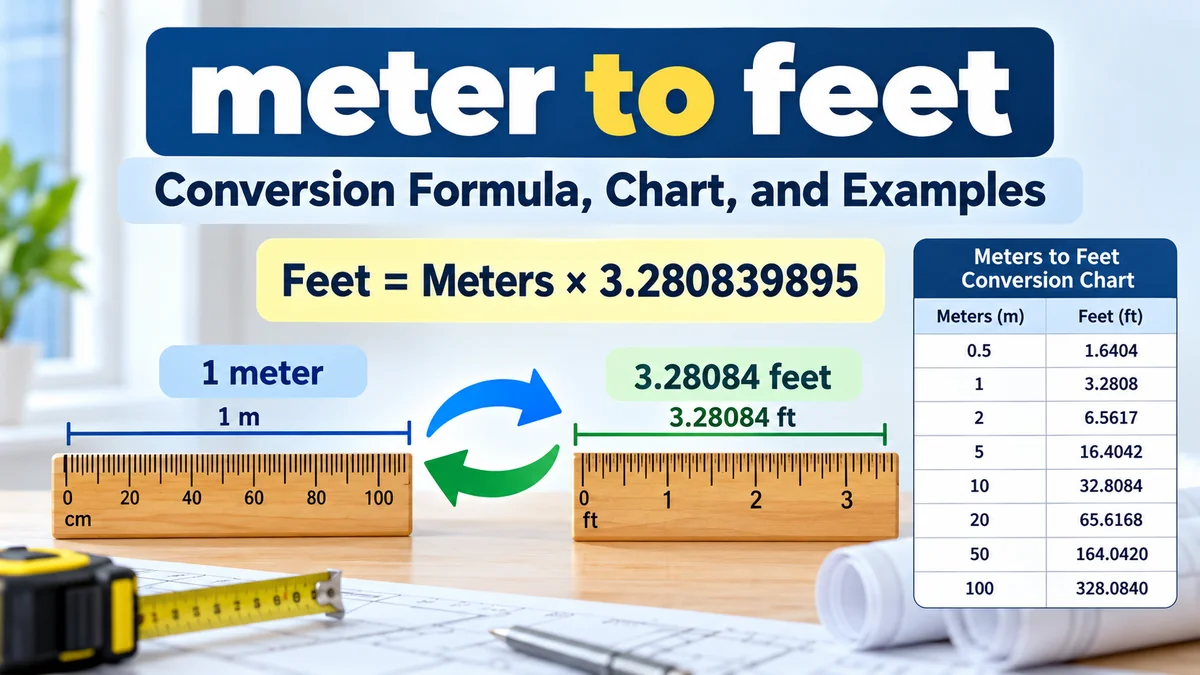
To convert meter to feet, multiply the length in meters by 3.280839895. One meter equals approximately 3.28084 feet, or 3 feet and 3.37 inches. For everyday measurements, using 3.28 is usually sufficient. For engineering, surveying, or other precision-sensitive calculations, use the more accurate conversion factor.
How to Convert meter to feet
The meter-to-feet conversion uses a fixed relationship between the metric system and the imperial and US customary measurement systems.
Conversion formula
\[ \text{Feet}=\text{Meters}\times 3.280839895 \]
1 meter
3.28084 ft
1 foot
0.3048 m
For example, to convert 5 meters into feet:
\[ 5\times3.280839895=16.404199475 \]
Therefore, 5 meters equals approximately 16.4042 feet.
The process works for any positive, zero, or negative numerical value, although physical lengths are normally nonnegative.
Interactive meters to feet converter
Meters to Feet Calculator
Exact factorMeters (m)
Result in feet (ft)
16.4042 ft
Calculated using 1 ft = 0.3048 mDecimal places
246
Copy result
Step-by-step conversion method
- Write down the length in meters.
- Multiply the number by 3.280839895.
- Round the answer to the number of decimal places required.
- Label the result in feet, abbreviated as ft.
For example, a 12-meter-long garden is:
\[ 12\times3.280839895=39.37007874\text{ ft} \]
The garden is approximately 39.37 feet long.
meter to feet Conversion Chart
A conversion table is useful when you need to compare several measurements without calculating each one individually.
| Meters (m) | Feet (ft) |
|---|---|
| 0.1 | 0.3281 |
| 0.5 | 1.6404 |
| 1 | 3.2808 |
| 1.5 | 4.9213 |
| 2 | 6.5617 |
| 3 | 9.8425 |
| 4 | 13.1234 |
| 5 | 16.4042 |
| 6 | 19.6850 |
| 7 | 22.9659 |
| 8 | 26.2467 |
| 9 | 29.5276 |
| 10 | 32.8084 |
| 15 | 49.2126 |
| 20 | 65.6168 |
| 25 | 82.0210 |
| 30 | 98.4252 |
| 50 | 164.0420 |
| 100 | 328.0840 |
| 500 | 1,640.4199 |
| 1,000 | 3,280.8399 |
All values are rounded to four decimal places. The underlying conversion is exact when calculated using 0.3048 meters per foot.
For quick estimates, remembering that 10 meters is about 32.8 feet and 100 meters is about 328 feet can save time.
Understanding Meters and Feet
Meters and feet are both units of length, but they belong to different measurement systems.
What is a meter?
The meter, symbolized by m, is the SI base unit of length in the International System of Units (SI).
It is defined using the speed of light in a vacuum, which has the exact value of 299,792,458 meters per second.
This definition connects the meter to a fundamental physical constant, allowing highly precise and reproducible measurements.
The metric system is widely used for scientific research, manufacturing, education, construction, and everyday measurements around the world.
Common metric length units include:
- Millimeter (mm): 0.001 meter
- Centimeter (cm): 0.01 meter
- Kilometer (km): 1,000 meters
What is a foot?
The foot, abbreviated ft, is a unit of length commonly used in the United States and in certain applications elsewhere.
One international foot is defined as exactly 0.3048 meters.
A foot contains 12 inches, and three feet make one yard. The international inch is exactly 2.54 centimeters.
Feet are frequently used for measuring human height, room dimensions, building elevations, and aviation altitude.
Meter vs. foot: Key differences
| Feature | Meter | Foot |
|---|---|---|
| Symbol | m | ft |
| Measurement system | SI / Metric | Imperial and US customary |
| Length in centimeters | 100 cm | 30.48 cm |
| Length in inches | 39.3701 in | 12 in |
| Relative size | Longer | Shorter |
| Common applications | Science, engineering, everyday measurements | Height, construction, aviation |
One meter is slightly longer than three feet. This is why converting meters into feet produces a larger numerical value.
How to Convert Meters to Feet and Inches
Sometimes a decimal value in feet is less useful than a measurement expressed in feet and inches.
For example, someone measuring their height may prefer 5 feet 10 inches instead of 5.8333 feet.
To convert meters into feet and inches, first calculate the total feet. Then separate the whole feet from the fractional part.
Example: Convert 1.75 meters to feet and inches
Step 1: Convert meters into decimal feet.
\[ 1.75\div0.3048=5.74147\text{ ft} \]
Step 2: Identify the whole feet.
The whole-number portion is 5 feet.
Step 3: Convert the remaining fraction into inches.
\[ 0.74147\times12=8.89764\text{ inches} \]
Final answer: 1.75 meters is approximately 5 feet 8.9 inches, or 5 feet 9 inches when rounded to the nearest inch.
Common height conversions
| Height in meters | Feet and inches |
|---|---|
| 1.50 m | 4 ft 11.1 in |
| 1.55 m | 5 ft 1.0 in |
| 1.60 m | 5 ft 3.0 in |
| 1.65 m | 5 ft 5.0 in |
| 1.70 m | 5 ft 6.9 in |
| 1.75 m | 5 ft 8.9 in |
| 1.80 m | 5 ft 10.9 in |
| 1.85 m | 6 ft 0.8 in |
| 1.90 m | 6 ft 2.8 in |
| 2.00 m | 6 ft 6.7 in |
These values are particularly useful when comparing heights recorded in different measurement systems.
Converting Feet Back to Meters
The reverse conversion is just as straightforward.
Instead of multiplying by approximately 3.28084, multiply the number of feet by 0.3048.
\[ \text{Meters}=\text{Feet}\times0.3048 \]
For example, to convert 20 feet into meters:
\[ 20\times0.3048=6.096\text{ m} \]
Therefore, 20 feet equals exactly 6.096 meters.
Feet to meters reference chart
| Feet | Meters |
|---|---|
| 1 | 0.3048 |
| 2 | 0.6096 |
| 3 | 0.9144 |
| 5 | 1.5240 |
| 10 | 3.0480 |
| 15 | 4.5720 |
| 20 | 6.0960 |
| 25 | 7.6200 |
| 50 | 15.2400 |
| 100 | 30.4800 |
An easy way to remember both conversions is that meters are larger units than feet. When converting the same length from meters into feet, the numerical value increases. When converting from feet into meters, it decreases.
Practical Uses of meter to feet Conversion
Understanding this conversion is useful in many everyday and professional situations.
Construction and architecture
Construction drawings sometimes use meters, while contractors and building material specifications may use feet and inches.
Suppose an architectural plan specifies a room measuring 4 meters long and 3 meters wide.
Converting each dimension:
- Length: 4 m = 13.1234 ft
- Width: 3 m = 9.8425 ft
The room measures approximately 13.12 feet by 9.84 feet.
When calculating the floor area, remember that converting length and converting area are different operations.
The original room area is:
\[ 4\times3=12\text{ m}^2 \]
Converting to square feet:
\[ 12\times10.7639104\approx129.17\text{ ft}^2 \]
You cannot convert square meters into square feet using the ordinary linear factor of 3.28084. The area conversion factor is the square of the length conversion factor.
Human height measurements
Medical records, sports profiles, and international documents may record height in meters or centimeters.
For example, a person measuring 1.82 meters tall is:
\[ 1.82\div0.3048\approx5.9711\text{ ft} \]
That corresponds to approximately 5 feet 11.65 inches, which rounds to 6 feet when expressed to the nearest whole inch.
Converting to feet and inches is often easier for readers accustomed to the US customary system.
Sports and athletics
Athletic events use various measurement units depending on the sport and country.
Track and field events generally use metric distances. Meanwhile, some sports broadcasts and historical records express distances or heights in feet.
For example, a high jump of 2.10 meters is approximately 6.89 feet, equivalent to about 6 feet 10.7 inches.
A 100-meter distance is approximately 328.08 feet.
These conversions help audiences compare measurements without changing the original sporting standards.
Aviation and elevation
Aviation commonly uses feet to express aircraft altitude, even though meters are standard for many other scientific and geographic measurements.
For example, an altitude of 3,000 meters is approximately 9,842.52 feet.
Similarly, a mountain elevation recorded as 2,500 meters equals approximately 8,202.10 feet.
Altitude and elevation comparisons require care because a converted number does not change the reference level from which the original height was measured.
Engineering and surveying
Engineers and surveyors may encounter both metric and foot-based dimensions in older plans, mapping datasets, and technical documents.
For most modern applications, the international foot provides the appropriate conversion standard.
However, historical US surveying records can use a slightly different definition of the foot. That distinction matters when converting large coordinate values or comparing legacy geospatial datasets.
International Foot vs. US Survey Foot
An easily overlooked detail in meter-to-feet calculations is that the United States historically used two slightly different foot definitions.
The international foot equals exactly 0.3048 meters.
The former US survey foot equals exactly 1200/3937 meters, approximately 0.3048006096 meters.
| Measurement | International foot | Former US survey foot |
|---|---|---|
| Length in meters | 0.3048000000 | 0.3048006096 |
| Feet per meter | 3.280839895 | 3.280833333 |
| Typical use | Modern standard | Historical surveying records |
| Current US status | Standard | Retired for new use |
The National Institute of Standards and Technology (NIST) and the National Oceanic and Atmospheric Administration (NOAA) coordinated the retirement of the US survey foot, effective January 1, 2023. The international foot superseded it for new applications, while the former unit remains relevant to interpreting historical data. NIST+1
The numerical difference is extremely small for everyday measurements. However, at very large distances or coordinate values, the discrepancy can become significant.
For ordinary height, furniture, room, and distance conversions, use the international foot.
Common meter to feet Conversion Mistakes
Although the formula is simple, several errors can produce misleading results.
Confusing decimal feet with feet and inches
A measurement of 5.5 feet does not mean 5 feet 5 inches.
Because one foot contains 12 inches, half a foot equals 6 inches.
Therefore:
5.5 feet = 5 feet 6 inches.
To convert a decimal foot fraction into inches, multiply the fraction by 12.
Multiplying by the wrong factor
A common mistake is multiplying meters by 0.3048 rather than dividing by it.
Remember:
- Meters to feet: divide by 0.3048.
- Feet to meters: multiply by 0.3048.
Using the reverse operation produces an incorrect answer.
Rounding too early
Using 3.28 instead of 3.280839895 is acceptable for rough estimates, but it introduces a small difference.
For example, converting 1,000 meters using 3.28 gives 3,280 feet.
Using the more precise factor gives approximately 3,280.8399 feet.
The difference is about 0.84 feet, or roughly 10 inches.
For precise calculations, retain the full conversion factor during calculation and round only the final result.
Confusing meters with square meters
Meters measure length, while square meters measure area.
Similarly, feet measure length, while square feet measure area.
Their conversion factors differ:
| Conversion | Factor |
|---|---|
| Meters to feet | 3.280839895 |
| Square meters to square feet | 10.763910417 |
| Cubic meters to cubic feet | 35.314666721 |
The square and cubic conversion factors are derived by raising the linear conversion factor to the second and third powers.
Reporting more precision than the measurement supports
An exact conversion factor does not make the original measurement exact.
For instance, a wall measured as approximately 3.2 meters using a tape measure should not automatically be reported as 10.498687664 feet.
A practical result such as 10.5 feet may better reflect the measurement’s actual precision.
NIST’s guidance on SI conversions recommends rounding results in a way that reflects the precision of the original measurement. NIST
Quick Mental Tricks for Converting Meters to Feet
You do not always need a calculator to estimate a measurement.
Multiply by 3.3
For a fast estimate, multiply meters by 3.3.
For example:
\[ 8\times3.3=26.4\text{ ft} \]
The more accurate result is approximately 26.25 feet.
This method is convenient when a small estimation error is acceptable.
Multiply by 3 and add about 28%
Another approach is to multiply by three and then add approximately 28% of the original meter value.
For 10 meters:
\[ (10\times3)+(10\times0.28)=32.8 \]
The precise result is approximately 32.8084 feet.
This works because the conversion factor is approximately 3.28.
Remember common benchmarks
Memorizing a few reference values makes estimation easier:
- 1 meter is about 3.28 feet.
- 2 meters is about 6.56 feet.
- 3 meters is about 9.84 feet.
- 10 meters is about 32.81 feet.
- 100 meters is about 328.08 feet.
These benchmarks are useful for visualizing unfamiliar measurements without performing a detailed calculation.
Why the Exact Conversion Factor Matters
The conversion factor is based on an internationally standardized definition rather than an approximate comparison of two independently measured lengths.
Since 1959, the international foot has been defined as exactly 0.3048 meters.
Consequently:
\[ 1\text{ meter}=\frac{1}{0.3048}\text{ feet} \]
Or:
\[ 1\text{ meter}=\frac{1250}{381}\text{ feet} \]
The decimal value 3.28083989501312… is a repeating approximation of this exact fraction.
This distinction is useful because the definition itself introduces no uncertainty. Any practical uncertainty usually comes from the original measurement, the measuring instrument, or rounding.
The standard is documented in NIST’s measurement conversion guidance. NIST+1
Final Thoughts on meter to feet Conversion
Converting meter to feet is simple once you know the relationship between the two units. Divide the number of meters by 0.3048, or multiply by approximately 3.28084, to obtain the equivalent length in feet.
For everyday measurements, rounding to two decimal places is often sufficient. For engineering, surveying, and other technical work, preserve the exact conversion relationship and apply an appropriate level of precision.
Use the conversion chart or calculator above whenever you need to convert a measurement quickly, and remember to distinguish decimal feet from feet-and-inches notation when expressing heights or construction dimensions.
