

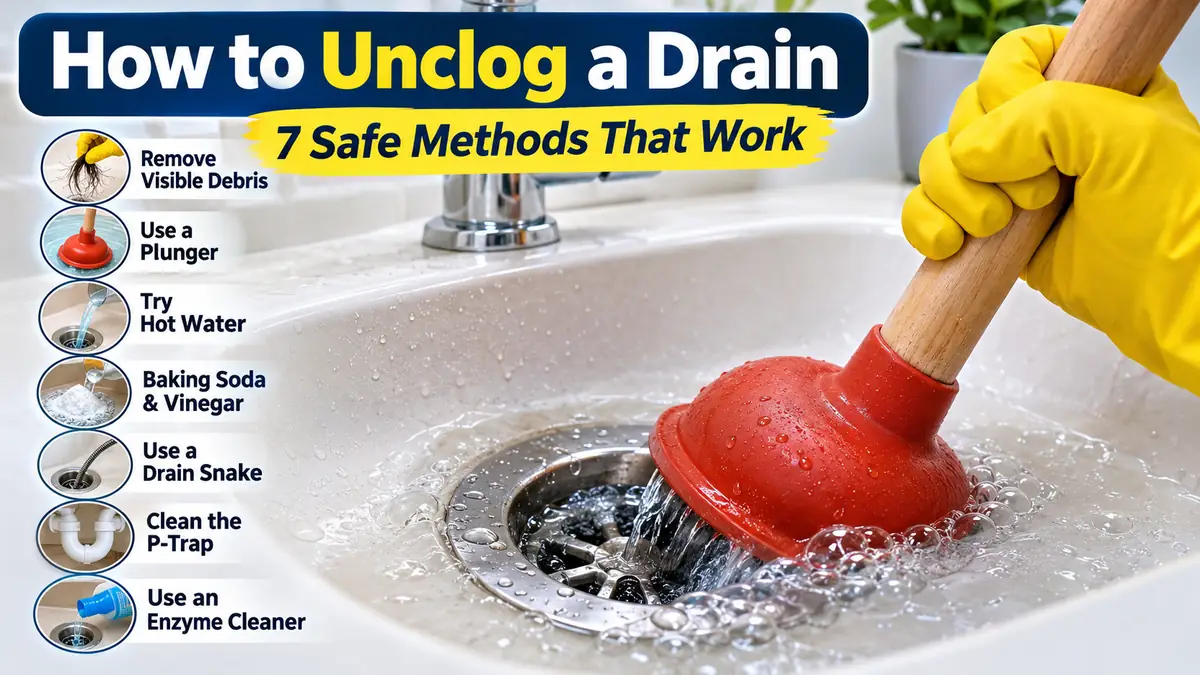
A slow-draining sink, a shower filling with water, or a kitchen drain that suddenly stops working can disrupt your day. Fortunately, many common household drain clogs can be cleared without damaging your plumbing or calling a professional.
Learning how to unclog a drain starts with identifying what is blocking the pipe. Hair, soap residue, grease, food particles, and other debris require different approaches. The safest methods include removing visible debris, using a plunger, cleaning the stopper or P-trap, and carefully using a drain snake.
How to Unclog a Drain: Start With the Cause
Before reaching for a drain cleaner, pay attention to how the water behaves. A sink that drains slowly usually has a partial obstruction. Standing water that does not move may indicate a more substantial blockage.
The location of the problem offers useful clues.
| Drain location | Common cause | Best first approach |
|---|---|---|
| Bathroom sink | Hair, toothpaste, soap residue | Clean stopper and use a plastic drain tool |
| Kitchen sink | Grease, food scraps, detergent residue | Plunger and P-trap inspection |
| Shower | Hair and soap scum | Remove hair from drain opening |
| Bathtub | Hair, bath products, debris | Clean stopper and use a drain snake |
| Laundry drain | Lint and detergent buildup | Inspect accessible trap and drain |
| Multiple fixtures | Shared drain or sewer line blockage | Professional plumbing assessment |
A single slow fixture usually points toward a localized clog. If several drains back up simultaneously, particularly when a toilet is flushed or a washing machine empties, the issue may involve a shared drain line.
Safety first: If wastewater is backing up into multiple fixtures, stop using water and arrange a plumbing inspection. Do not open a cleanout or dismantle pipes that may contain backed-up sewage.
1. Remove Visible Debris From the Drain
The simplest method is often the most effective, particularly for bathroom sinks and showers.
Hair collects around drain covers, pop-up stoppers, and the upper section of the drainpipe. Soap scum binds the strands together, creating a blockage that gradually traps more debris.
Step-by-step instructions
- Put on rubber gloves and remove any standing water you can safely scoop out.
- Lift or unscrew the drain cover, if it is designed to be removed.
- Remove visible hair, soap residue, and debris using a plastic drain-cleaning tool or needle-nose pliers.
- Clean the stopper and the surrounding opening with warm, soapy water.
- Reinstall the cover and test the drain using a small amount of water.
For a bathroom sink with a pop-up stopper, the stopper may be connected to a pivot rod underneath the sink. Check the mechanism before attempting removal rather than forcing it upward.
A flexible plastic hair-removal tool is especially useful for shallow clogs. However, its barbed edges can scratch surfaces or catch on delicate components, so use gentle movements.
2. How to Unclog a Drain With a Plunger
A plunger can dislodge blockages by creating pressure changes inside the drainpipe. It works particularly well when the obstruction is close to the fixture.
For sinks and bathtubs, use a flat-bottom cup plunger. A flange plunger is generally designed for toilets.
How to plunge a sink correctly
- Remove the drain stopper if necessary.
- Add enough water to cover the rubber cup of the plunger.
- Seal the sink’s overflow opening with a wet cloth, where applicable.
- Place the plunger directly over the drain to create a tight seal.
- Push and pull firmly for approximately 15–20 seconds.
- Lift the plunger and check whether the water begins to drain.
- Repeat a few times if the blockage is loosening.
For a double-basin kitchen sink, seal the second drain opening while plunging the affected side. This helps maintain pressure.
If the sink connects to a garbage disposal, turn off power to the disposal before investigating a blockage. Never place your hand inside the disposal chamber.
Avoid plunging a drain containing chemical cleaner. The pressure can splash corrosive liquid onto your skin or eyes.
Why a plunger sometimes fails
A plunger is less effective when the obstruction is too far down the pipe, the overflow opening remains unsealed, or the blockage consists of hardened deposits.
If several attempts produce no improvement, switch to a mechanical method rather than applying excessive force.
3. Use Hot Water to Loosen Grease and Soap Residue
Warm or hot water may help move softened soap residue and minor greasy buildup, but it is not a reliable solution for a fully blocked pipe.
This method is most appropriate when water still drains slowly and there is no sign of a serious obstruction.
How to use hot water safely
Run hot tap water through the drain for a short period and observe whether the flow improves. For greasy kitchen buildup, a small amount of dishwashing liquid may help disperse residue.
Avoid pouring boiling water into a drain when the pipe material, joints, fixture finish, or manufacturer’s temperature limits are unknown. Very high temperatures may damage certain plumbing components.
Hot water will not dissolve hair, remove solid objects, or reliably clear hardened grease deeper inside the drainage system. Grease may cool and solidify farther along the pipe.
Quick takeaway: Hot water is a limited maintenance measure, not a substitute for physically removing a blockage.
4. Try Baking Soda and Vinegar for Minor Residue
Baking soda and vinegar are frequently recommended as homemade drain cleaners. Their reaction produces carbon dioxide bubbles, which can create fizzing and agitation.
However, the reaction does not reliably dissolve hair, hardened grease, or substantial obstructions. Its effectiveness against real drain clogs is limited.
How to try this method
If the drain contains no chemical cleaner and water is still flowing:
- Remove visible debris first.
- Add approximately half a cup of baking soda to the drain.
- Slowly pour in half a cup of household white vinegar.
- Allow the fizzing reaction to finish.
- Flush with warm tap water and check the drainage.
This approach may help rinse away some light residue, but it should not be considered a dependable clog-removal technique.
Never combine vinegar or other household ingredients with commercial drain-cleaning chemicals. Dangerous reactions can occur, particularly when products contain bleach, strong acids, or caustic alkalis.
If the drain remains blocked, use a plunger or drain snake instead of repeatedly adding mixtures.
5. How to Unclog a Drain With a Drain Snake
A drain snake, also called a plumbing auger, is one of the most useful tools for stubborn clogs that cannot be reached by hand.
A manual drum auger typically consists of a flexible metal cable that travels through the drainpipe. Its tip can break up or retrieve certain obstructions.
Steps for using a drain snake
- Remove the drain cover or stopper.
- Insert the cable slowly into the drain opening.
- Advance the cable until you encounter resistance.
- Rotate the handle gently while maintaining controlled pressure.
- Continue feeding the cable if the obstruction begins to loosen.
- Withdraw the cable slowly, removing any collected debris.
- Flush the drain with water to check the result.
Some resistance comes from normal pipe bends rather than a clog. Never force the cable through an obstruction, as doing so can damage pipes or fittings.
For shower drains, a plastic hair-removal tool may be enough. A longer auger can reach blockages farther into the branch drain.
Motorized drain snakes require additional care and can damage fixtures or cause injury if operated incorrectly. Deep or persistent blockages are better handled by a trained plumber.
Can a drain snake damage pipes?
Yes. Incorrect use can scratch fixtures, damage older or deteriorated pipes, or cause a cable to become stuck.
Use a tool appropriate for the drain diameter and follow its instructions. If the cable repeatedly jams, stop rather than forcing it.
6. Clean the P-Trap Under a Sink
The P-trap is the curved section of pipe beneath many bathroom and kitchen sinks. Its water seal prevents sewer gases from entering the room.
Its shape also makes it a common place for debris to collect.
Chọn xi phông chống mùi, chống tắc: 5 tiêu chí vàng bạn không nên bỏ q
How to clean a P-trap
- Stop using the sink and place a bucket beneath the trap.
- Put on gloves and protect the cabinet floor with an old towel.
- Inspect the connections and identify whether the trap can be safely removed.
- Loosen the slip-joint nuts carefully using your hands or an appropriate tool.
- Allow the trapped water to drain into the bucket.
- Remove food debris, sludge, or other material from the trap.
- Inspect the washers and reinstall the trap without overtightening.
- Run water and check every joint for leaks.
This method is particularly useful when a clog is confined to a kitchen or bathroom sink.
Not every trap is designed for easy disassembly. Glued connections, corroded metal plumbing, and complicated installations may require professional assistance.
If the trap is clear but the sink remains blocked, the obstruction may be in the pipe leading into the wall.
What if the sink smells bad after cleaning?
A sewer-like odor can occur if the trap is leaking, incorrectly assembled, or no longer holding its water seal. Running water should refill a properly installed trap.
If odors persist, inspect for leaks and have the drain or venting system evaluated. Persistent sewer gas smells should not be ignored.
7. Use an Enzyme-Based Drain Cleaner for Organic Buildup
Enzyme-based and bacterial drain treatments are designed to break down certain organic materials over time. They are generally intended for maintenance or gradual buildup rather than emergency clearing of a completely blocked drain.
Their performance depends on the formulation, temperature, contact time, and type of debris.
Follow the manufacturer’s label for the specific product and plumbing system. Do not combine it with another cleaner.
An enzyme treatment will not remove a dropped object, a solid obstruction, or tree roots inside a sewer line.
What about chemical drain cleaners?
Conventional chemical drain cleaners may contain sodium hydroxide, sulfuric acid, or other highly reactive ingredients.
These products can cause severe chemical burns and eye injuries. Some generate considerable heat and may be unsuitable for certain pipes or fixtures.
They also complicate later mechanical clearing because hazardous liquid can remain inside the drain.
For routine household clogs, physical removal, plunging, and appropriate mechanical tools are usually preferable.
If a chemical cleaner has already been used, follow the product label and tell the plumber before any further work. Never mix different drain cleaners or attempt to neutralize one with another household chemical.
How to Unclog a Drain in Different Areas of the House
The most effective approach changes depending on the fixture.
Kitchen sink drains
Kitchen clogs commonly involve cooking oils, grease, starch, food scraps, and detergent residue.
Begin by checking the removable strainer. If the sink has a garbage disposal, ensure the unit is powered off before checking for obstructions, and follow the manufacturer’s safe clearing procedure.
Try a sink plunger. If the clog persists, inspect the P-trap if it is safely removable.
Avoid pouring fats and oils down the sink. Even when liquid, they can cool and adhere to pipe walls.
Bathroom sink drains
Bathroom sinks often become slow because hair, toothpaste, and soap accumulate around the stopper mechanism.
Cleaning the stopper and the first few inches of the drain is usually the best starting point. A plastic drain tool can remove material that is just out of sight.
If this does not help, try a plunger and then inspect the P-trap.
Shower and bathtub drains
Hair is a leading cause of shower and bathtub blockages. It combines with soap scum to form dense clumps.
Remove the cover, retrieve visible hair, and use a suitable flexible drain tool. For bathtubs, some stopper mechanisms require specific removal procedures.
A plunger may also help, but the overflow opening often needs to be sealed for effective pressure.
Floor drains and laundry drains
Floor drains can collect sediment, lint, dirt, and other debris. Laundry standpipes may also develop restrictions from lint and detergent residue.
Clean accessible strainers and check for obvious obstructions. If water backs up when the washing machine discharges, stop using the machine until the cause is identified.
Do not confuse a dry floor-drain trap with a clog. A dry trap may allow sewer odors into the room and can sometimes be corrected by restoring its water seal.
How to Tell Whether a Drain Clog Is Serious
Not every blocked drain is a simple maintenance problem.
The following symptoms may indicate an obstruction deeper in the drainage system:
- Several fixtures drain slowly at the same time.
- Water rises in a shower or bathtub when a toilet is flushed.
- A floor drain backs up when the washing machine runs.
- Gurgling occurs across multiple fixtures.
- Wastewater or sewage enters the home.
- A blockage returns shortly after being cleared.
These signs may involve a shared branch drain, main sewer line, or drainage venting issue. Gurgling alone does not prove that a sewer line is blocked, but it is worth investigating when combined with other symptoms.
Tree roots, pipe collapse, mineral deposits, and misaligned pipe sections are examples of problems that cannot be reliably solved with household cleaning methods.
A plumber may use a drain inspection camera to locate the obstruction and determine whether cabling, hydro jetting, repair, or replacement is appropriate.
How to Prevent Drain Clogs From Returning
Preventing buildup is usually easier than clearing a fully blocked drain.
Use drain strainers
A mesh strainer captures food scraps in the kitchen, while a hair catcher reduces buildup in showers and bathtubs.
Clean these devices regularly rather than allowing collected material to wash through.
Dispose of grease properly
Allow cooking oil and grease to cool, then place them in a suitable waste container according to local disposal guidance.
Wiping greasy pans with a paper towel before washing can also reduce the amount of fat entering the drainage system.
Keep inappropriate materials out of drains
Coffee grounds, fibrous food scraps, wipes, dental floss, cotton swabs, and sanitary products can contribute to blockages.
Even products marketed as flushable may create problems in household plumbing and sewer systems.
Clean drain stoppers regularly
Hair and soap residue often accumulate where they are easiest to remove: around the stopper and drain opening.
Periodic cleaning can prevent a small obstruction from becoming a complete blockage.
Pay attention to early warning signs
A drain that gradually becomes slower is giving you an opportunity to address buildup before standing water develops.
If the same drain clogs repeatedly despite proper cleaning, investigate the underlying cause rather than relying on repeated treatments.
Common Drain-Unclogging Mistakes to Avoid
Some popular methods can make a drainage problem worse.
| Mistake | Why it is risky | Better approach |
|---|---|---|
| Mixing drain cleaners | Can produce heat, splashes, or toxic gases | Never mix cleaning chemicals |
| Pouring boiling water into unknown pipes | May damage susceptible materials or connections | Use water within plumbing temperature limits |
| Forcing a metal snake | Can damage pipes or trap fittings | Advance gently and stop if it jams |
| Repeatedly adding chemicals | Increases chemical exposure without removing solid obstructions | Switch to appropriate mechanical clearing |
| Ignoring recurring clogs | May overlook damaged or poorly graded piping | Investigate the underlying problem |
| Plunging after chemical cleaner | Can splash corrosive liquid | Follow the product’s safety instructions |
A particularly common mistake is treating every slow drain as a grease clog. In bathroom fixtures, hair and stopper buildup are often the real problem, so pouring liquids into the pipe may accomplish very little.
When Should You Call a Professional Plumber?
Professional assistance is appropriate when a blockage cannot be safely reached or when the symptoms suggest a larger drainage problem.
Call a plumber if multiple fixtures are backing up, sewage appears indoors, a drain snake repeatedly jams, or a clog returns soon after clearing.
Older metal pipes, deteriorating drain lines, and inaccessible plumbing also warrant caution.
A professional may use a mechanical cable machine, inspection camera, or other equipment suited to the condition of the pipe. High-pressure water jetting should be selected only after assessing whether the plumbing can tolerate it.
Final Thoughts on How to Unclog a Drain
Knowing how to unclog a drain can save time and prevent a minor plumbing problem from becoming more disruptive.
Start with the least invasive method: remove visible debris, clean the stopper, and try a properly sealed plunger. For stubborn localized blockages, a drain snake or P-trap cleaning may be effective. Avoid mixing chemicals, forcing tools, or repeatedly treating a clog without identifying its cause.
Once water flows normally, simple habits such as using strainers, removing hair, and keeping grease out of pipes can help prevent future blockages. If several drains are affected or sewage backs up, stop using the plumbing and seek professional help.
