

A few tiny flies hovering around your fruit bowl can quickly turn into a frustrating kitchen infestation. You throw away the overripe bananas, wipe down the counter, and somehow the flies are still there the next morning.
The problem is that removing the visible insects doesn’t necessarily eliminate the places where they’re breeding.
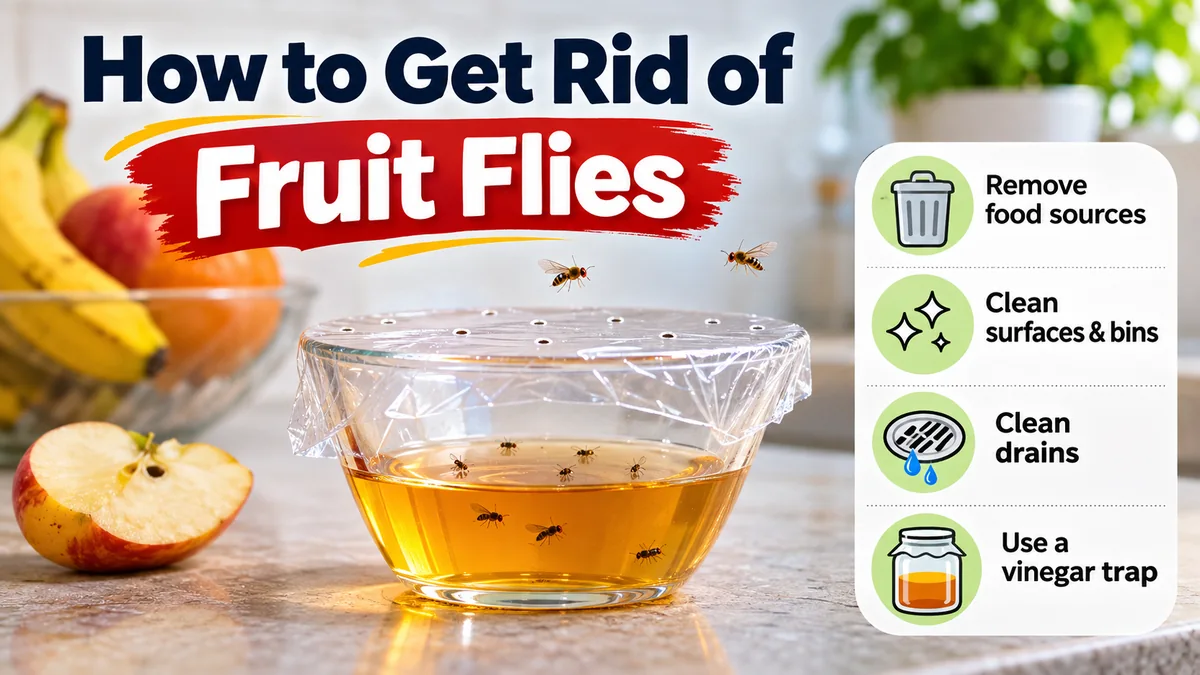
How to get rid of fruit flies, remove overripe produce and other fermenting food, clean sticky spills and garbage containers, and use an apple cider vinegar trap to catch adult flies. Check recycling bins, drains, and hidden food waste for breeding sites. Continue cleaning and trapping until the infestation disappears.
Most household fruit fly problems can be controlled without harsh insecticides. The key is understanding what attracts these pests, where they reproduce, and why certain home remedies work better than others.
What Are Fruit Flies and Why Do They Appear?
Fruit flies are small insects commonly found around ripening fruit, vegetables, kitchen waste, and fermenting liquids. The common household fruit fly, Drosophila melanogaster, belongs to the family Drosophilidae.
Adults are typically about 3 millimeters long, with tan or yellowish-brown bodies and often reddish eyes.
They are attracted to odors produced by yeast and microorganisms as sugars ferment. That explains why they gather around a forgotten peach, an open wine bottle, or residue inside a recycling container.
Common things that attract fruit flies
Fruit flies frequently appear around:
- Overripe bananas, apples, peaches, tomatoes, and other produce
- Fermenting fruit juice, wine, beer, and cider
- Sticky spills beneath kitchen appliances
- Unwashed bottles and beverage cans
- Compost containers and kitchen garbage
- Rotting vegetables, including potatoes and onions
- Damp cleaning cloths containing food residue
- Food waste trapped in sink drains or garbage disposals
They can enter through open windows and doors, and they may arrive on produce carrying eggs or larvae.
How quickly do fruit flies reproduce?
Fruit flies develop through four stages: egg, larva, pupa, and adult.
Under favorable warm conditions, some common fruit flies can complete their development in approximately 8–10 days. Females can lay hundreds of eggs over their lifetimes, depositing them near suitable fermenting material.
That rapid life cycle explains why a minor problem can become noticeable within days.
Removing adult flies is useful, but interrupting their breeding cycle is what stops the infestation from returning.
How to Get Rid of Fruit Flies With Apple Cider Vinegar
How to Get Rid of Fruit Flies and Gnats | Grit & Home
An apple cider vinegar trap is one of the simplest ways to catch adult fruit flies. The vinegar’s fermented aroma attracts the insects, while a small amount of dish soap reduces the liquid’s surface tension.
Method 1: Apple cider vinegar and dish soap trap
You will need a small bowl or glass, apple cider vinegar, liquid dish soap, and optionally plastic wrap.
- Pour approximately half an inch of apple cider vinegar into a small glass.
- Add one or two drops of dish soap.
- Leave the mixture uncovered, or cover the glass with plastic wrap and poke several small holes.
- Place the trap near the area where flies gather, away from food preparation surfaces.
- Check it daily and replace the mixture when it becomes dirty or loses effectiveness.
Fruit flies attracted to the vinegar may land on the liquid and become trapped.
The soap is helpful because it makes it harder for insects to remain on the surface.
Does apple cider vinegar actually kill fruit flies?
The vinegar primarily acts as an attractant. When dish soap is added, flies that contact the liquid are more likely to sink and drown.
However, vinegar traps catch adults rather than destroying eggs and larvae in their breeding sites.
For lasting results, combine trapping with thorough sanitation.
Method 2: Make a paper funnel fruit fly trap
A paper funnel trap works by allowing flies to enter a container through a narrow opening.
To make one:
- Place a little apple cider vinegar or a piece of very ripe fruit in a jar.
- Roll a sheet of paper into a cone.
- Insert the cone with its narrow opening pointing toward the bait.
- Ensure the funnel tip stays above the liquid or fruit.
- Seal gaps around the jar’s rim with tape.
- Position the trap near the infestation.
The flies follow the fermented odor through the opening. Some struggle to find their way out.
This approach can be useful when you prefer a trap without dish soap, although it may not capture every fly.
Method 3: Use ripe fruit as bait
Overripe fruit can also attract adult fruit flies into a covered container.
Place a small banana peel or soft fruit piece inside a jar and cover it with plastic wrap containing tiny holes.
Check the trap frequently. Dispose of its contents in a sealed outdoor trash container before the bait becomes another breeding source.
Fruit-based traps require particularly careful maintenance because flies may lay eggs in the bait.
How to Get Rid of Fruit Flies Without Vinegar
Apple cider vinegar is convenient, but it isn’t the only way to manage an infestation.
Other methods can work when vinegar is unavailable or its smell is unpleasant.
Method 4: Use a wine or beer trap
Fruit flies are attracted to fermentation odors, making leftover wine or beer possible trap baits.
Pour a small quantity into a narrow-necked bottle and add a drop of dish soap if appropriate.
Place the bottle where flies are active and dispose of the contents regularly.
A narrow opening may make escape more difficult, but it does not guarantee that every insect entering the bottle will remain trapped.
Method 5: Remove adult flies with a vacuum cleaner
A vacuum can quickly reduce the number of flies resting on walls, windows, cabinets, or other surfaces.
Use a hose attachment to capture clusters of insects, then empty the vacuum contents into a sealed bag outside.
This provides immediate relief but does not eliminate eggs or larvae.
It is best used alongside cleaning and breeding-site removal.
Method 6: Use sticky traps for monitoring
Yellow sticky cards and other insect-monitoring traps can capture some adult flies.
Position them near suspected activity areas, following the manufacturer’s instructions and keeping them away from exposed food.
Sticky traps can help reveal where insects are concentrated, but they should not replace sanitation.
Method 7: Remove the breeding source completely
The most effective long-term method is often the least complicated: find and eliminate the decaying or fermenting material where flies reproduce.
Inspect every likely source rather than focusing only on the fruit bowl.
A trap can catch dozens of adult flies while a forgotten potato continues producing new ones.
How to Get Rid of Fruit Flies in the Kitchen
Kitchen infestations often persist because food residue remains in places that are easy to overlook.
A systematic cleaning routine is more effective than repeatedly spraying visible insects.
Step 1: Inspect fruits and vegetables
Examine produce stored on countertops, in baskets, and inside cupboards.
Discard items showing decay or fermentation. Refrigerate suitable ripe produce and store remaining food in clean, protected containers.
Pay particular attention to potatoes and onions kept in dark cabinets. One decomposing vegetable can support a surprising number of insects.
Step 2: Clean countertops and appliances
Wash surfaces using warm water and an appropriate household cleaner.
Focus on:
- Areas beneath coffee machines and blenders
- Juice spills around refrigerators
- Spaces beneath toasters
- Cabinet corners
- Crumbs and residue beneath appliances
- Recycling storage areas
A tiny amount of sugary residue may attract flies even when the kitchen appears clean.
Step 3: Empty and wash garbage bins
Remove food waste, tie garbage bags securely, and take them outside.
Then wash the inside of the bin, including the lid, rim, and bottom.
Let it dry before replacing the liner.
A clean garbage bag inside a dirty container will not solve the problem if fermenting residue remains underneath.
Step 4: Clean recycling containers
Empty beverage cans and bottles before recycling them.
Rinse away leftover soda, juice, wine, and beer, and wash any sticky recycling containers.
Small amounts of liquid left in containers can attract adult flies and provide breeding material.
Step 5: Maintain kitchen cleaning tools
Wash reusable dishcloths, sponges, and mop heads regularly.
Allow them to dry thoroughly and replace heavily contaminated materials when necessary.
Fruit flies are primarily interested in fermenting organic matter rather than moisture alone, but dirty, damp cleaning materials can hold suitable food residue.
How to Get Rid of Fruit Flies in Drains and Garbage Disposals
Fruit flies sometimes breed in organic residue inside drains, particularly when food particles and fermenting material accumulate.
However, not every tiny insect near a sink is a fruit fly. Drain flies and phorid flies can look similar, so identification matters.
How to check whether flies are coming from a drain
Inspect the sink area after removing other possible food sources.
For a simple test, place a clear plastic bag over the drain opening overnight and secure it around the edges while the drain is not in use.
If flies emerge from inside the drain, some may become trapped in the bag. This can help identify a suspected breeding location. Entomology+1
How to clean a drain properly
- Remove the drain stopper or strainer.
- Clean visible food particles and debris.
- Scrub accessible drain surfaces with a suitable drain brush.
- Clean the garbage disposal splash guard, following the appliance manufacturer’s safety instructions.
- Use an appropriate drain-cleaning product if necessary, following its label.
- Repeat cleaning when organic buildup returns.
Do not mix bleach with vinegar, ammonia, or other drain cleaners. Dangerous chemical reactions can occur.
Pouring vinegar or baking soda into a drain may not remove the accumulated organic film that supports breeding. Physical cleaning is generally more reliable.
If insects persist around drains despite cleaning, inspect for leaks, blocked plumbing, or inaccessible waste buildup.
How Long Does It Take to Get Rid of Fruit Flies?
The time required depends on the size of the infestation, how many breeding sites exist, and whether new flies continue entering the home.
You may notice fewer adult flies within 24–48 hours after removing food sources and setting effective traps.
Complete elimination can take several days to two weeks or longer, particularly when larvae or pupae are already present.
What to expect during treatment
| Time frame | What may happen | Recommended action |
|---|---|---|
| First 24 hours | Traps begin catching adults | Remove food waste and clean surfaces |
| Days 2–3 | Visible fly activity may decrease | Inspect drains, bins, and hidden produce |
| Days 4–7 | Remaining adults may still appear | Maintain traps and sanitation |
| Days 8–14 | Activity should continue declining if breeding sites are eliminated | Investigate any persistent fly activity |
| Beyond 14 days | Continued activity suggests an overlooked source or reinfestation | Recheck identification and breeding locations |
These are practical estimates rather than guaranteed treatment results.
Because the common fruit fly can complete its life cycle in approximately 8–10 days under favorable conditions, maintaining sanitation beyond the first few days is essential. University of Maryland Extension+1
Why do fruit flies keep coming back?
Recurring infestations usually indicate one or more of these problems:
- An overlooked breeding location
- New produce carrying eggs or larvae
- Food waste accumulating in drains
- Dirty recycling containers
- Outdoor flies entering through damaged screens
- Incomplete cleaning of sticky spills
If vinegar traps repeatedly catch insects but the population never decreases, investigate the environment instead of simply adding more traps.
Fruit Flies vs. Drain Flies vs. Fungus Gnats
Correct identification prevents wasted effort.
Fruit flies, drain flies, and fungus gnats are different insects with different breeding habits.
Drosophila Fruit Fly #1 Photograph by Pascal Goetgheluck / Science Photo Library – Pixels
Fruit fly
Drain fly
How to Get Rid of Gnats on Succulents | Succulents Box
Fungus gnat
| Feature | Fruit flies | Drain flies | Fungus gnats |
|---|---|---|---|
| Appearance | Small, often tan, frequently red-eyed | Fuzzy, moth-like wings | Dark, slender, mosquito-like |
| Common location | Fruit bowls, trash, recycling | Sinks, drains, bathrooms | Houseplants and potting soil |
| Breeding material | Fermenting organic matter | Organic film in wet drains | Moist growing media containing fungi |
| Primary control | Remove fermenting food | Clean drain buildup | Address excess soil moisture and breeding conditions |
Fruit flies are frequently confused with phorid flies as well. Phorid flies often have a distinctive hump-backed appearance and may run across surfaces before flying.
The University of Maryland Extension and Colorado State University Extension describe these differences in their household fly identification resources. University of Maryland Extension+1
Why are there tiny flies around houseplants?
When insects gather around potting soil rather than fruit, fungus gnats may be responsible.
Their larvae commonly develop in moist growing media, feeding on fungi and organic material.
Allowing suitable potting soil to dry between waterings, removing decaying plant debris, and using appropriate monitoring traps can help.
Apple cider vinegar traps intended for fruit flies are not a reliable solution to every fungus gnat infestation.
Which Fruit Fly Remedies Actually Work?
Many household remedies circulate online, but their effectiveness varies.
The most useful comparison is whether a method captures adult insects, removes breeding sites, or simply masks odors.
| Method | Effectiveness | Main limitation |
|---|---|---|
| Remove decaying produce | Very high for source control | Other breeding sites may remain |
| Apple cider vinegar and soap | Useful for adult trapping | Does not eliminate larvae |
| Paper funnel trap | Useful for adult trapping | Requires regular maintenance |
| Wine or beer bait | Can attract adult flies | Does not remove breeding sources |
| Thorough drain cleaning | Effective when drains are the source | Not necessary for every infestation |
| Sticky monitoring traps | Helps capture and monitor adults | Limited impact on breeding |
| Essential oils | Unreliable as primary control | Does not eliminate breeding material |
| Household insecticide sprays | May kill exposed adults | Limited long-term benefit without sanitation |
Does bleach kill fruit flies?
Bleach may kill insects or microorganisms that come into direct contact with a properly used solution, but pouring bleach down a drain is not a dependable method of eliminating fruit fly breeding sites.
Organic buildup can remain even after chemical treatment.
Use cleaning products only according to their labels, and never combine bleach with other household chemicals.
Does boiling water get rid of fruit flies?
Very hot water may help loosen some residue, but it cannot reliably reach every breeding location.
Boiling water may also damage certain plumbing components or cause burns.
Mechanical cleaning and removal of fermenting material are more dependable approaches.
Do essential oils repel fruit flies?
Peppermint, eucalyptus, lemongrass, and other strongly scented oils are sometimes promoted as natural insect repellents.
However, evidence supporting them as reliable household fruit fly treatments is limited.
They should not replace removal of breeding sources. Some essential oils can also be harmful to pets when used improperly.
Do fruit flies disappear on their own?
They may eventually disappear if suitable breeding material becomes unavailable and no new flies enter.
However, waiting while fermenting food remains accessible allows reproduction to continue.
Active cleaning is faster and more predictable than waiting for an infestation to resolve naturally.
How to Prevent Fruit Flies From Coming Back
Prevention is easier once the original infestation is under control.
Fruit flies need suitable food and breeding conditions. Reducing access to both makes the kitchen less attractive.
Store produce properly
Refrigerate ripe fruit when appropriate, especially during warm weather.
Check produce regularly and discard items showing decay.
Keep onions, potatoes, and other pantry vegetables in suitable storage conditions, inspecting them for spoilage.
Maintain a clean kitchen
Wipe up juice, soda, wine, and other sugary spills promptly.
Clean around appliances and inspect hard-to-reach areas periodically.
Do not leave food-soiled dishes or beverage containers sitting overnight.
Manage garbage and compost
Empty indoor food waste containers frequently.
Use containers with secure lids, wash them regularly, and keep outdoor garbage areas clean.
Move kitchen compost scraps to an appropriate outdoor collection system before they begin fermenting indoors.
Prevent insects from entering
Inspect window screens, door seals, and other possible entry points.
Repair damaged screens and avoid leaving doors open unnecessarily.
Utah State University Extension recommends exclusion measures, sanitation, and removal of breeding material as part of integrated fruit fly management. USU
Follow a simple prevention schedule
| Frequency | Task |
|---|---|
| Daily | Remove food waste, wipe spills, check exposed produce |
| Every 2–3 days | Inspect recycling and compost containers |
| Weekly | Wash garbage bins and inspect hidden food storage areas |
| As needed | Clean drains and garbage disposals with organic buildup |
| Regularly | Inspect screens and seal obvious entry gaps |
Consistency matters more than using large amounts of cleaning chemicals.
Are Fruit Flies Dangerous to Humans?
Common household fruit flies are primarily nuisance pests. They do not bite or sting people.
However, they can travel between decaying organic material and food preparation surfaces, potentially transferring microorganisms.
That makes basic food hygiene important, especially when an infestation is substantial.
Can you eat fruit that fruit flies have landed on?
A fruit fly briefly landing on intact produce does not automatically make it unsafe.
Wash fresh produce under running water before eating it, and discard fruit that is visibly rotten, moldy, leaking, or otherwise spoiled.
Do not rely on washing to make badly decomposed fruit safe.
Can fruit flies lay eggs in food?
Yes. Female fruit flies deposit eggs on suitable fermenting or decaying material.
Their larvae develop in that food source, feeding on microorganisms and organic material.
Store food properly, cover exposed dishes, and dispose of contaminated or decomposing items.
What to Do When Fruit Flies Won’t Go Away
If flies remain after a week or more of consistent sanitation, investigate the infestation more carefully.
Start by identifying the insects. A fly that looks similar to a fruit fly may actually require a different treatment approach.
Next, examine overlooked locations:
- Beneath refrigerators and dishwashers
- Refrigerator drip pans
- Garbage disposal splash guards
- Damaged food packages
- Storage cabinets containing vegetables
- Recycling containers and trash bins
- Floor drains and plumbing access areas
- Wet debris beneath kitchen equipment
Fruit flies can reproduce in surprisingly small quantities of fermenting material. Texas A&M AgriLife Extension identifies hidden spills, dirty garbage containers, recycling residue, and drain areas as common sources. Texas A&M AgriLife Extension Service
When should you contact a pest control professional?
Professional inspection may be worthwhile when:
- Flies persist despite thorough cleaning and trapping.
- The breeding source cannot be located.
- Large numbers emerge from inaccessible plumbing.
- There are signs of sewage leaks or damaged drainpipes.
- Infestations repeatedly return in a restaurant or commercial kitchen.
A professional can help identify the insect and locate breeding areas that are difficult to inspect.
Chemical treatments alone are unlikely to provide lasting control if the underlying breeding conditions remain.
The Best Way to Get Rid of Fruit Flies for Good
Learning how to get rid of fruit flies comes down to combining two approaches: removing the conditions that allow them to reproduce and trapping the adults already flying around your home.
An apple cider vinegar trap is an inexpensive way to reduce visible activity. But the real solution is finding the source, whether that’s an overripe banana, a forgotten onion, a dirty recycling bin, or food residue inside a drain.
Begin with a thorough kitchen inspection, remove fermenting waste, clean affected areas, and maintain traps while remaining adults disappear.
With consistent sanitation and proper food storage, most ordinary household fruit fly infestations can be controlled without routine insecticide use.
