

How long is dental school?Becoming a dentist requires several years of education, practical training, and professional examinations. Understanding this timeline early can help you plan your academic journey, finances, and future career.
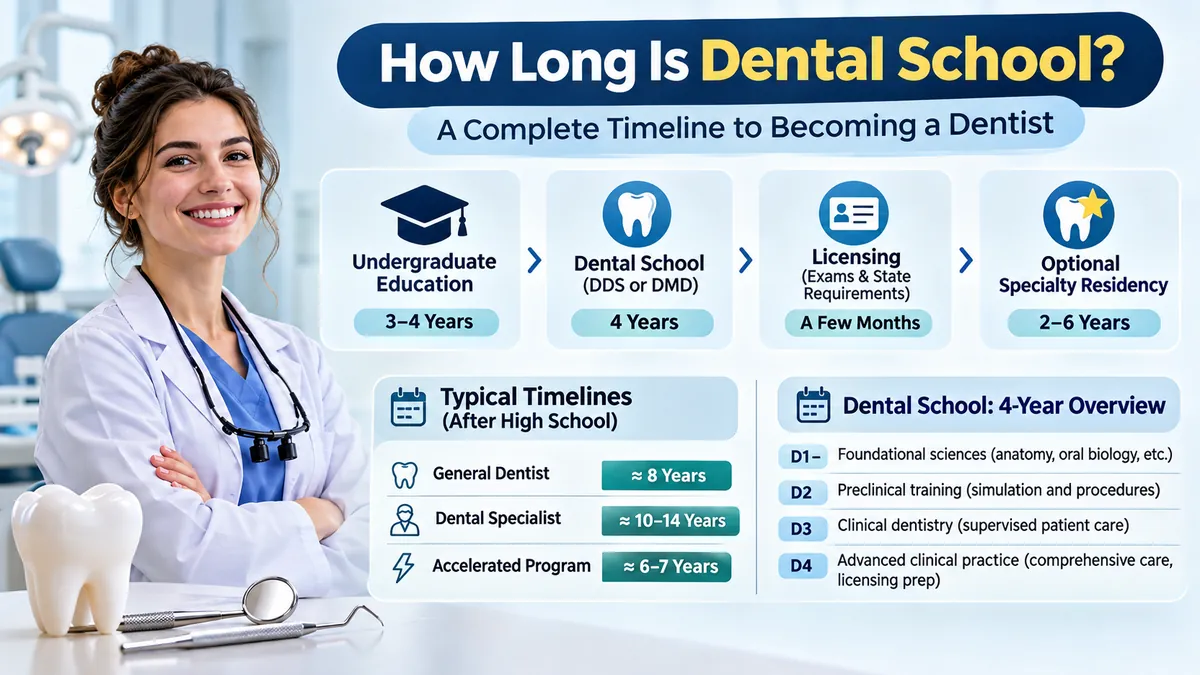
Dental school typically takes four years to complete in the United States after four years of undergraduate education. Most students therefore need eight years after high school to become general dentists. Those pursuing dental specialties may require an additional two to six years of postgraduate residency training.
The exact duration depends on your educational background, dental degree program, career goals, and state licensing requirements.
How Many Years Does It Take to Become a Dentist?
The traditional pathway to dentistry involves completing an undergraduate degree followed by a professional dental degree. Students graduate with either a Doctor of Dental Surgery (DDS) or Doctor of Dental Medicine (DMD).
Both qualifications provide equivalent professional preparation for general dentistry.
According to the American Dental Education Association (ADEA), four years remains the standard duration for dental education in the United States. However, accelerated programs are also available at a limited number of institutions. ADEA+1
Dentist Education Timeline
| Educational Stage | Duration |
|---|---|
| Undergraduate education | 3–4 years |
| Traditional dental school | 4 years |
| Accelerated dental school | 3–3.5 years |
| General dentistry residency, where applicable | 1–2 years |
| Specialty residency | 2–6 years |
| Typical general dentist pathway | 8 years |
| Typical dental specialist pathway | 10–14 years |
Licensing examinations and application processing may add further time before independent practice.
At What Age Do Most Dentists Graduate?
Students who enter college at age 18 and complete the traditional eight-year educational pathway generally graduate from dental school at approximately 26.
A student pursuing orthodontics or another specialty may finish training at around 28–30. Oral and maxillofacial surgeons may complete their education later because of longer residency requirements.
These ages are examples rather than professional requirements. Many students enter dentistry after changing careers or completing another academic qualification.
how long is dental school After High School?
After high school, the conventional route to becoming a dentist takes approximately eight years. The first four years focus on undergraduate education and dental school preparation, while the remaining four provide professional dental training.
Undergraduate Education Requirements
Most prospective dental students complete a bachelor’s degree before entering dental school. However, certain institutions accept applicants who have completed sufficient undergraduate credits and prerequisite courses without earning a full degree.
Common prerequisite subjects include:
- Biology
- General chemistry
- Organic chemistry
- Physics
- Biochemistry
- English
- Mathematics
- Anatomy and physiology
Specific requirements differ between dental schools.
Students do not necessarily need to major in biology or chemistry. A degree in psychology, business, engineering, or another subject may also be acceptable if all required science courses are completed. MouthHealthy+1
Taking the Dental Admission Test (DAT)
The Dental Admission Test is a standardized examination administered by the American Dental Association (ADA).
It evaluates several abilities relevant to dental education, including natural science knowledge, perceptual ability, reading comprehension, and quantitative reasoning.
Many applicants take the DAT during their junior year of college or before submitting their dental school applications.
Applying to Dental School
Most American dental schools participate in the ADEA Associated American Dental Schools Application Service (ADEA AADSAS).
Admissions committees typically consider undergraduate GPA, DAT performance, recommendation letters, dental shadowing, personal statements, extracurricular activities, and interviews.
Applying during the final stage of undergraduate education can help students avoid an unnecessary gap year between college and dental school.
What Happens During the Four Years of Dental School?
Dental education combines scientific knowledge, technical skills, clinical experience, and professional responsibilities.
Although individual institutions organize their curricula differently, students generally progress from foundational sciences and simulated procedures to supervised patient treatment.
Four-year dental school curriculum
Typical progression from foundational education to clinical practice
D1
Foundational sciencesAnatomy, physiology and oral biology
D2
Preclinical trainingSimulation and restorative procedures
D3
Clinical dentistrySupervised patient care and treatment
D4
Advanced clinical practiceComprehensive care and licensing preparation
First Year: Foundational Dental Sciences
The first year, commonly called D1, establishes the scientific foundation needed to understand oral health and disease.
Students learn subjects such as human anatomy, microbiology, biochemistry, physiology, oral histology, and dental anatomy.
They also begin developing manual skills through laboratory exercises and dental simulation equipment.
Second Year: Preclinical Dental Training
The second year, or D2, introduces more complex dental procedures and treatment principles.
Typical areas of study include restorative dentistry, dental materials, pharmacology, pathology, radiology, prosthodontics, and local anesthesia.
Students practice procedures using dental models and simulated patients before performing treatments on actual patients.
Some institutions introduce supervised patient interactions during this stage.
Third Year: Clinical Dentistry
During the third year, known as D3, students generally spend more time working in clinical environments.
Under faculty supervision, students develop experience in diagnosing oral diseases, preparing treatment plans, restoring damaged teeth, providing preventive care, and managing patient records.
The transition from laboratory exercises to real patient care requires stronger communication, clinical judgment, and time management skills.
Fourth Year: Advanced Clinical Experience
The final year, or D4, focuses on managing more comprehensive patient cases and preparing for professional practice.
Students may participate in community dentistry programs, hospital rotations, advanced restorative procedures, and practice management courses.
They also prepare for national examinations and complete their graduation requirements.
The American Dental Education Association describes this general progression as two years emphasizing foundational and simulated learning, followed by two years emphasizing clinical education. ADEA
DDS vs. DMD: Which Dental Degree Takes Longer?
The Doctor of Dental Surgery and Doctor of Dental Medicine are equivalent professional qualifications.
Neither degree is inherently more advanced than the other. Universities select which title to award, but graduates must satisfy applicable professional and licensing standards.
| Feature | DDS | DMD |
|---|---|---|
| Full name | Doctor of Dental Surgery | Doctor of Dental Medicine |
| Typical duration | 4 years | 4 years |
| Academic level | Professional doctorate | Professional doctorate |
| Clinical training | Required | Required |
| General dentistry eligibility | Yes, with licensure | Yes, with licensure |
| Specialty training eligibility | Yes | Yes |
Both degrees can lead to careers in general dentistry, orthodontics, pediatric dentistry, oral surgery, and other recognized dental specialties.
When selecting a dental school, accreditation, clinical opportunities, educational costs, and curriculum quality are more significant than the degree title.
how long is dental school for Dental Specialists?
Dentists who want to specialize must generally complete postgraduate education after earning their DDS or DMD.
Most specialty programs require two to three additional years. Certain advanced surgical specialties require considerably longer training.
Dental Specialty Training Duration
Typical total education after high school, including specialty training
General dentistry
8 years
Endodontics
10–11 years
Pediatric dentistry
10–11 years
Orthodontics
10–11 years
Periodontics
11 years
Prosthodontics
11 years
Oral and maxillofacial surgery
12–14 years
Undergraduate and dental education
Specialty training, upper estimate
Orthodontics
Orthodontists diagnose and correct problems involving tooth alignment, jaw development, and bite relationships.
Orthodontic residency usually takes two to three years after dental school, bringing the total educational timeline to approximately 10–11 years.
Pediatric Dentistry
Pediatric dentists specialize in oral healthcare for infants, children, adolescents, and patients with certain special healthcare needs.
Their postgraduate training generally lasts two to three years.
Endodontics
Endodontists specialize in diagnosing and treating conditions affecting the dental pulp and tissues surrounding tooth roots.
Endodontic residency commonly lasts two to three years.
Oral and Maxillofacial Surgery
Oral and maxillofacial surgeons receive advanced surgical training involving the mouth, jaws, and facial structures.
Residency programs typically last four to six years. Some six-year programs incorporate a medical degree (MD).
This makes oral and maxillofacial surgery one of the longest dental training pathways.
Periodontics and Prosthodontics
Periodontists focus on gum health, supporting tooth structures, periodontal disease, and related implant procedures.
Prosthodontists specialize in restoring and replacing teeth using crowns, bridges, dentures, implants, and other restorations.
Both specialties commonly involve three years of postgraduate training.
The American Dental Association recognizes 12 dental specialties, each with its own educational and professional requirements. MouthHealthy
Can You Finish Dental School in Less Than Four Years?
Yes. A limited number of institutions offer accelerated educational pathways that allow qualified students to complete dental training in less time.
Three-Year Dental School Programs
Accelerated dental programs compress the traditional curriculum into approximately three calendar years.
The University of the Pacific’s Arthur A. Dugoni School of Dentistry is a well-known example of a three-year DDS program.
These programs generally involve intensive academic schedules, shorter vacation periods, and continuous clinical development.
An accelerated program does not eliminate the professional competencies students must demonstrate before graduation.
Combined Bachelor’s and Dental Degree Programs
Some universities offer combined BS/DDS, BA/DDS, or BS/DMD pathways.
Depending on the institution, students may complete their undergraduate and professional dental education in six or seven years.
| Program Type | Approximate Total Duration |
|---|---|
| Traditional undergraduate and dental program | 8 years |
| Accelerated dental degree after college | 7 years |
| Combined seven-year dental program | 7 years |
| Combined six-year dental program | 6 years |
Combined programs typically have competitive admissions criteria and academic progression requirements.
Advanced Standing Programs for International Dentists
Internationally trained dentists may qualify for advanced standing programs at American dental schools.
These programs commonly take two to three years and allow eligible graduates to obtain an accredited American DDS or DMD qualification.
Applications may be submitted through the ADEA Centralized Application for Advanced Placement for International Dentists (ADEA CAAPID), depending on the institution.
Admission and licensing requirements vary, so an overseas dental qualification does not automatically guarantee eligibility to practice in the United States.
Do Dentists Need a Residency After Dental School?
General dentists do not universally need to complete a residency after graduation in the United States. However, certain jurisdictions require postgraduate training, and many graduates voluntarily pursue it to strengthen their clinical abilities.
Two common postgraduate general dentistry programs are:
| Residency Program | Typical Length | Primary Focus |
|---|---|---|
| General Practice Residency (GPR) | 1–2 years | Hospital-based care and medically complex patients |
| Advanced Education in General Dentistry (AEGD) | 1–2 years | Advanced comprehensive dental treatment |
| Specialty residency | 2–6 years | Specialized dental procedures and patient care |
A general dentistry residency can provide additional experience before entering independent practice.
Students considering residency should factor the additional training time into their educational and financial plans.
Dental Licensing Requirements
Graduating from dental school does not automatically authorize independent dental practice.
In the United States, the licensing process generally includes graduating from a program accredited by the Commission on Dental Accreditation (CODA), passing the Integrated National Board Dental Examination (INBDE), and satisfying state-specific clinical assessment and licensing requirements.
Some states also require jurisprudence examinations, background checks, or postgraduate clinical experience.
Always consult the relevant state dental board before choosing a professional pathway.
Dental School Duration Around the World
The American dental education system differs from those in countries where students can enter professional dental programs directly after secondary education.
| Country | Typical Dental Degree | Educational Duration |
|---|---|---|
| United States | DDS/DMD | 7–8 years, including undergraduate education |
| Canada | DDS/DMD | Approximately 7–8 years through the usual pathway |
| United Kingdom | BDS/BChD | Usually 5 years |
| Australia | BDS/DMD | Approximately 5–7 years, depending on pathway |
| India | BDS | 5 years, including internship |
| Germany | State examination | Approximately 5.5 years |
These estimates exclude some postgraduate training, registration requirements, and specialty qualifications.
A shorter international dental program does not necessarily mean less professional training. Differences frequently reflect how undergraduate science education and professional dentistry are integrated.
Students planning to practice abroad should investigate qualification recognition before enrolling.
How Difficult and Expensive Is Dental School?
Dental school is academically demanding because students must develop scientific understanding and precise technical abilities simultaneously.
Unlike many conventional university degrees, dental education requires students to demonstrate competence in laboratory work, clinical judgment, patient communication, and practical procedures.
How Many Hours Do Dental Students Study?
Dental school is generally a full-time commitment. Classes, laboratory sessions, clinical appointments, examinations, and independent study can occupy much of a student’s week.
Workloads vary significantly throughout the program. Early academic examinations may require extensive revision, while clinical years introduce patient scheduling and treatment responsibilities.
Consistent study habits and regular practical training are more effective than relying exclusively on last-minute examination preparation.
How Much Does Dental School Cost?
Dental education costs depend on the institution, residency status, geographic location, and available financial assistance.
Reported average first-year dental school tuition for the 2024–2025 academic year included the following figures. Pomona College
| School Type | Average First-Year Tuition |
|---|---|
| Public school, in-state | $42,071 |
| Public school, out-of-state | $71,266 |
| Private dental school | $82,320 |
Students must also budget for instruments, clinical equipment, textbooks, housing, transportation, examinations, insurance, and other living expenses.
A longer educational pathway can increase borrowing costs and delay full-time professional earnings.
What Can Extend Your Dental Education?
Although four years is the standard dental school duration, several factors can increase the overall timeline:
- Taking gap years before admission.
- Retaking the Dental Admission Test.
- Completing missing prerequisite courses.
- Reapplying after unsuccessful admission cycles.
- Repeating academic or clinical requirements.
- Pursuing postgraduate research or dual degrees.
- Completing specialty residency programs.
Planning prerequisite courses and application deadlines early can reduce avoidable delays.
Conclusion
The answer to the question how long is dental school depends primarily on your chosen educational pathway and professional ambitions.
Traditional dental school takes four years, while becoming a general dentist usually requires approximately eight years of education after high school. Accelerated programs may reduce this timeline to six or seven years, whereas specialty training can extend it to 10–14 years.
Although dentistry requires a substantial investment of time, its structured progression allows students to develop the scientific knowledge, clinical expertise, and practical abilities necessary for responsible patient care.
Start by reviewing accredited dental schools, undergraduate prerequisites, admission requirements, educational costs, and state licensing regulations. Understanding these requirements early will help you establish a realistic timeline for your dental career.
