

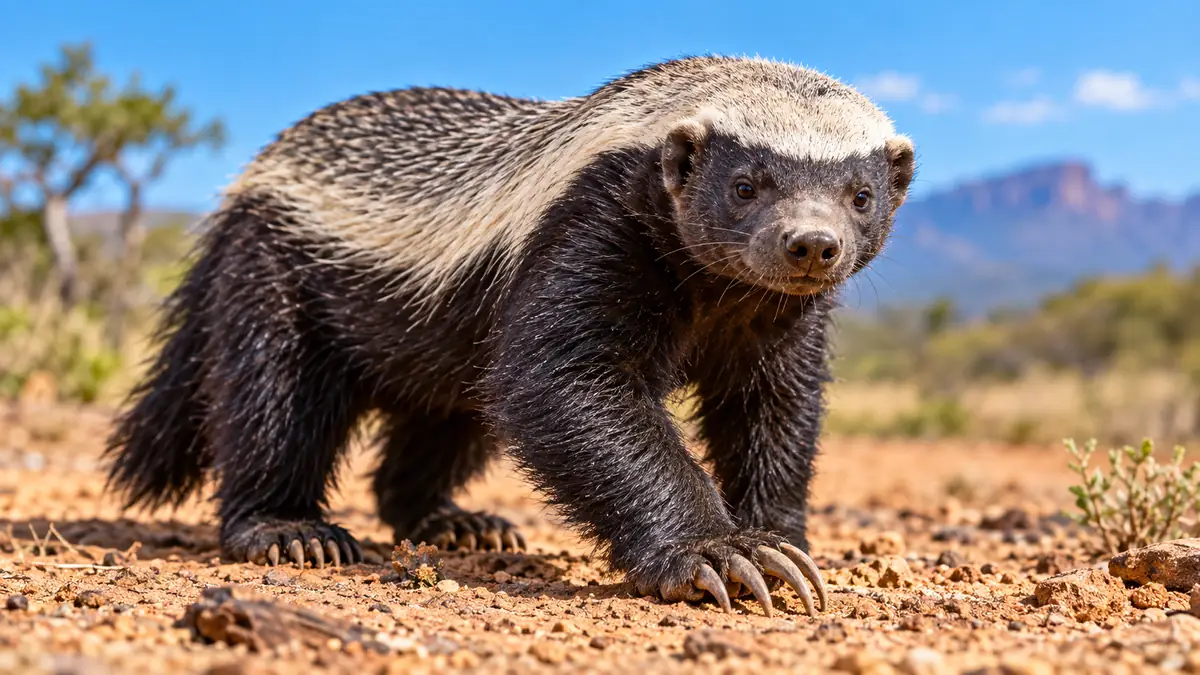
Few mammals have built a reputation as formidable as the honey badger. Its willingness to defend itself against much larger animals, raid beehives, dig out hidden prey, and hunt venomous snakes has made it famous far beyond its native range.
The reality is more interesting than the internet legend. The honey badger (Mellivora capensis), also called the ratel, is a highly adaptable member of the mustelid family. It occurs across much of Africa and parts of the Middle East and Asia, where it survives in habitats ranging from deserts and grasslands to forests and mountains.
The honey badger is a stocky, powerful mammal known for digging ability, flexible feeding habits, loose protective skin, strong claws, and aggressive defense when threatened. Despite its name, honey is only one part of its varied diet. It primarily feeds on animal prey, including rodents, reptiles, insects, birds, eggs, and snakes.
What Is a Honey Badger?
The honey badger’s scientific name is Mellivora capensis. It belongs to the family Mustelidae, the group that also includes weasels, otters, ferrets, martens, and other badgers.
Despite the common name, honey badgers are not simply African versions of European or American badgers. They represent a distinctive branch of the mustelid family and have a body plan particularly well suited to digging and ground-level hunting.
They are also commonly called ratels, especially in southern Africa.
A typical animal has a low, muscular body, short but powerful legs, long front claws, small ears, and a broad head. Perhaps its most recognizable feature is its coloration: the lower body is generally dark, while a broad pale gray or whitish mantle extends across the upper body from the head toward the tail.
National Geographic reports a shoulder height of roughly 9–11 inches and a weight of about 13–30 pounds, although body size varies by sex and geographic population.
| Feature | Honey Badger |
|---|---|
| Scientific name | Mellivora capensis |
| Other common name | Ratel |
| Family | Mustelidae |
| Animal class | Mammalia |
| General diet | Primarily carnivorous/opportunistic |
| Distribution | Africa, Arabian Peninsula and parts of Asia |
| Habitat | Deserts, grasslands, woodland, forests and rocky areas |
| Conservation status | Least Concern |
| Key adaptations | Powerful claws, strong jaws, loose skin and scent glands |
Where Do Honey Badgers Live?
The honey badger habitat is unusually diverse. Rather than depending on one narrow ecosystem, the species can survive under dramatically different environmental conditions.
Its distribution covers much of sub-Saharan Africa, extends through parts of the Arabian Peninsula and Middle East, and continues into western and southern Asia, including parts of India, Pakistan, Afghanistan and neighboring regions.
Habitats Used by Honey Badgers
Depending on the region, they may occur in:
- Savannas and grasslands
- Open woodland
- Thorn forest
- Riparian areas
- Scrubland
- Rocky hills
- Arid steppe
- Desert environments
- Some tropical and subtropical forests
- Mountainous terrain
Animal Diversity Web reports honey badgers from sea level to elevations of around 4,050 meters (13,287 feet). They generally need access to suitable shelter, such as burrows, rock crevices or similar protected locations.
That ecological flexibility helps explain their enormous geographic range.
Honey Badger Home Ranges
Honey badgers can travel considerable distances while searching for food. National Geographic notes that home ranges can reach approximately 500 square kilometers (193 square miles), although actual territory and movement patterns depend on sex, habitat and food availability.
A large range makes sense for an opportunistic predator. Instead of waiting for one predictable food source, the animal continually searches for whatever prey is available.
Quick takeaway: The honey badger is not strictly a desert or savanna animal. Its success comes partly from its ability to use many different habitats across Africa and Asia.
What Do Honey Badgers Eat?
One of the most common questions about the species is surprisingly easy to misunderstand: Do honey badgers mainly eat honey?
No.
Honey and bee products are part of their diet, but the name gives an exaggerated impression of their importance.
Honey badgers are exceptionally flexible foragers. Their diet can include:
- Rodents and other small mammals
- Snakes
- Lizards and geckos
- Frogs
- Birds
- Eggs
- Insects
- Scorpions and other arthropods
- Tortoises and turtles
- Carrion
- Bee larvae
- Honey
- Roots and bulbs
- Some fruits
Animal Diversity Web describes the species as an opportunistic forager whose diet changes with seasonal prey availability.
Why Are They Called Honey Badgers?
The name comes from their tendency to raid beehives.
But the nutritional prize isn’t necessarily just the honey. Honey badgers also consume the energy-rich larvae and other contents found inside bee colonies.
Their long claws and digging ability help them tear into nests and reach food that many other predators cannot easily access.
This behavior can create conflict with beekeepers. In areas where honey badgers repeatedly damage hives, people may persecute them to protect their livelihoods.
Seasonal Changes in the Diet
Honey badgers do not follow exactly the same menu all year.
Research summarized by Animal Diversity Web found major seasonal changes in Kalahari animals. During periods when small mammals were abundant, they formed a large proportion of the diet. During another season, large snakes became especially important.
That adaptability is a major survival advantage.
If rodents become scarce, the animal can switch to reptiles, insects, scorpions or other available foods instead of depending on a single prey species.
Research summarized by the South African National Biodiversity Institute also suggests that fruits such as tsamma melons can be particularly useful as a source of moisture in water-scarce environments.
Why Is the Honey Badger So Tough?
The honey badger’s fearsome reputation isn’t entirely a myth.
Its survival strategy combines anatomy, behavior and a willingness to defend itself aggressively when escape is difficult.
Thick, Loose Skin
One of its best-known adaptations is its thick and relatively loose skin.
Loose skin can make it harder for another animal to maintain an effective grip. Combined with a compact, muscular body, this gives the honey badger valuable protection during close encounters.
It does not make the animal invulnerable. Lions, leopards and spotted hyenas are among the predators capable of killing honey badgers.
The better way to describe the adaptation is therefore defensive protection, not armor.
Powerful Claws
Honey badgers have large front claws designed for digging.
These claws allow them to excavate burrows, uncover underground prey and tear into difficult food sources. Digging is central to their feeding strategy rather than simply a way of constructing a home.
Their low, strong body gives them leverage while excavating.
Strong Teeth and Jaws
A varied diet demands a versatile feeding apparatus.
Honey badgers have prominent teeth and strong jaws that help them handle everything from small vertebrates to tougher food. They can consume remarkably large portions of prey, including material that a more specialized predator might leave behind.
Scent Glands
Honey badgers also possess well-developed anal scent glands.
When threatened, they can release a powerful odor. Animal Diversity Web describes this as one component of a broader defensive display that can also involve raised hair, vocalization and charging.
This feature is one reminder of their relationship to other mustelids and musteloid carnivores with chemical defenses.
Can a Honey Badger Survive a Snake Bite?
The relationship between the honey badger and venomous snakes has generated some of the biggest myths surrounding the animal.
Honey badgers do hunt snakes, including venomous species. Studies of their diet have documented snake prey, and researchers have long been interested in whether they possess physiological adaptations that reduce the effects of venom.
But saying that honey badgers are simply “immune to snake venom” goes too far.
Venoms differ enormously among snake species, and the biological mechanisms involved in venom resistance are complex.
Animal Diversity Web notes that venom resistance occurs in several groups of mammals and considers resistance likely in honey badgers, while also pointing out that the exact physiological mechanism has not been demonstrated there in the simple way popular accounts sometimes suggest.
Their success against snakes also depends on behavior.
Speed, strong jaws, thick skin and an experienced predator’s ability to control prey can all reduce the chance or severity of a bite.
So, can a honey badger survive a venomous snake bite? It may survive bites that would be dangerous to many animals, but that should not be interpreted as universal immunity to every venom or every dose.
Honey Badger Behavior and Intelligence
Honey badgers are generally solitary animals, although pairs may be observed during mating and mothers live with dependent young.
Their behavior varies according to habitat and human pressure.
National Geographic notes that they can be active during the day, but individuals living near people may become more nocturnal.
This flexibility helps them reduce risky encounters.
Are Honey Badgers Aggressive?
Calling the species “aggressive” without context can be misleading.
A honey badger does not spend every moment searching for large animals to attack. Much of its life consists of ordinary activities such as walking, digging, hunting small prey, resting and finding shelter.
Its reputation comes from what happens when it feels threatened.
Rather than relying only on escape, a cornered honey badger may stand its ground, vocalize or charge. This defensive intensity can discourage animals substantially larger than itself.
That is different from being fearless.
Wild animals constantly evaluate risk. Honey badgers survive because their behavior works alongside strong physical defenses—not because they lack survival instincts.
Are Honey Badgers Smart?
They are often described as intelligent and persistent problem solvers.
Observations of captive individuals have helped popularize stories about escape behavior and object manipulation. In the wild, however, intelligence is better considered in the context of ecological challenges.
A successful honey badger must locate underground prey, investigate potential feeding sites, choose shelters, navigate a large home range and respond to many different threats.
Its flexible foraging behavior is particularly significant. An animal capable of switching efficiently among rodents, reptiles, arthropods, carrion and bee colonies can cope better with environmental change than an extreme dietary specialist.
Honey Badger vs. Other Badgers
The name creates another common misconception.
A honey badger is not simply the same animal as the American or Eurasian badger living on another continent.
Several unrelated-looking or only more distantly related mustelids carry the common name “badger.” Animal Diversity Web highlights honey badgers, American badgers and Eurasian badgers as distinct animals despite the shared common terminology.
| Trait | Honey Badger | American Badger | Eurasian Badger |
|---|---|---|---|
| Scientific name | Mellivora capensis | Taxidea taxus | Meles meles |
| Main range | Africa and parts of Asia | North America | Europe and parts of Asia |
| Family | Mustelidae | Mustelidae | Mustelidae |
| Lifestyle | Mostly solitary | Mostly solitary | Often more social |
| Notable adaptation | Generalist feeding and strong defense | Exceptional digging | Complex burrow systems |
| Typical appearance | Pale upper mantle, dark underside | Facial stripe pattern | Black-and-white facial stripes |
All three are powerful digging mammals, but their evolutionary histories, social systems and ecological niches differ.
Honey Badger Predators: What Can Kill One?
The internet sometimes portrays honey badgers as animals with no natural predators.
That is false.
Potential predators include:
- Lions
- Leopards
- Spotted hyenas
Animal Diversity Web identifies all three among known predators.
What makes honey badgers unusual isn’t the absence of enemies. It’s that attacking one can be difficult and potentially costly.
A predator has to overcome a compact animal equipped with claws, teeth, loose skin, chemical defenses and an intense defensive response.
For a large carnivore, the question is not simply “Can I kill this animal?” but also whether doing so is worth the effort and risk compared with easier prey.
This helps explain why dramatic encounters between honey badgers and much larger predators can occur without proving that the smaller animal would consistently defeat them.
Honey Badger Reproduction and Cubs
Honey badgers are generally solitary, so males and females typically associate only temporarily around mating.
National Geographic reports that mating can occur throughout the year and that females often have one cub at a time.
Young honey badgers require a substantial period of learning.
Foraging is not just a matter of instinctively biting whatever moves. A young animal must learn where to dig, how to handle different prey, how to investigate bee colonies and how to react to potential danger.
Maternal care therefore gives cubs opportunities to develop the skills required for an exceptionally broad diet.
Where Do Honey Badgers Sleep?
They use secure shelters such as:
- Burrows
- Rock crevices
- Hollow trees
- Dens abandoned by other animals
They are capable diggers and can create shelter themselves, but they also make use of existing structures when convenient.
National Geographic reports that abandoned dens made by animals such as porcupines and yellow mongooses may also be used.
This is another example of the species’ opportunistic approach to survival.
The Honey Badger and Honeyguide Myth
One of the most interesting honey badger stories involves the greater honeyguide, a bird famous for guiding humans toward bee colonies in parts of Africa.
For years, books and documentaries repeated a neat story: the bird supposedly guides honey badgers to a hive; the mammal tears it open; both animals then share the rewards.
It is a compelling example of supposed cooperation between two species.
The problem is that evidence for this partnership is lacking.
The honeyguide’s cooperative relationship with humans is well known, but claims of a comparable honey badger partnership have been challenged. National Geographic has specifically discussed the lack of convincing evidence behind the long-repeated story.
This distinction matters because popular wildlife facts often spread by repetition.
Once a claim appears in enough books, documentaries and websites, it can sound established even when the underlying evidence is weak.
Quick takeaway: Honey badgers certainly raid bee colonies, but the famous story that honeyguides routinely lead them to hives should not be treated as established animal behavior.
How Long Do Honey Badgers Live?
Estimating the honey badger lifespan in nature is difficult because long-term monitoring of secretive, wide-ranging carnivores is challenging.
National Geographic lists an average wild lifespan of up to around seven years, while other animal references report different estimates and considerably longer survival under captive conditions.
Differences among published numbers can reflect sample size, study conditions and the distinction between an average lifespan and the maximum age an individual might reach.
Wild honey badgers face threats that captive animals largely avoid, including predators, disease, injuries, food shortages and conflict with people.
For that reason, a single lifespan number should not be interpreted as a fixed biological limit.
Are Honey Badgers Endangered?
The honey badger has a wide geographic distribution and is currently classified as Least Concern on the IUCN Red List, as reflected in major wildlife references.
“Least Concern,” however, does not mean the species faces no problems.
Honey badgers may be killed because of conflict with:
- Beekeepers
- Poultry keepers
- Livestock farmers
- Hunters and trappers
They may also be affected by habitat changes, accidental trapping, bushmeat hunting and use in traditional medicine in some areas. National Geographic notes persecution associated with farming and beekeeping as well as harvesting for bushmeat and traditional medicine.
Local population trends can therefore differ from the global picture.
A species can remain widespread overall while becoming uncommon in particular landscapes.
Reducing Human-Honey Badger Conflict
Conservation does not always require keeping people and wildlife completely separate.
Practical prevention can be more effective.
For beekeepers, stronger hive protection and placement strategies can make colonies more difficult for honey badgers to access. Reducing easy food opportunities around settlements can also discourage repeated visits.
The goal is to prevent conflict before lethal control becomes the response.
That approach protects wildlife while recognizing that farmers and beekeepers also need to protect their livelihoods.
Why Honey Badgers Matter in Their Ecosystem
Honey badgers are mesopredators and opportunistic foragers that interact with a broad range of animals.
Their diet includes rodents, reptiles, insects and other organisms, making them part of multiple food-web relationships.
Digging also physically alters small patches of soil. Burrowing predators can disturb soil while searching for prey, potentially creating localized opportunities for other organisms.
Honey badgers are themselves prey for larger carnivores, so they occupy both sides of predator-prey relationships.
Their adaptability also makes them interesting to scientists studying how medium-sized carnivores cope with seasonal environments.
A specialist predator may struggle when its primary prey declines. A honey badger can switch targets.
That flexibility is one of the central themes of its ecology.
Common Honey Badger Myths vs. Reality
The animal’s online fame has blurred the boundary between genuine adaptation and exaggeration.
| Popular claim | What the evidence suggests |
|---|---|
| Honey badgers are fearless | They are unusually defensive but still respond to risk |
| Nothing can kill them | Lions, leopards and hyenas can prey on them |
| They are immune to all snake venom | Evidence suggests adaptations or resistance, not universal invulnerability |
| They mainly eat honey | Their diet consists largely of animal prey |
| Honeyguides always lead them to hives | This famous partnership lacks convincing evidence |
| Their skin is impossible to penetrate | Thick, loose skin provides protection but is not impenetrable |
| They constantly fight large predators | Most normal activity involves foraging, traveling and sheltering |
The real animal doesn’t need the myths.
A medium-sized carnivore capable of surviving across deserts, forests, grasslands and mountains while hunting everything from rodents to venomous snakes is impressive enough.
What Makes the Honey Badger So Successful?
There isn’t one secret weapon.
Its success comes from a collection of adaptations working together.
Flexible diet: It can shift among many food sources as conditions change.
Powerful digging: Long claws provide access to underground prey and shelter.
Strong defenses: Loose skin, teeth, claws, scent glands and assertive behavior make it difficult to attack.
Broad habitat tolerance: It survives across very different climates and landscapes.
Behavioral flexibility: Activity patterns and food choices can change according to environmental conditions.
Wide-ranging movement: Individuals can search large areas when resources are scattered.
This combination is more useful than extreme specialization when food availability changes dramatically from season to season.
Final Thoughts on the Honey Badger
The honey badger deserves its reputation as one of nature’s most resilient small carnivores, but the science is more nuanced than the memes.
Mellivora capensis is a wide-ranging mustelid adapted for digging, opportunistic hunting and determined self-defense. It eats rodents, reptiles, insects, birds, eggs, bee larvae, honey and numerous other foods. Its thick loose skin, powerful claws, strong jaws and defensive behavior help it survive encounters that would be dangerous for many similarly sized mammals.
At the same time, honey badgers are not indestructible, do not live entirely on honey, and should not be assumed to be immune to every snake venom. Even the famous honeyguide partnership turns out to be far less certain than popular wildlife stories suggest.
Understanding those distinctions reveals something more interesting than the legend: the honey badger succeeds not because it is magically fearless, but because it is remarkably adaptable.
