

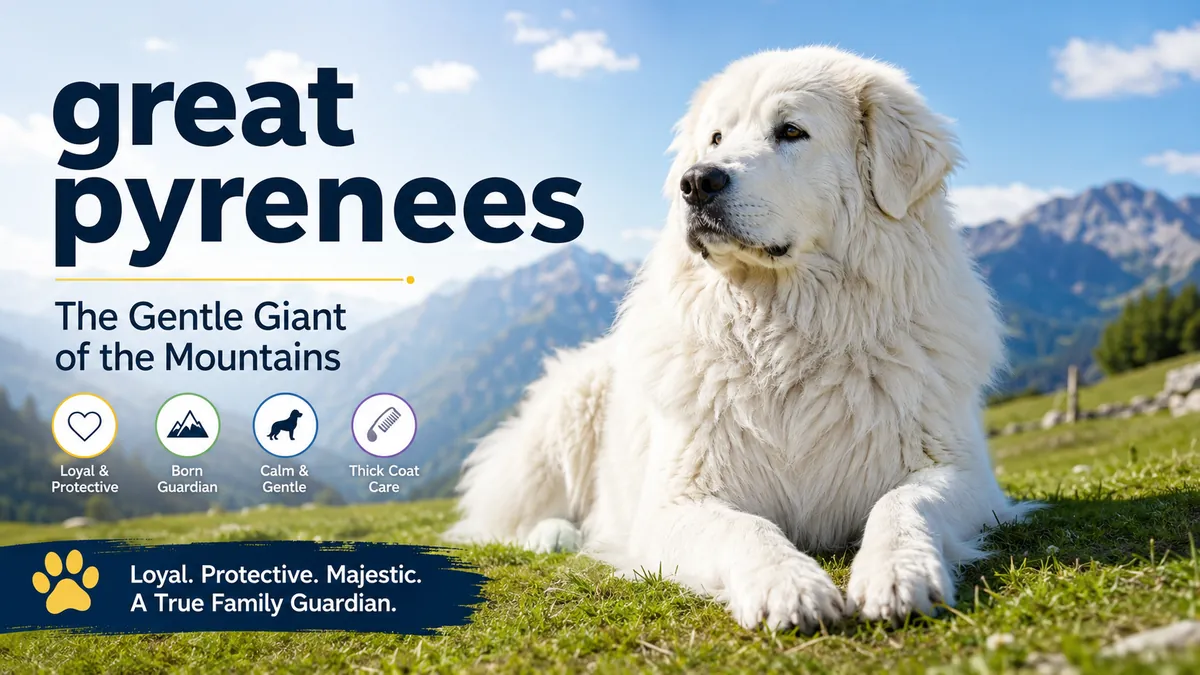
A Great Pyrenees can look like an enormous, relaxed white teddy bear—right up until something unfamiliar approaches the property. Then centuries of livestock-guardian instinct become obvious.
Calm, powerful, independent, and intensely watchful, this is a dog developed to make decisions without waiting for human instructions. That history explains many traits modern owners notice, from nighttime barking and stubborn training sessions to remarkable patience with family members.
The Great Pyrenees is a giant livestock guardian breed developed in the Pyrenees Mountains between France and Spain. Adults generally stand 25–32 inches tall, with females starting around 85 pounds and males around 100 pounds. They are known for a thick double coat, independent temperament, protective instincts, moderate exercise needs, and an average lifespan of roughly 10–12 years.
Understanding those guardian instincts is the key to understanding almost everything else about the breed.
Great Pyrenees Breed Overview
The Great Pyrenees belongs to the American Kennel Club’s Working Group and is known internationally as the Pyrenean Mountain Dog. Its original purpose wasn’t herding sheep from place to place. It was protecting livestock from predators.
| Characteristic | Great Pyrenees |
|---|---|
| Breed type | Giant livestock guardian |
| AKC group | Working Group |
| Origin | Pyrenees Mountains, France/Spain |
| Male height | About 27–32 inches |
| Female height | About 25–29 inches |
| Male weight | Usually 100+ pounds |
| Female weight | Usually 85+ pounds |
| Coat | Dense, weather-resistant double coat |
| Common color | White; some dogs have gray, tan, badger, or reddish-brown markings |
| Energy level | Moderate |
| Temperament | Calm, independent, protective, patient |
| Trainability | Intelligent but independent |
| Shedding | Significant |
| Barking | Frequently alert and territorial |
| Life expectancy | About 10–12 years |
Individual dogs naturally fall outside averages. Nutrition, genetics, activity, sex, and overall body condition can all affect adult size.
What Were Great Pyrenees Bred For?
The breed developed around the Pyrenees Mountains separating France and Spain. Shepherds needed dogs capable of remaining with livestock and protecting it from predators such as wolves and bears.
This work demanded a particular kind of intelligence.
A livestock guardian couldn’t constantly look toward a shepherd for instructions. It had to notice a possible threat, assess the situation, and decide what to do independently.
That independence remains deeply embedded in the modern breed.
It explains why a Pyr may understand a command perfectly and still appear to consider whether following it is worthwhile.
Great Pyrenees vs. Pyrenean Mountain Dog
These names generally refer to the same breed.
Great Pyrenees is the name used by the American Kennel Club in the United States, while Pyrenean Mountain Dog is commonly used elsewhere. In France, the breed has also been called Patou and Chien de Montagne des Pyrénées.
The similarly named Pyrenean Mastiff, however, is a different breed.
Great Pyrenees Size, Weight and Appearance
The Great Pyrenees is a giant dog, but all that fur can make the animal look even larger than its actual body mass suggests.
According to the AKC breed standard, males should stand roughly 27–32 inches at the shoulder and females about 25–29 inches. Males weighing around 100 pounds and females around 85 pounds are typical starting points, although larger healthy individuals certainly exist.
What Does a Great Pyrenees Look Like?
The classic Pyr has a strong but balanced frame rather than the extremely heavy build associated with some mastiff-type breeds.
Typical features include:
- Large, powerful body
- Wedge-shaped head
- Medium-sized triangular drop ears
- Dark eyes with an intelligent, calm expression
- Dense undercoat
- Long, weather-resistant outer coat
- Noticeable neck and shoulder ruff
- Feathering on the legs
- Long, plumed tail
- Double dewclaws on the hind legs
Despite their size, correctly built Pyrs should move efficiently rather than appearing cumbersome. The AKC standard emphasizes smooth, balanced movement combining power with agility.
Are All Great Pyrenees White?
White is the dominant color, but a Pyr doesn’t necessarily have to be completely white.
The AKC standard permits white dogs with markings that can include gray, badger, reddish brown, and various shades of tan. These markings may occur around the head, ears, tail, and portions of the body.
That predominantly white coat wasn’t merely decorative. It suited a dog working among sheep in mountainous environments.
How Big Does a Great Pyrenees Get?
Many people underestimate just how much space a 100-pound dog occupies.
A male may reach 27–32 inches at the shoulder, while females commonly reach 25–29 inches. Purina gives typical male weights of about 100–130 pounds and female weights of about 85–120 pounds.
Growth also takes time.
Giant-breed puppies can become physically enormous while remaining behaviorally immature. A 90-pound adolescent may still think and behave very much like a puppy.
That makes early manners particularly valuable.
Quick Takeaway: Don’t judge this breed only by its fluffy appearance. The adult Great Pyrenees is an extremely powerful working dog whose physical size makes training and socialization much easier when started early.
Great Pyrenees Temperament and Personality
The classic Great Pyrenees temperament combines traits that can initially seem contradictory.
A well-adjusted Pyr can be gentle yet formidable, relaxed yet vigilant, affectionate yet independent.
The official AKC breed standard describes the ideal temperament as confident, gentle, affectionate, patient, tolerant, attentive, fearless, loyal, independent, and strong-willed. Excessive nervousness, shyness, or aggression toward humans is not considered normal breed temperament.
Are Great Pyrenees Friendly?
With their families, they commonly are.
Many Pyrs develop strong attachments to the household and behave calmly around familiar people. Their protective behavior isn’t supposed to mean indiscriminate aggression.
They tend to observe first.
Strangers, unfamiliar dogs, unexpected sounds, or activity around the property’s boundary may receive much more scrutiny.
Early socialization helps a puppy learn the difference between ordinary life and something genuinely concerning.
Are Great Pyrenees Good Family Dogs?
For the right household, yes.
Their patient, composed nature can make them affectionate family companions. Many are particularly gentle around children. Hill’s describes the breed as deeply bonded to family members and naturally inclined to regard the household as something it should protect.
But “gentle giant” shouldn’t be interpreted as effortless.
A large Pyr can accidentally knock over a small child simply by turning around. Children should also learn not to climb on dogs, disturb them while eating, or treat them like oversized stuffed animals.
Supervision matters with any dog and young child.
Are Great Pyrenees Aggressive?
Aggression toward people isn’t the breed’s ideal temperament.
Protectiveness is different.
These dogs were created to confront genuine threats to livestock. Consequently, territorial awareness, alert barking, reservation around unfamiliar people, and defensive behavior can occur.
Poor socialization, fear, irresponsible breeding, inadequate management, or repeatedly forcing a dog into uncomfortable situations can create behavioral problems.
A stable Pyr should be confident rather than unpredictably hostile.
Do Great Pyrenees Get Along With Other Dogs?
Many can, particularly when properly socialized.
Individual personality matters, however, and territorial behavior toward unfamiliar dogs is possible. Introductions should therefore be controlled rather than assuming every Pyr will immediately welcome another dog.
Their livestock-guardian heritage can also allow properly introduced Pyrs to live successfully alongside various household or farm animals.
Why Are Great Pyrenees So Independent?
Imagine guarding sheep at night while the shepherd is far away.
Waiting for someone to say “go check that noise” wouldn’t be useful.
Natural selection and purposeful breeding favored dogs capable of evaluating situations independently. The result is an intelligent breed that doesn’t necessarily equate intelligence with obedience.
This distinction matters enormously during training.
Great Pyrenees Training: Smart but Strong-Willed
Training a Great Pyrenees can humble someone accustomed to highly handler-focused breeds.
The dog isn’t necessarily confused.
It may simply have a different opinion.
AKC notes that the breed’s independent working history can make traditional obedience more challenging and recommends early puppy training and socialization.
How to Train a Great Pyrenees
Focus on cooperation instead of trying to overpower the dog.
A practical approach is:
- Begin immediately. Teach household rules while the puppy is still physically manageable.
- Keep sessions short. Repetitive drilling often produces diminishing returns.
- Reward the behavior you want. Food, praise, play, and access to desired activities can all reinforce cooperation.
- Practice in different environments. A command learned in the kitchen isn’t automatically reliable outdoors.
- Prioritize essential behaviors. Recall, leash manners, waiting at doors, handling, and settling calmly have everyday value.
- Socialize thoughtfully. Introduce people, dogs, surfaces, noises, vehicles, grooming, and veterinary handling gradually.
- Stay consistent. Allowing a behavior sometimes and punishing it other times creates unnecessary confusion.
Harsh training can damage trust without removing the dog’s underlying independence.
Clear boundaries and patient repetition work better.
Why Does My Great Pyrenees Ignore Commands?
Sometimes because the environment is more rewarding than you are.
Sometimes because the behavior hasn’t been trained thoroughly enough.
And sometimes because independent decision-making is part of the breed.
Purina similarly notes that the Great Pyrenees is intelligent but may resist conventional obedience because it was bred to work independently.
Owners generally get better results once they stop expecting retriever-like responsiveness.
Recall Can Be Difficult
A livestock guardian’s instinct to patrol can conflict directly with reliable off-leash recall.
A scent, distant animal, unfamiliar sound, or perceived boundary issue can suddenly become more important than returning to its owner.
For that reason, secure fencing is especially valuable.
Electronic boundaries shouldn’t be assumed to offer the same physical containment as a secure fence for a large guardian breed.
Great Pyrenees Barking, Guarding and Everyday Behavior
If there is one behavior prospective owners routinely underestimate, it’s barking.
A Pyr doesn’t necessarily bark because it is bored or poorly behaved.
Barking was part of the job.
A livestock guardian could warn predators that a flock was protected before a physical confrontation became necessary.
Do Great Pyrenees Bark a Lot?
Many do.
Expect barking at unfamiliar people, wildlife, neighboring dogs, vehicles, unusual noises, and things humans may never notice.
Nighttime can be particularly active because potential predators historically posed a threat after dark.
AKC material specifically notes that Great Pyrenees are not a quiet breed and may loudly announce activity around the home or yard.
Training and management can reduce unnecessary barking, but expecting complete silence conflicts with the breed’s genetics.
Why Do Great Pyrenees Patrol?
Patrolling is another guardian behavior.
Some repeatedly walk around the property’s perimeter, inspect gates, watch from elevated locations, or position themselves where they can monitor family members and entrances.
Owners sometimes interpret this as restlessness.
For the dog, it can simply be work.
Are Great Pyrenees Protective?
Yes. Protection is the foundation of the breed.
But good guardian temperament isn’t about attacking everything unfamiliar.
A capable livestock guardian uses observation, presence, barking, positioning, and escalation when genuinely necessary. The enormous white dog standing between its flock and a potential threat is itself a powerful deterrent.
Great Pyrenees Exercise and Living Requirements
Their giant size creates a misleading impression that they must need hours of strenuous exercise.
Usually, they don’t.
Great Pyrenees have moderate exercise needs compared with highly active working and sporting breeds. Daily walks, exploration, play, and access to a securely fenced outdoor area can provide appropriate physical activity for many adults.
How Much Exercise Does a Great Pyrenees Need?
There isn’t one perfect number for every dog.
Age, body condition, health, weather, and personality matter. A healthy adult generally benefits from consistent moderate daily activity rather than intense repetitive exercise.
Useful activities include:
- Leisurely walks
- Sniffing and exploration
- Supervised yard time
- Hiking at an appropriate pace
- Training exercises
- Food puzzles
- Livestock-guardian work where appropriate
- Calm interactive play
Young giant-breed puppies should not be pushed into excessive repetitive impact exercise while their bodies are developing.
Can Great Pyrenees Live in Apartments?
Physically, a calm Pyr may spend surprising amounts of time sleeping.
Practically, apartment living can be difficult.
Size is only part of the issue. Barking, shared walls, elevators, limited outdoor space, and the dog’s desire to monitor its surroundings can create problems.
A house isn’t automatically sufficient either. A bored dog left in a small yard with no interaction hasn’t gained much simply because the property has more square footage.
Secure Fencing Matters
Wandering deserves special attention.
A guardian historically needed to patrol whatever territory contained its flock. Modern property lines mean nothing to a dog’s instincts.
Secure physical fencing therefore provides both freedom and safety.
Check gates regularly, because a determined giant dog can expose weaknesses that a smaller pet might never test.
What Climate Is Best?
That thick double coat developed for mountain weather.
Great Pyrenees generally tolerate cool conditions better than extreme heat. In warm weather, provide shade, fresh water, air-conditioned or cool indoor areas, and exercise during cooler parts of the day.
Watch carefully for overheating.
Never shave the coat simply because summer arrives unless a veterinarian recommends clipping for a medical reason. The coat has functions beyond providing winter warmth, and routine coat care is usually a better strategy.
Great Pyrenees Grooming and Shedding
There will be hair.
Lots of it.
The breed has a weather-resistant double coat consisting of a dense undercoat beneath longer outer guard hairs. The coat becomes particularly profuse around the neck and shoulders, producing the characteristic mane or ruff.
Do Great Pyrenees Shed?
Yes.
Regular shedding occurs, with heavier seasonal coat loss commonly becoming especially noticeable when the undercoat changes. AKC material identifies seasonal shedding and regular coat maintenance as important realities of ownership.
People who want a low-shedding dog should look elsewhere.
How Often Should You Brush a Great Pyrenees?
Regular thorough brushing—often at least weekly—is a sensible baseline, with more frequent grooming during heavy shedding.
Pay particular attention to:
- Behind the ears
- Neck and ruff
- Tail
- Rear feathering
- Armpits
- Areas where friction encourages tangles
Brushing removes loose undercoat, catches developing mats, and provides an opportunity to inspect the skin.
Should You Shave a Great Pyrenees?
Routine shaving isn’t generally necessary.
The double coat is part of the breed’s natural protection. Proper brushing and undercoat removal are usually more appropriate for routine maintenance.
Severe matting or medical situations are different; a veterinarian or experienced professional groomer can recommend the safest approach.
Other Grooming Needs
Coat care isn’t the entire grooming routine.
Check and maintain:
- Nails
- Ears
- Teeth
- Paw pads
- Skin
- Dewclaws
Those famous double rear dewclaws also mean extra nails to monitor.
Getting a puppy comfortable with feet, ears, mouth, brushes, nail tools, and grooming tables makes adult care far easier.
A cooperative 110-pound dog is dramatically easier to handle than a frightened 110-pound dog.
Quick Takeaway: Great Pyrenees grooming isn’t complicated, but it must be consistent. The real challenge is coat volume and shedding rather than elaborate trimming.
Great Pyrenees Health and Lifespan
The typical Great Pyrenees lifespan is approximately 10–12 years, which is relatively respectable for a giant breed.
No individual dog’s lifespan can be predicted from a breed average. Genetics, nutrition, body condition, preventive veterinary care, environment, and disease all matter.
Common Great Pyrenees Health Concerns
Potential issues owners and breeders should understand include orthopedic disorders and several inherited conditions.
The Great Pyrenees Club of America recommends specific health screening through the Canine Health Information Center (CHIC) and Orthopedic Foundation for Animals (OFA) systems.
Hip Dysplasia
Hip dysplasia involves abnormal development or fit of the hip joint.
Signs can include stiffness, reduced activity, difficulty rising, altered gait, or lameness, although severity varies considerably.
Maintaining a healthy body condition reduces unnecessary stress on joints.
Patellar Luxation
This condition occurs when the kneecap moves outside its normal position.
A patellar luxation examination is one of the mandatory screenings listed by the Great Pyrenees Club of America for its CHIC requirements.
Elbow and Other Orthopedic Problems
Elbow dysplasia and shoulder osteochondritis dissecans (OCD) are among additional conditions for which screening may be considered.
Large dogs place substantial mechanical load on their skeletons, making sound structure and responsible growth management particularly relevant.
Bloat and Gastric Dilatation-Volvulus
Owners of deep-chested large breeds should understand gastric dilatation-volvulus (GDV), commonly called bloat.
GDV is a medical emergency in which the stomach expands and may rotate. A swollen abdomen, unsuccessful attempts to vomit, excessive salivation, distress, restlessness, weakness, or collapse require immediate veterinary attention.
Don’t wait to see whether suspected GDV improves by itself.
Breed-Specific Health Testing
The Great Pyrenees Club of America currently identifies hip evaluation and patellar luxation examination as core CHIC requirements, along with an additional qualifying test from options such as elbow, cardiac, thyroid, eye, hearing, shoulder OCD, and certain DNA evaluations.
The club has also highlighted DNA testing relevant to conditions including neuronal degeneration (NDG) and dwarfism.
Other tests referenced in the health program include:
- Canine multifocal retinopathy (CMR)
- Glanzmann’s thrombasthenia (GT)
- ACVO eye examination
- BAER hearing testing
- Cardiac evaluation
- Thyroid testing
Health testing doesn’t guarantee that a puppy will never become ill.
It does provide information that responsible breeding programs can use to reduce avoidable inherited risk.
Feeding a Great Pyrenees and Maintaining Healthy Weight
A giant dog does not need to be overweight to look impressive.
Keeping a Great Pyrenees lean is one of the practical ways owners can reduce unnecessary stress on joints and support general health.
You should be able to feel the ribs beneath a reasonable layer of tissue rather than having to press through substantial fat.
The dog’s enormous coat can hide weight changes, so use your hands as well as your eyes.
Feeding Great Pyrenees Puppies
Puppies require particular attention because they are growing into giant adults.
Use nutritionally complete food appropriate for the dog’s life stage and discuss giant-breed puppy nutrition with your veterinarian.
The goal isn’t to make the puppy grow as quickly as possible.
Controlled, healthy development is preferable to excessive calories and rapid weight gain.
Adult Feeding
Food requirements vary too much for one universal cup measurement.
A 90-pound older companion with limited activity won’t necessarily need what a 120-pound working guardian requires.
Base portions on:
- Body condition
- Current weight
- Activity
- Age
- Food calorie density
- Health status
- Veterinary guidance
Treat calories count too.
A handful here and a biscuit there can become significant when repeated every day.
Living With a Great Pyrenees: What Owners Should Expect
Breed profiles can make Pyr ownership sound straightforward: brush the coat, provide moderate exercise, and enjoy a calm giant dog.
Daily life has more nuance.
The breed’s most appealing qualities and biggest challenges frequently come from exactly the same instincts.
Its independence creates confident decision-making—but makes obedience harder.
Its protectiveness creates devotion—but also territorial vigilance.
Its alertness makes an excellent watchdog—but produces barking.
Its mountain coat handles difficult weather—but covers your home in white hair.
Understanding those tradeoffs before bringing one home prevents many mismatches.
Great Pyrenees Pros and Challenges
| Trait | Why People Love It | Potential Challenge |
|---|---|---|
| Guardian instinct | Naturally watchful and protective | Territorial behavior requires management |
| Independence | Confident and self-reliant | Can appear stubborn |
| Calm nature | Often relaxed indoors | Still needs daily activity |
| Large size | Impressive, powerful presence | Expensive and physically difficult to manage |
| Double coat | Beautiful and weather-resistant | Heavy shedding |
| Alertness | Excellent watchdog | Frequent barking |
| Family attachment | Loyal and affectionate | May be wary of unfamiliar people |
| Moderate energy | Doesn’t require marathon exercise | Still needs enrichment and secure outdoor time |
Do Great Pyrenees Make Good First Dogs?
They aren’t usually the easiest introduction to dog ownership.
A committed beginner can certainly learn to care for one successfully, but the combination of giant size, guardian behavior, independence, barking, shedding, and fencing requirements creates less room for mistakes.
Someone comfortable with consistent training and independent working breeds will generally find the adjustment easier.
Are Great Pyrenees Hypoallergenic?
No.
Their dense double coat sheds substantially, so this isn’t considered a hypoallergenic breed.
Anyone with dog allergies should spend meaningful time around the breed before making a long-term commitment rather than relying on coat appearance.
Can a Great Pyrenees Be Left Alone?
Their historical job required considerable independence, but that doesn’t mean modern companion dogs should simply be isolated for long periods.
They still need social contact, enrichment, exercise, and appropriate interaction.
A bored Pyr may find its own activities—barking, digging, patrolling, escaping, or investigating whatever lies beyond the fence.
Great Pyrenees Puppies: What to Focus on Early
A fluffy Pyr puppy can make future size easy to forget.
Don’t.
The behaviors tolerated in a 25-pound puppy become much harder when that puppy becomes a 100-pound adolescent.
Prioritize:
- Calm leash walking
- Coming when called
- Waiting at doors and gates
- Accepting grooming
- Nail handling
- Appropriate greetings
- Settling quietly
- Giving up objects
- Comfortable veterinary handling
- Safe interactions with people and animals
- Remaining composed around unfamiliar sights and sounds
Socialization Doesn’t Mean Meeting Everyone
Quality matters more than simply maximizing the number of encounters.
The goal is to teach a puppy that ordinary people, animals, vehicles, surfaces, sounds, and environments don’t require a defensive response.
Forced interactions can have the opposite effect.
Allow the puppy to observe safely and build confidence gradually.
Don’t Accidentally Reward Guardian Problems
Suppose the puppy sees someone outside, erupts into barking, and everyone in the house starts yelling.
From the dog’s perspective, the entire family may now appear to be joining the alarm.
Instead, develop a predictable routine for acknowledging alerts and redirecting the dog.
The objective isn’t to erase guardian instinct. It is to create a dog that can disengage when its owner indicates that the situation is safe.
Is the Great Pyrenees Right for You?
The Great Pyrenees can be extraordinary when its natural behavior matches the household.
It makes the most sense for someone who appreciates guardian breeds rather than merely tolerating their characteristics.
A good home can provide secure containment, regular grooming, patient training, appropriate socialization, veterinary care, moderate exercise, and realistic expectations about barking.
The breed may be a particularly good match if you value:
- Calm companionship
- A protective presence
- Independent intelligence
- Large working dogs
- Outdoor activity at moderate intensity
- A dog that doesn’t constantly demand entertainment
- Livestock-guardian instincts
Think carefully if you require:
- Near-silent behavior
- Minimal shedding
- Highly precise obedience
- Dependable off-leash freedom
- A small dog
- Easy apartment living
- Very low grooming
- A dog that enthusiastically follows every command
There is no contradiction in saying that a Great Pyrenees can be wonderfully gentle while also being a serious guardian.
That combination is the breed.
Great Pyrenees: The Bottom Line
The great pyrenees is best understood as a working guardian first and a giant fluffy companion second. Its history in the Pyrenees Mountains shaped a dog capable of independently protecting livestock from serious predators, and those instincts remain visible in modern family dogs.
Expect an adult weighing roughly 85 pounds or more, a thick shedding double coat, moderate exercise requirements, strong protective instincts, frequent alert barking, independent training behavior, and a lifespan commonly around 10–12 years.
For the right household, those aren’t drawbacks to eliminate. They’re characteristics to understand and manage.
Provide secure boundaries, early socialization, patient reward-based training, regular grooming, healthy weight management, appropriate health screening, and enough freedom to observe the world around them. In return, you get what generations of shepherds valued in this remarkable mountain breed: a calm, loyal, watchful dog capable of thinking for itself.
