

Buying expensive equipment in Old School RuneScape does not always mean dealing more damage. A cheaper weapon can outperform an endgame weapon when fighting a monster with particular defensive weaknesses.
A dps calculator osrs helps players calculate damage per second by combining combat levels, equipment bonuses, attack speed, prayers, potions, and enemy defence. It estimates maximum hits, attack accuracy, and average kill times, allowing players to compare melee, ranged, and magic equipment before upgrading their combat setups.
Understanding these calculations can improve Slayer training, bossing efficiency, raid performance, and equipment selection.
What Is a dps calculator osrs?
An OSRS DPS calculator is a combat analysis tool designed to measure the effectiveness of different equipment combinations in Old School RuneScape.
Instead of judging weapons exclusively by their maximum damage, it considers the likelihood of successful attacks and the frequency of those attacks.
Most advanced calculators provide the following measurements:
| Metric | Meaning |
|---|---|
| DPS | Average damage dealt per second |
| Max hit | Highest possible damage from a standard attack |
| Accuracy | Probability of landing an attack |
| Average hit | Expected damage per attack |
| Attack speed | Time between attacks |
| Time to kill (TTK) | Estimated time required to defeat an enemy |
| Special attack damage | Expected damage from a weapon’s special attack |
The OSRS Wiki calculator also provides hit distribution charts, equipment comparisons, and time-to-kill distributions, helping players understand how different setups perform beyond basic damage estimates. OSRS Wiki
How Is DPS Calculated in OSRS?
Damage per second depends primarily on three factors: average damage, attack accuracy, and weapon speed.
The fundamental formula is:
DPS = Average successful hit × Accuracy ÷ Attack interval
Accuracy must be expressed as a decimal rather than a percentage.
For ordinary attacks that roll damage between zero and the maximum hit, with successful zero-damage rolls increased to one, the average successful hit is calculated as:
\[ \text{Average hit}=\frac{M}{2}+\frac{1}{M+1} \]
Here, \(M\) represents the maximum hit. Certain weapons and combat mechanics require different formulas. OSRSPlan+1
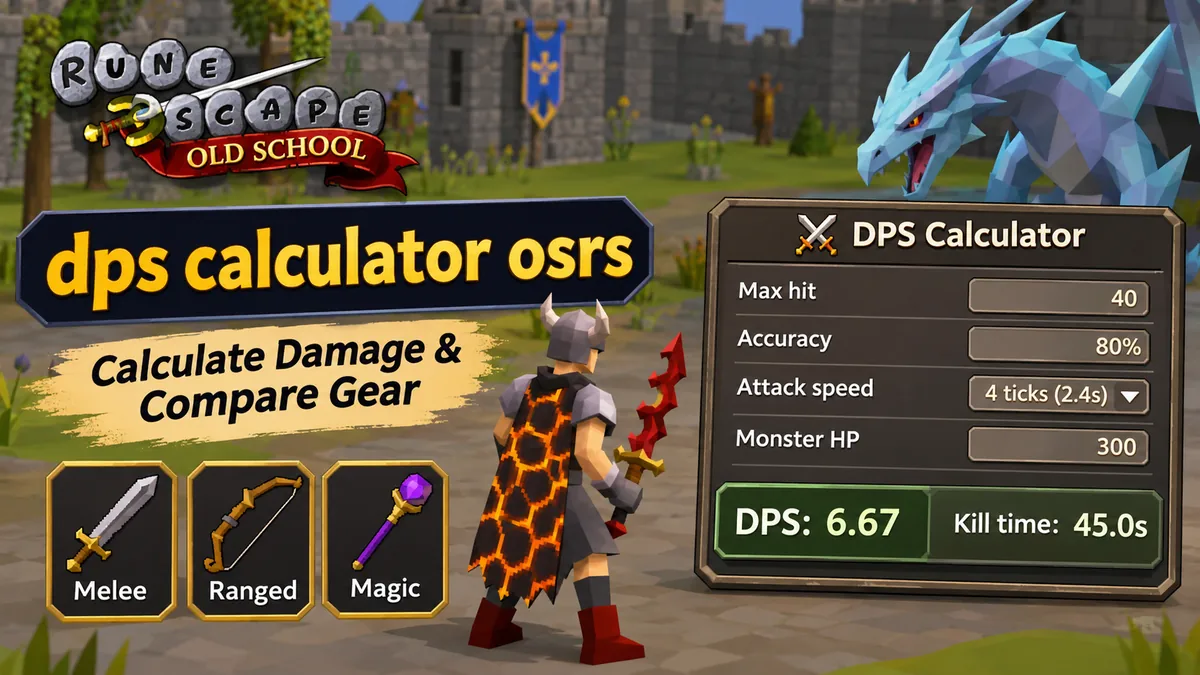
OSRS DPS calculation example
Suppose your character has the following combat statistics:
- Maximum hit: 40
- Accuracy: 80%
- Attack speed: 4 ticks
- Attack interval: 2.4 seconds
The estimated DPS is approximately 6.67.
Against a monster with 300 Hitpoints, a simple continuous-damage estimate gives a kill time of approximately 45 seconds.
Actual combat results may differ because of random damage rolls, movement, overkill damage, and boss mechanics.
OSRS DPS calculator example
Combat DPS calculator
Maximum hit
40
Attack accuracy
80%Attack speed
4 ticks (2.4s)Monster Hitpoints
Damage per second
6.67
Approximate kill time
44.9s
Expected damage per attack
16.02
Damage per minute
400.5
Simplified calculator for ordinary attacks. Excludes special weapon effects, defence reduction and encounter mechanics.
Why weapon attack speed matters
Old School RuneScape operates using game ticks. Each game tick lasts approximately 0.6 seconds under normal conditions.
| Attack speed | Attack interval | Attacks per minute |
|---|---|---|
| 2 ticks | 1.2 seconds | 50 |
| 3 ticks | 1.8 seconds | 33.33 |
| 4 ticks | 2.4 seconds | 25 |
| 5 ticks | 3 seconds | 20 |
| 6 ticks | 3.6 seconds | 16.67 |
| 7 ticks | 4.2 seconds | 14.29 |
Faster weapons can deliver considerably more damage over time, even when their maximum hits are lower.
Attack speed versus damage output
Illustrative comparison assuming 80% accuracy
Weapon A · Max hit 30 · 3 ticks
6.68 DPS
Weapon B · Max hit 40 · 4 ticks
6.67 DPS
Weapon C · Max hit 45 · 5 ticks
6.01 DPS
Weapon D · Max hit 50 · 6 ticks
5.56 DPS
This explains why an Abyssal whip can outperform slower, harder-hitting weapons against certain enemies.
How to Use a dps calculator osrs
Using a combat calculator requires accurate character information and the correct target settings.
Step 1: Enter your combat statistics
Enter your current combat skill levels, including Attack, Strength, Defence, Ranged, Magic, Prayer, and Hitpoints.
Some calculators allow you to import character levels directly through the OSRS Hiscores using your RuneScape username.
Step 2: Select your equipment
Choose your complete equipment setup, including your weapon, helmet, body armour, leg armour, cape, amulet, gloves, boots, ring, ammunition, and shield.
Equipment bonuses affect both damage and accuracy. Changing a single item can sometimes increase your maximum hit.
Step 3: Configure prayers and potions
Select the combat boosts you intend to use during the encounter.
Common options include Piety, Rigour, Augury, Super combat potions, Ranging potions, and Overloads where available.
Make sure your selected boosts are realistic for the activity you are planning.
Step 4: Select your target monster
Search for the boss or monster you intend to fight.
Popular targets include Vorkath, Zulrah, General Graardor, Nex, the Phantom Muspah, and Abyssal demons.
Advanced calculators automatically load enemy Hitpoints, defensive bonuses, combat levels, and relevant monster attributes.
Step 5: Compare equipment loadouts
Create multiple equipment setups and compare their DPS, accuracy, maximum hits, and estimated kill times.
Keep your character levels, prayers, potions, and target settings consistent to ensure a fair comparison.
Melee, Ranged and Magic DPS Comparison
Each combat style operates differently. The strongest equipment setup depends heavily on the enemy’s defensive statistics and special weaknesses.
OSRS Skeletal Wyverns Guide 2023 – VirtGold
MeleeStab, slash and crush
Buy Twisted Bow Item – OSRS Services | KBoosting.com
RangedBows and projectiles
Tumeken’s shadow (uncharged) – Live OSRS GE Price
MagicSpells and powered staves
Melee DPS calculator
Melee damage depends on Attack, Strength, equipment attack bonuses, melee strength bonuses, and attack style.
OSRS melee attacks are divided into stab, slash, and crush.
Popular melee weapons include the Dragon scimitar, Abyssal whip, Ghrazi rapier, Osmumten’s fang, Dragon hunter lance, and Scythe of Vitur.
Osmumten’s fang has specialised accuracy and damage mechanics that make it effective against many high-defence opponents. The Dragon hunter lance receives additional benefits against dragons.
Ranged DPS calculator
Ranged damage depends on Ranged level, equipment bonuses, ammunition, attack speed, and enemy defence.
Popular ranged weapons include the Toxic blowpipe, Twisted bow, Bow of Faerdhinen, Dragon hunter crossbow, and Zaryte crossbow.
The Toxic blowpipe benefits from rapid attacks, while the Twisted bow scales its performance based on relevant enemy Magic statistics.
The Bow of Faerdhinen becomes particularly effective when combined with Crystal armour.
Modern calculators should also account for light, standard, and heavy ranged defence categories when evaluating NPCs.
Magic DPS calculator
Magic damage involves spell strength, Magic level, equipment bonuses, enemy Magic defence, and attack frequency.
Common magic weapons include the Trident of the seas, Trident of the swamp, Sanguinesti staff, and Tumeken’s shadow.
Powered staves often attack every four ticks, whereas many conventional combat spells use five-tick attack intervals.
Elemental weaknesses can also influence spell effectiveness, making certain elemental spells stronger against susceptible monsters.
Best OSRS DPS Calculators
Several browser-based calculators allow players to analyse combat performance without manually calculating equipment statistics.
OSRS Suqah Slayer Task Guide: Gear & Cannon Strategy
OSRS Wiki DPS Calculator
Detailed equipment comparisons, monster settings, accuracy calculations, and damage distribution graphs.OSRS Wiki CalculatorBest for detailed combat analysis
Introducing GearScape: a new dps and best-in-slot calculator for Oldschool Runescape. : r/2007scape
GearScape
Compare equipment combinations and identify suitable setups according to your character statistics, budget, and target.GearScapeBest for budget-based gear selection
OSRS Firecape Guide: TzHaar Fight Caves Done Easy
OSRS Portal
Supports numerous specialised weapons, equipment set effects, and standard combat calculations.OSRS Portal CalculatorUseful for alternative calculations
OSRS Chinning Guide: Gear + Strategy For MM1 & MM2
RuneTools
Offers multiple equipment and monster comparisons alongside special attack modelling and defence reduction analysis.RuneTools DPS CalculatorUseful for advanced encounter comparisons
Many OSRS calculators build upon combat mathematics developed through Bitterkoekje’s DPS spreadsheet and equipment data maintained by the OSRS Wiki community. GitHub+3
Factors That Affect Damage Per Second in OSRS
Several combat mechanics influence damage output beyond basic weapon statistics.
Combat accuracy and monster defence
Accuracy determines how frequently an attack successfully lands.
A monster with high slash defence might be considerably easier to defeat using a stab or crush weapon. Magic accuracy against NPCs generally depends on their Magic level and Magic defence bonuses.
Selecting an appropriate combat style can produce a larger improvement than purchasing expensive equipment.
Equipment set bonuses
Certain equipment combinations provide additional combat benefits.
| Equipment | Main effect |
|---|---|
| Slayer helmet (i) | Increased damage and accuracy during eligible Slayer tasks |
| Void Knight equipment | Combat-style-specific set bonuses |
| Crystal armour | Improves compatible crystal bow performance |
| Salve amulet (ei) | Combat bonuses against eligible undead enemies |
| Inquisitor’s armour | Enhances crush-based combat |
| Dharok’s equipment | Increased damage at lower Hitpoints |
| Obsidian equipment | Improves eligible Obsidian weapon setups |
The Slayer helmet and Salve amulet bonuses do not stack. Calculators should apply the appropriate effect rather than combining both bonuses.
Special attacks and defence reduction
Weapons such as the Dragon warhammer, Bandos godsword, and Elder maul can reduce enemy Defence.
These reductions may improve subsequent attack accuracy and overall damage output.
Other weapons provide powerful burst damage through special attacks. The value of these attacks depends on special attack energy, accuracy, enemy mechanics, and encounter duration.
Monster size and weapon-specific effects
The Scythe of Vitur can deliver multiple damage rolls against larger enemies, making monster size an essential calculation input.
Similarly, enchanted ruby bolts, dragonbane weapons, demonbane weapons such as Arclight and Emberlight, and other specialised equipment require calculations beyond the standard DPS formula.
Using DPS Calculations for Bossing and Raids
Boss encounters frequently involve mechanics that affect real combat performance.
| Boss or activity | Important DPS considerations |
|---|---|
| Vorkath | Dragonbane bonuses and attack styles |
| Zulrah | Phase changes and damage restrictions |
| Nex | Accuracy, team size and movement |
| General Graardor | Defence reduction and equipment accuracy |
| Chambers of Xeric | Raid-specific boosts and monster scaling |
| Tombs of Amascut | Invocation level and path scaling |
| Theatre of Blood | Boss phases and team coordination |
When calculating raid damage, ensure the selected settings reflect your actual raid difficulty, team size, and available combat boosts.
Theoretical DPS vs. actual DPS
Theoretical DPS assumes attacks occur under the conditions configured in the calculator.
Actual DPS can be lower because of movement, eating food, switching equipment, avoiding mechanics, waiting through invulnerability phases, and missed attack opportunities.
For example, an equipment setup capable of delivering 10 DPS with uninterrupted attacks may deliver approximately 7.5 DPS if the player can attack during only 75% of the encounter.
This difference is particularly relevant when choosing between weapons with different attack speeds and ranges.
What Is a Good DPS in OSRS?
There is no universal DPS number that defines a good combat setup.
A beginner training against low-level monsters and an endgame player completing high-invocation raids face completely different combat conditions.
A more useful measurement is the percentage improvement between two equipment setups against the same target.
For example:
| Equipment setup | DPS | Improvement |
|---|---|---|
| Current equipment | 5.0 | Baseline |
| Upgrade A | 5.5 | 10% |
| Upgrade B | 6.0 | 20% |
| Upgrade C | 7.0 | 40% |
An affordable upgrade delivering a 20% improvement may offer better value than an expensive upgrade delivering only 2%.
Common DPS calculation mistakes
Incorrect settings can produce misleading results. Avoid these common mistakes:
- Selecting the wrong monster variant or boss phase.
- Forgetting to enable applicable Slayer task bonuses.
- Selecting prayers or potions you cannot use.
- Using incorrect ammunition or attack styles.
- Ignoring enemy elemental weaknesses.
- Assuming maximum hit determines overall performance.
- Overlooking weapon-specific mechanics.
- Comparing equipment under different combat conditions.
- Using outdated calculators after game balance updates.
Conclusion
A dps calculator osrs is a valuable resource for understanding combat mechanics, comparing equipment, and improving damage efficiency in Old School RuneScape.
By considering accuracy, maximum hit, weapon attack speed, enemy defence, and equipment effects together, players can make better decisions about combat upgrades without relying exclusively on equipment prices or recommendations.
Start by calculating the performance of your existing equipment against your preferred monster. Compare potential upgrades individually, maintain consistent combat conditions, and consider practical encounter mechanics before deciding which setup performs best.
