

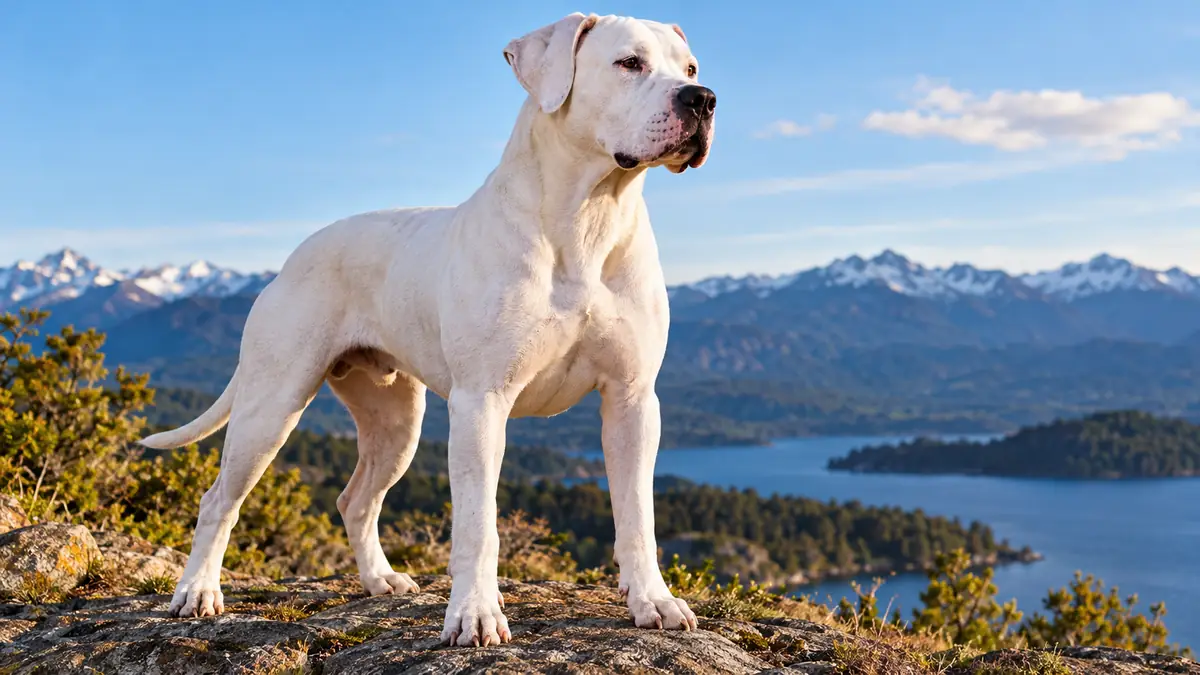
The dogo argentino is a powerful, athletic dog with a striking white coat and a history rooted in big-game hunting. Its muscular appearance can be intimidating, but understanding the breed requires looking beyond physical strength to its temperament, intelligence, loyalty, and demanding care needs.
Originally developed in Argentina, this breed combines remarkable endurance with a strong attachment to its human family. However, its hunting instincts, physical capabilities, and need for structured training mean it is not suitable for every household.
The dogo argentino is a large, muscular working dog developed in Argentina for hunting wild boar and other big game. Recognized for its short white coat, courage, athleticism, and loyalty, the breed typically weighs 80–100 pounds and lives approximately 9–15 years. It requires consistent training, early socialization, substantial exercise, and responsible ownership.
What Is a dogo argentino?


11
The Dogo Argentino, sometimes called the Argentine Dogo or Argentine Mastiff, is a large working breed developed specifically for physically demanding hunting activities.
Unlike many modern companion breeds, it was created to track, pursue, and hold dangerous game, particularly wild boar and puma. This background explains its combination of stamina, muscular strength, determination, and a powerful prey drive.
Although hunting shaped its development, the breed can also serve as a loyal household companion when its physical and behavioral needs are properly managed.
Dogo Argentino breed overview
| Characteristic | Details |
|---|---|
| Origin | Argentina |
| Breed group | Working (AKC) |
| Original purpose | Big-game hunting |
| Height | Approximately 24–27 inches |
| Weight | Approximately 80–100 pounds |
| Life expectancy | Approximately 9–15 years |
| Coat | Short, smooth, predominantly white |
| Shedding | Moderate |
| Temperament | Loyal, courageous, confident, protective |
| Exercise needs | High |
| Grooming needs | Low to moderate |
| Training difficulty | Moderate to challenging |
| Best suited for | Experienced, active owners |
Individual dogs vary, and characteristics such as aggression, sociability, and trainability cannot be predicted solely from breed identity.
History and Origin of the dogo argentino
The history of the breed begins in Córdoba, Argentina, during the early twentieth century.
Dr. Antonio Nores Martínez, working alongside his brother Agustín Nores Martínez, sought to develop a dog that could handle Argentina’s challenging hunting environments while maintaining the physical stamina necessary for long pursuits.
How the breed was developed
The foundation of the breed was the now-extinct Fighting Dog of Córdoba, which was crossed with several established breeds to introduce particular physical and behavioral characteristics.
Breeds commonly identified in its development include:
- Great Dane, for height and size
- Boxer, for athleticism and working qualities
- Bull Terrier, for determination
- English Bulldog, for strength
- Pointer, for scenting ability
- Irish Wolfhound, for hunting-related characteristics
- Dogue de Bordeaux, for powerful structure
- Pyrenean Mastiff, for size and substance
- Spanish Mastiff, for strength
These historical influences helped produce a dog capable of working in challenging terrain and confronting large prey.
Recognition and international popularity
The Federación Cinológica Argentina recognized the breed in 1964, and the Fédération Cynologique Internationale (FCI) granted recognition in 1973.
The American Kennel Club (AKC) officially recognized the Dogo Argentino in 2020, placing it in the Working Group.
Today, the breed is known internationally, although ownership is restricted or regulated in certain jurisdictions.
Dogo Argentino Size, Weight, and Physical Appearance
The dogo argentino has a distinctive appearance: a muscular body, broad head, strong neck, and short white coat.
Its physical structure reflects its original purpose. The breed was developed for endurance and functional strength rather than simply maximum body weight.
How big does a Dogo Argentino get?
Adult males are generally larger and heavier than females.
| Measurement | Male | Female |
|---|---|---|
| Height | 24–27 inches | 24–26 inches |
| Typical weight | 88–100 pounds | 80–95 pounds |
| Body structure | Muscular, substantial | Athletic, muscular |
| Physical maturity | Around 18–24 months or later | Around 18–24 months or later |
These are approximate ranges rather than strict limits. Breed standards differ slightly between organizations, and healthy adult size depends on genetics, nutrition, and development.
Why are Dogo Argentinos white?
The predominantly white coat is one of the breed’s defining features.
Historically, its light coloring helped hunters distinguish the dog from dark-colored game and surrounding vegetation.
The coat is short, smooth, and close-fitting, making routine grooming relatively straightforward.
Some breed standards permit a small dark patch around one eye, provided it stays within specified limits. A completely white coat is also common.
Are Dogo Argentinos born with cropped ears?
No. Puppies are born with natural ears that hang alongside the head.
Some dogs have cropped ears, but ear cropping is a human-performed surgical procedure, not a natural breed characteristic. It is restricted or prohibited in various countries and has no established routine health benefit.
Natural ears are entirely compatible with a healthy, functional dog.
Dogo Argentino Temperament and Personality

The dogo argentino is often described as confident, loyal, alert, and courageous. It typically forms close relationships with familiar people and can be affectionate within its household.
However, this is a physically capable breed with a strong hunting background. Temperament must be considered alongside training, socialization, genetics, and individual behavior.
Are Dogo Argentinos aggressive?
Dogo Argentinos are not automatically aggressive because of their breed, but some individuals may display aggression toward unfamiliar dogs, other animals, or people.
Risk factors can include inadequate socialization, fear, poor management, unsuitable training methods, and individual temperament.
Their size and strength increase the potential consequences of an aggressive incident.
Responsible ownership requires recognizing early signs of discomfort, avoiding situations the dog cannot handle safely, and seeking qualified behavioral assistance when necessary.
Are Dogo Argentinos good family dogs?
A well-socialized Dogo Argentino may become a devoted family companion.
However, families must consider several practical factors:
- The dog’s strength can make accidental collisions hazardous for small children.
- Rough play may lead to overexcitement.
- Children must never be left unsupervised with a dog, regardless of breed.
- The dog needs predictable routines, adequate exercise, and clear boundaries.
- Adult supervision is essential during interactions with visitors and unfamiliar animals.
Families with young children or limited experience handling powerful dogs should carefully assess whether they can meet these responsibilities.
Can Dogo Argentinos live with other pets?
Some can coexist peacefully with other household animals, particularly when introduced carefully and raised with appropriate social experiences.
Nevertheless, the breed’s prey drive can create challenges around cats, rabbits, and smaller pets.
Compatibility should never be assumed.
Introductions should be gradual, supervised, and supported by secure barriers where necessary. Even dogs that appear comfortable together may require separation when unsupervised.
Do Dogo Argentinos bark a lot?
They are not generally characterized as constant barkers, but individuals may vocalize when alerting, excited, frustrated, or responding to environmental stimuli.
Excessive barking can indicate boredom, stress, inadequate exercise, or insufficient enrichment.
Identifying the underlying cause is more effective than punishing the barking itself.
Training a dogo argentino: What Actually Works?
Training is one of the most important responsibilities of owning a dogo argentino. Intelligence and physical confidence make the breed capable of learning complex behaviors, but its independence and strength demand patience and consistency.
A successful training program should emphasize cooperation, impulse control, and reliable responses rather than intimidation or physical punishment.
Start socialization during puppyhood
The early socialization period is especially important for helping puppies become comfortable with unfamiliar environments.
Appropriate experiences may include meeting calm people, observing other dogs at safe distances, hearing everyday noises, and visiting different locations.
Socialization does not mean forcing a puppy to interact with everyone. The goal is to build positive associations while respecting the dog’s comfort level.
Puppies should receive safe, controlled social experiences while following veterinary guidance on vaccinations and infectious disease risks.
Essential obedience commands
The following skills are especially valuable for a large, powerful dog:
- Recall: Returning promptly when called.
- Sit and stay: Developing patience and impulse control.
- Loose-leash walking: Preventing pulling during walks.
- Leave it: Disengaging from potentially dangerous objects or animals.
- Drop it: Releasing objects safely.
- Place: Settling on a designated mat or bed.
- Wait: Remaining controlled around doors, gates, and food.
Use rewards such as treats, praise, and play to reinforce desired behaviors.
Short, frequent training sessions are usually more productive than long sessions that create frustration.
Avoid dominance-based training
Harsh corrections, intimidation, and punishment-based methods can increase fear, stress, or defensive responses.
A dog does not need to be frightened into obedience.
Reward-based training, predictable boundaries, and careful management are safer foundations for long-term behavior.
For persistent aggression, severe reactivity, or dangerous behavior, seek help from a qualified veterinary behaviorist or experienced reward-based behavior professional.
Dogo Argentino Exercise and Mental Stimulation

The dogo argentino was developed for demanding physical work, making regular activity essential to its physical and emotional well-being.
A brief walk around the block is unlikely to satisfy the needs of many healthy adult dogs.
How much exercise does a Dogo Argentino need?
Many healthy adults benefit from approximately 60–120 minutes of daily physical activity, adjusted to their age, fitness, health, and individual temperament.
This is a practical planning range, not a medically established requirement for every dog.
Suitable activities include brisk walking, controlled hiking, scent games, structured retrieving, and obedience exercises.
High-impact exercise should be limited in growing puppies because their developing joints are more vulnerable to repetitive stress.
Best activities for this breed
| Activity | Main benefit | Important consideration |
|---|---|---|
| Brisk walking | Cardiovascular fitness | Use secure leash equipment |
| Hiking | Endurance and exploration | Avoid extreme heat |
| Scent work | Mental enrichment | Provide controlled search areas |
| Obedience training | Focus and impulse control | Keep sessions positive |
| Puzzle feeders | Problem-solving | Match difficulty to the dog |
| Controlled fetch | Physical engagement | Avoid excessive jumping |
| Tracking games | Natural scenting behavior | Use safe, enclosed locations |
A secure fenced area is particularly valuable because hunting instincts may cause sudden chasing behavior.
Even a well-trained dog should not be assumed reliable off-leash around wildlife or unfamiliar animals.
Can a Dogo Argentino live in an apartment?
Apartment living is possible for some individuals, but it requires substantial commitment.
The more important factors are the dog’s daily exercise, mental enrichment, noise tolerance, behavior around neighbors, and access to suitable outdoor spaces.
A large yard alone is not a substitute for training or meaningful interaction.
Dogo Argentino Health Problems and Lifespan
The dogo argentino is generally athletic and robust, but it can develop inherited and acquired health conditions.
Routine veterinary examinations, appropriate nutrition, weight management, and health screening can help identify problems earlier.
How long do Dogo Argentinos live?
A commonly reported lifespan is approximately 9–15 years, although individual longevity varies.
Genetics, body condition, preventive veterinary care, environment, and underlying disease all influence lifespan.
A longer life cannot be guaranteed through diet or exercise alone.
Common health concerns
| Condition | What owners should know |
|---|---|
| Congenital deafness | Can affect one or both ears |
| Hip dysplasia | Abnormal hip development that may cause pain and mobility problems |
| Elbow dysplasia | Joint abnormalities that can contribute to lameness |
| Cardiac disease | Certain heart abnormalities require veterinary evaluation |
| Skin allergies | May cause itching, redness, or recurring infections |
| Hypothyroidism | Can contribute to lethargy, coat changes, and weight gain |
| Gastric dilatation-volvulus | A potentially fatal emergency involving stomach distension and twisting |
Not every condition occurs at the same frequency, and being listed as a possible concern does not mean an individual dog will develop it.
Why is deafness a concern in Dogo Argentinos?
Congenital sensorineural deafness is a recognized health issue in the breed.
It may affect one ear, known as unilateral deafness, or both ears, known as bilateral deafness.
Dogs with hearing loss may still respond to visual signals, vibrations, and consistent routines. However, owners need to adapt training and safety management.
The Brainstem Auditory Evoked Response (BAER) test provides an objective assessment of hearing function and can identify hearing loss that may not be obvious through everyday observation.
The Dogo Argentino Club of America recommends BAER testing as part of its breed health-screening program.
Recommended health testing
The Dogo Argentino Club of America’s Canine Health Information Center (CHIC) program includes screening for congenital deafness, hip dysplasia, and cardiac conditions, along with an additional elective evaluation.
Depending on the screening protocol, evaluations may involve the Orthopedic Foundation for Animals (OFA), PennHIP, veterinary cardiologists, ophthalmologists, or approved laboratories.
A CHIC number indicates that the required screening information has been submitted and made available; it does not necessarily mean every result was normal.

Dogo Argentino Club
+1
Warning signs that require veterinary attention
Owners should arrange veterinary evaluation for persistent limping, unexplained fatigue, repeated ear or skin problems, or noticeable changes in appetite and behavior.
An emergency veterinary visit is necessary for symptoms such as a suddenly swollen abdomen, repeated unproductive retching, collapse, or severe difficulty breathing.
These signs can indicate life-threatening conditions and should not be managed through home remedies.
Feeding and Nutrition for a Dogo Argentino
Nutrition supports muscle development, healthy joints, immune function, and overall well-being.
Because the dogo argentino is a large, active breed, its food should be selected according to life stage, body condition, and individual activity.
What should a Dogo Argentino eat?
A complete and balanced diet formulated for the dog’s life stage is the foundation of appropriate feeding.
For puppies expected to reach a large adult size, a food formulated for large-breed growth can help support controlled development.
Adult dogs may require different calorie amounts depending on activity, metabolism, reproductive status, and health.
Useful nutritional considerations include:
- Adequate high-quality protein
- Appropriate dietary fat
- Balanced calcium and phosphorus, especially during growth
- Essential fatty acids
- Vitamins and minerals
- Suitable daily calorie intake
Protein percentage alone does not determine whether a food is appropriate.
How much food should a Dogo Argentino eat?
There is no single correct number of cups for every dog.
Two adults of similar weight may have very different calorie requirements because one is highly active while the other spends more time resting.
Start with the feeding guidance for the chosen complete diet, then adjust with veterinary advice according to weight and body condition.
An ideal body condition generally allows the ribs to be felt without excessive fat covering, with a visible waist when viewed from above.
Feeding practices and bloat prevention
Large, deep-chested dogs can be vulnerable to gastric dilatation-volvulus (GDV).
Dividing daily food into measured meals, avoiding rapid consumption, and discussing individual risk factors with a veterinarian are sensible management steps.
No feeding routine completely prevents GDV. For higher-risk dogs, veterinarians may discuss preventive gastropexy, a procedure that reduces the risk of stomach twisting but does not prevent all stomach distension.
Grooming and Coat Care
The dogo argentino has relatively straightforward grooming needs compared with long-haired breeds.
Its short white coat does not require frequent trimming, but routine maintenance still matters.
Do Dogo Argentinos shed?
Yes. They shed throughout the year, with the amount varying between individuals and environments.
Weekly brushing with a rubber grooming mitt or soft brush can remove loose hair and help maintain coat condition.
Bathing and skin care
Bathing every several weeks or when necessary is generally sufficient for a healthy dog.
Use a gentle shampoo formulated for dogs, and avoid excessive bathing that may irritate the skin.
Because the coat is short and lightly colored, redness, rashes, and other skin changes may be relatively easy to notice.
Dogs with recurrent itching, hair loss, or skin infections should receive veterinary assessment rather than repeated use of over-the-counter products.
Ear, nail, and dental care
Natural hanging ears should be checked regularly for discharge, unpleasant odor, or irritation.
Nails need trimming when they become excessively long, and teeth should ideally be brushed daily using dog-safe toothpaste.
Routine dental care helps reduce plaque buildup and periodontal disease.
Dogo Argentino vs Pit Bull, Cane Corso, and Other Breeds
The dogo argentino is sometimes confused with other muscular breeds, particularly the American Pit Bull Terrier, Cane Corso, and American Bulldog.
Although these dogs can share physical characteristics, they differ in ancestry, typical size, and historical working roles.
| Feature | Dogo Argentino | American Pit Bull Terrier | Cane Corso |
|---|---|---|---|
| Origin | Argentina | United States | Italy |
| Typical build | Large, athletic, muscular | Medium, athletic | Large, substantial |
| Historical role | Big-game hunting | Bull-and-terrier working ancestry | Farm guarding and protection |
| Coat | Short, predominantly white | Short, various colors | Short, several recognized colors |
| Typical temperament | Confident, determined | Energetic, people-oriented | Alert, protective |
| Training needs | High | High | High |
| Prey drive | Often strong | Variable, sometimes strong | Variable |
These are broad breed descriptions, not reliable predictions of an individual dog’s behavior.
Dogo Argentino vs Cane Corso: Which is bigger?
The Cane Corso may be heavier, particularly in males with substantial builds.
However, the Dogo Argentino is also a large dog and is typically bred for athletic endurance rather than extreme bulk.
The two breeds can overlap considerably in height and weight.
Is a Dogo Argentino stronger than a Pit Bull?
There is no universally accepted scientific measure that determines which breed is categorically stronger.
The Dogo Argentino generally has a larger body and greater overall mass than the American Pit Bull Terrier.
However, strength can refer to pulling ability, muscular endurance, bite performance, or other characteristics.
Claims that one breed will always defeat another in a fight are unsupported and should not be used to evaluate dogs.
How strong is a Dogo Argentino’s bite?
The breed has powerful jaws suited to its historical hunting purpose.
However, widely circulated bite-force figures, often expressed in pounds per square inch (PSI), should be treated cautiously.
Reliable, standardized breed-specific measurements are limited, and bite force varies with individual anatomy, motivation, measurement method, and testing conditions.
A single internet ranking cannot accurately establish the biting ability of every dog within a breed.
Is the dogo argentino Dangerous or Banned?
The dogo argentino’s strength and hunting history have contributed to legal restrictions in some countries.
These regulations vary significantly between jurisdictions and may include prohibitions, licensing requirements, or special handling conditions.
Why is the breed restricted in some places?
Breed-specific legislation is generally intended to reduce perceived risks associated with particular types of dogs.
Supporters argue that restrictions may help address risks involving powerful animals.
Critics point out that breed identification can be unreliable and that individual behavior, owner responsibility, socialization, and enforcement also affect public safety.
The effectiveness of breed-specific legislation remains debated.
Countries with restrictions
The breed is subject to restrictions or prohibitions in some jurisdictions, including the United Kingdom and Australia.
In the United Kingdom, Dogo Argentinos are among the dog types covered by dangerous-dog legislation, with limited exemptions subject to strict legal conditions.
Australia generally restricts their importation and has additional rules governing restricted breeds.
Rules in other countries, states, provinces, and municipalities may differ.
Anyone responsible for a Dogo Argentino should verify current local legislation through official government sources rather than relying on general online breed lists.
Dogo Argentino Puppies: Growth and Development

Dogo Argentino puppies grow rapidly during their first year, but physical maturity takes longer than their early increase in height might suggest.
Large-breed development requires attention to nutrition, joint health, behavior, and appropriate exercise.
Typical development stages
| Age | Development focus |
|---|---|
| 8–12 weeks | Gentle socialization, routines, handling |
| 3–6 months | Basic obedience, leash introduction, confidence building |
| 6–12 months | Adolescent behavior, impulse control, continued socialization |
| 12–18 months | Increasing physical maturity, ongoing training |
| 18–24+ months | Continued muscular and behavioral maturation |
These stages are approximate. Individual puppies develop at different rates.
Common puppy training mistakes
One common mistake is allowing a young puppy to practice behaviors that become difficult to manage once it weighs 90 pounds.
Jumping on people, pulling toward other dogs, and ignoring recall may appear harmless in a small puppy but become serious safety concerns in adulthood.
Another mistake is assuming that puppy socialization alone guarantees lifelong friendliness.
Social experiences and training should continue through adolescence and adulthood.
Exercise precautions for growing dogs
Puppies need activity, but repetitive forced running, prolonged high-impact exercise, and excessive jumping should be avoided while their musculoskeletal systems are developing.
Short walks, gentle play, sniffing opportunities, and age-appropriate training are generally more suitable.
A veterinarian can advise when more strenuous activities are appropriate.
Is a dogo argentino Right for First-Time Dog Owners?
The dogo argentino is usually better suited to people who already understand canine behavior and have experience handling large, powerful dogs.
This does not mean that every first-time owner will struggle or that every experienced owner will succeed.
The key consideration is whether the household can provide appropriate training, exercise, supervision, and safe management consistently.
Advantages of the breed
- Strong attachment to familiar family members
- Athletic ability and physical endurance
- Intelligence and capacity for advanced training
- Relatively simple coat maintenance
- Confidence and alertness
- Enjoyment of structured activities
Challenges to consider
- High exercise and enrichment requirements
- Powerful prey drive
- Potential difficulty with unfamiliar animals
- Need for consistent training throughout life
- Significant strength that requires responsible handling
- Possible legal and housing restrictions
- Health-screening considerations, particularly congenital deafness
What kind of home is most suitable?
An ideal environment offers secure boundaries, predictable routines, opportunities for exercise, and owners willing to invest time in training.
A securely fenced outdoor area can be useful, although it does not replace supervised activity.
Households with multiple small animals may need additional management arrangements.
The breed also needs regular interaction with people. Keeping a Dogo Argentino isolated outdoors is not a suitable substitute for companionship, exercise, or behavioral care.
Understanding Responsible Dogo Argentino Ownership
Responsible ownership begins with understanding the breed’s capabilities and limitations rather than focusing exclusively on appearance.
The Dogo Argentino’s reputation as a strong dog should not encourage aggressive training, confrontation, or attempts to demonstrate physical dominance.
A well-managed dog should be able to relax, respond to familiar cues, and move through everyday environments without unnecessary conflict.
Practical responsibilities include maintaining secure fencing, using appropriate leash equipment, supervising interactions with children and animals, and keeping veterinary care current.
Owners should also learn canine body language.
Signs such as freezing, hard staring, stiff posture, repeated avoidance, growling, and sudden changes in behavior may indicate discomfort or escalating tension.
Growling should be treated as meaningful communication, not simply punished or suppressed.
When warning signals appear, increasing distance and seeking professional guidance can prevent more serious incidents.
For some dogs, positive muzzle training is another valuable safety skill. A properly fitted basket muzzle allows panting and drinking while providing an additional layer of management in appropriate situations.
Final Thoughts on the dogo argentino
The dogo argentino is a remarkable working breed whose defining characteristics include strength, athleticism, courage, and loyalty.
Its history as a big-game hunter explains much of its physical structure and behavioral tendencies, but breed identity alone does not determine an individual dog’s temperament.
With appropriate socialization, reward-based training, regular exercise, veterinary care, and responsible management, many Dogo Argentinos can become devoted companions.
The most important consideration is not simply whether the breed looks impressive. It is whether an owner can consistently meet the needs of a powerful, intelligent, active dog throughout its life.
