

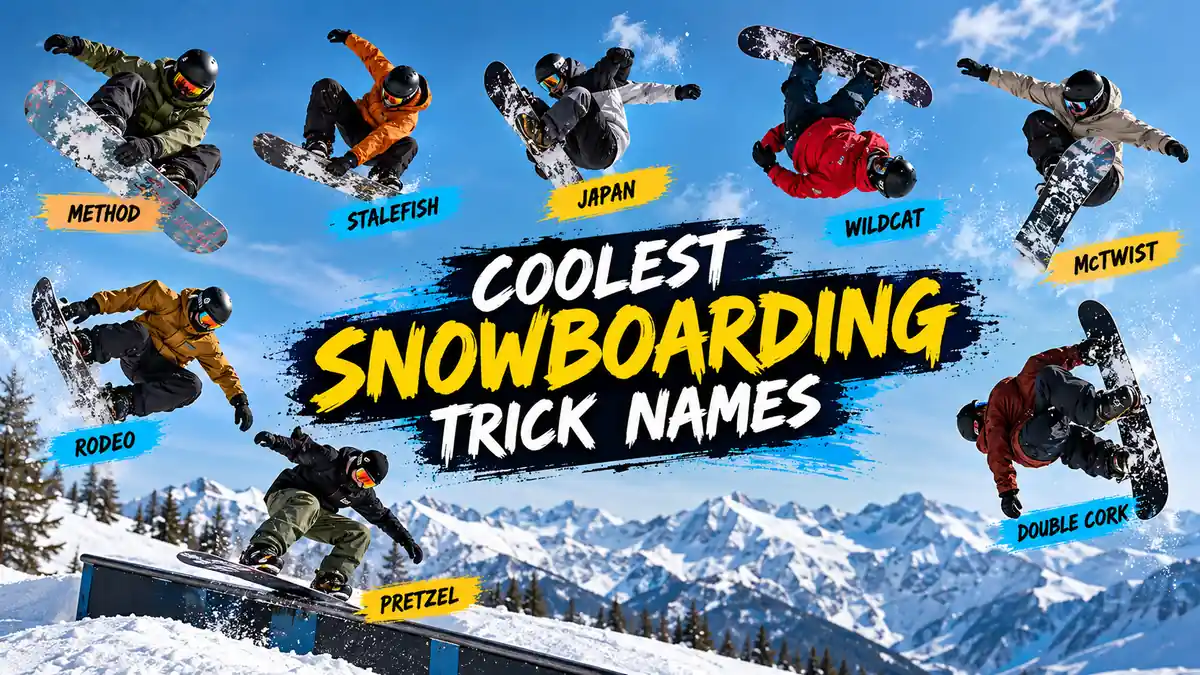
Snowboarding has some of the most colorful vocabulary in action sports. A rider can throw a Wildcat, tweak a Stalefish, spin a McTwist, lock into a Pretzel, or launch a triple cork—and every one of those names describes a different movement or piece of freestyle history.
The coolest snowboarding trick names include Method, Stalefish, Japan, Roast Beef, Wildcat, Tamedog, Rodeo, McTwist, Haakon Flip, Crippler, Pretzel, and Double Cork. Some describe the rider’s movement, others come from skateboarding culture or influential athletes, while modern names precisely describe stance, rotation, inversion, and grabs. NBC Olympics
Once you understand how snowboard trick names work, phrases such as “switch backside triple cork 1440 Japan” stop sounding like another language. They become compact descriptions of exactly what happened in the air.
Coolest Snowboarding Trick Names at a Glance
Here are some names you are likely to hear in terrain parks, halfpipes, big-air contests, snowboard videos, and conversations between freestyle riders.
| Trick Name | Type | What It Generally Describes |
|---|---|---|
| Method | Grab | Heel-edge grab with a strong stylish tweak |
| Stalefish | Grab | Rear hand grabbing the heel edge |
| Japan | Grab | Front-hand grab with the board strongly tweaked |
| Roast Beef | Grab | Rear hand reaching between the legs to the heel edge |
| Canadian Bacon | Grab | Rear hand reaching behind the rear leg to the toe edge |
| Truck Driver | Double grab | Indy and Melon held simultaneously |
| Wildcat | Flip | Cartwheel-like backflip |
| Tamedog | Flip | Forward-flipping counterpart to the Wildcat |
| Rodeo | Inverted spin | Flipping, spinning off-axis rotation |
| McTwist | Halfpipe invert | Inverted 540-style halfpipe maneuver |
| Haakon Flip | Halfpipe invert | Switch inverted aerial with rotation |
| Crippler | Halfpipe flip | Backflip on the frontside wall |
| Cork | Off-axis spin | Rotation tilted away from a flat spin |
| Double Cork | Off-axis spin | Two distinct off-axis inversions |
| Pretzel | Rail trick | Exit rotation opposite the entry rotation |
| Bluntslide | Rail trick | Tweaked slide emphasizing the nose or tail |
The International Ski and Snowboard Federation’s trick terminology includes many of these names, alongside more unusual terms such as Swiss Cheese Air, Tai Pan, Truck Driver, Weddle, Underflip, and Tuck Knee. FIS Ski
Why Do Snowboarding Tricks Have Such Strange Names?
Snowboard terminology grew from several overlapping cultures rather than from one official naming system.
Early freestyle snowboarding borrowed heavily from skateboarding. Halfpipes, grabs, airs, spins, and rail tricks naturally carried some skateboard vocabulary onto snow. As riders developed snowboard-specific movements, new terms emerged.
That produced two broad styles of trick names.
The first is the colorful, old-school vocabulary:
- Stalefish
- Roast Beef
- Canadian Bacon
- Wildcat
- Tamedog
- McTwist
- Pretzel
The second is technical terminology:
- frontside 720
- switch backside 900
- double cork 1080
- backside triple cork 1440
- switch backside triple cork 1620
Modern competition descriptions can combine several components because each part tells judges and viewers something about the maneuver. NBC’s snowboarding glossary, for example, explains trick descriptions through stance, spin direction, number of corks, degrees of rotation, and grab type. NBC Olympics
Think of the name as a sentence compressed into snowboard language.
Grab Names: Where Snowboarding Gets Especially Creative
Grabs are among the easiest trick names to recognize because they describe where and how the rider holds the snowboard while airborne.
The differences can appear small to a newcomer. Changing the grabbing hand, board edge, position of the hand, or body tweak can produce an entirely different trick.
Method
Few snowboard tricks represent style as strongly as the Method.
The rider grabs the heel edge with the front hand and aggressively tweaks the board. The exact visual style varies between riders, and that individuality is part of the Method’s appeal.
The World Snowboard Federation describes the Method as a front-hand heel-edge grab with the board pulled upward in the classic Method position. World Snowboard Federation
Unlike a huge cork rotation, a Method is not impressive because someone counted more spins.
It is impressive because of how it looks.
A beautifully extended Method can sometimes be more memorable than a technically complicated spin.
Stalefish
Despite sounding like something you would avoid at a seafood restaurant, Stalefish is a classic grab.
The rider reaches with the rear hand around the outside of the rear knee and grabs the heel edge between the feet. World Snowboard Federation
It requires enough mobility and board control to make the grab look deliberate rather than rushed.
Indy
The Indy is one of the fundamental grab names.
In snowboarding terminology, the rear hand grabs the toe edge between the bindings. World Snowboard Federation
It is relatively easy to understand visually, making it one of the first grabs many developing freestyle riders learn to identify.
Melon
A Melon uses the front hand to grab the heel edge between the bindings.
Add a strong extension or tweak and a relatively simple grab can become dramatically more stylish.
The distinction between Melon and Method demonstrates an important principle: two tricks may involve similar contact points on the board while body positioning transforms their appearance.
Japan
The Japan is another instantly recognizable freestyle name.
It involves the front hand reaching for the toe-side area while the rider tweaks the board into a distinctive position.
Japan grabs are particularly striking when paired with large airs and rotations.
Roast Beef
Yes, this is genuinely snowboard terminology.
For a Roast Beef, the rear hand reaches between the legs to grab the heel edge. The World Snowboard Federation includes Roastbeef among established snowboard grabs. World Snowboard Federation
It belongs to the wonderfully strange family of food-related boardsport names.
Canadian Bacon
The culinary theme continues.
A Canadian Bacon has the rear hand reaching behind the rear leg to grab the toe edge. World Snowboard Federation
The names Roast Beef and Canadian Bacon are good reminders that freestyle vocabulary grew from rider culture—not from engineers designing a standardized terminology system.
Truck Driver
The Truck Driver sounds unusual until you see the hand position.
It combines an Indy and Melon, putting both hands on the board in a position reminiscent of holding a steering wheel. FIS describes it as both hands grabbing Indy and Melon. FIS Ski
That makes Truck Driver one of the easier strange snowboard names to remember once you understand the visual reference.
Weddle
Older snowboard material may use a different name for the Weddle grab.
Current World Snowboard Federation terminology identifies Weddle as the name for the front-hand toe-edge grab between the bindings and notes that the older terminology was changed to honor Chris Weddle. World Snowboard Federation
That change is useful to know when reading older snowboard guides or watching archived videos.
Wildcat and Tamedog: Two of the Coolest Snowboarding Trick Names
Some names become memorable because they almost sound like characters.
Wildcat and Tamedog are perfect examples.
Wildcat
A Wildcat is essentially a backflip-style maneuver where the board remains aligned with the direction of travel, producing a cartwheel-like appearance from some viewing angles.
It is different from simply throwing an ordinary backward flip with the board positioned across the direction of travel. Dopesnow
The animal-like name fits the movement: fast, aggressive, and visually dramatic.
Tamedog
The Tamedog moves in the opposite flipping direction.
Rather than initiating a backward rotation like a Wildcat, the rider rotates forward, commonly using a forceful nollie-style movement from the nose to initiate the flip. Dopesnow
Wildcat and Tamedog are particularly useful names for understanding snowboard vocabulary because the terms describe recognizable families of movement rather than simply degrees of rotation.
Rodeo: A Name That Looks Like the Trick
A Rodeo combines inversion and rotation.
Rather than remaining upright through a conventional spin, the rider moves off-axis, creating a twisting, flipping aerial.
That chaotic-looking movement makes “Rodeo” feel surprisingly appropriate. The rider appears to be getting thrown around in the air while still maintaining control.
You may encounter terms such as:
- frontside Rodeo
- backside Rodeo
- Rodeo 540
- Rodeo 720
Adding rotation numbers communicates how much rotation accompanies the inverted movement.
This is where snowboard terminology starts shifting from memorable nicknames toward technical descriptions.
McTwist: A Legendary Boardsport Name
The McTwist originated in skateboarding and became part of snowboarding’s halfpipe vocabulary.
The World Snowboard Federation describes a McTwist as an inverted backside 540 performed in the halfpipe. World Snowboard Federation
The name traces back to skateboarder Mike McGill, whose pioneering vert maneuver became one of action sports’ most recognizable trick names.
Snowboarding’s adoption of the McTwist demonstrates how closely the sport’s early freestyle language was connected with skate culture.
Instead of merely saying “an inverted 540,” riders can say McTwist.
The nickname carries history with it.
Haakon Flip
The Haakon Flip is another name closely associated with snowboard history.
NBC’s Olympic glossary defines it as an inverted aerial performed from switch on the frontside wall of a halfpipe, with the rider rotating 720 degrees before returning forward into the pipe. NBC Olympics
Its name references legendary Norwegian snowboarder Terje Haakonsen.
Names like Haakon Flip are particularly interesting because knowing the terminology also introduces riders to important figures in freestyle snowboarding.
Crippler and Double Crippler
The Crippler sounds intimidating—and the maneuver matches the dramatic name.
In halfpipe terminology, a Crippler is a backflip performed on the frontside wall.
Do it with two flips and it becomes a Double Crippler. NBC Olympics
This illustrates another common naming pattern: once a fundamental maneuver exists, adding another flip or inversion can create a double or triple version.
Cork, Double Cork, Triple Cork, and Quad Cork
Modern snowboard trick descriptions often sound less like nicknames and more like geometry.
A cork is an off-axis rotation. Instead of rotating around a completely upright axis, the rider tilts off-axis during the spin.
NBC describes a cork as an off-axis rotation, with double and triple corks involving additional inversions. NBC Olympics
That gives us:
| Term | Basic Meaning |
|---|---|
| Cork | Off-axis rotation |
| Double Cork | Two distinct off-axis inversions |
| Triple Cork | Three |
| Quad Cork | Four |
The terminology becomes much more descriptive when combined with spin numbers.
For example:
backside triple cork 1440
The rider is spinning backside, rotating through 1440 degrees—or four complete rotations—while incorporating three off-axis inversions.
Modern competitive snowboarding needs this precision because simply saying “spin” no longer communicates enough information.
Understanding 180, 360, 540, 720, and Bigger Spins
Numbers are among the most systematic parts of snowboard trick terminology.
Every 180 degrees equals half a rotation.
| Trick Number | Complete Rotations |
|---|---|
| 180 | ½ |
| 360 | 1 |
| 540 | 1½ |
| 720 | 2 |
| 900 | 2½ |
| 1080 | 3 |
| 1260 | 3½ |
| 1440 | 4 |
| 1620 | 4½ |
| 1800 | 5 |
This pattern continues as riders push rotational progression.
Odd multiples of 180—such as 180, 540, 900, and 1260—generally change which foot leads on landing relative to takeoff. Full multiples of 360 bring the rider through complete rotations.
Knowing this simple system makes complicated snowboard commentary much easier to decode.
Frontside, Backside, Switch, and Cab
The rotation number is only part of a trick’s identity.
Direction and stance matter too.
Frontside
Frontside describes one direction of rotation, but its exact interpretation depends on the feature and context.
For aerial spins, body orientation during initiation helps distinguish frontside from backside.
Backside
Backside indicates rotation in the opposite direction.
A backside 720 and frontside 720 contain the same number of degrees but are distinct tricks because the rider initiates the spin differently.
Switch
Switch means riding with the opposite foot forward from the rider’s normal stance.
A regular rider riding in the opposite orientation is switch; the same principle applies to a goofy rider.
Switch approaches increase the number of possible variations because virtually every trick can potentially be performed from a different stance.
Cab
You’ll also hear Cab in freestyle terminology.
The term has roots in the Caballerial from skateboarding and is commonly associated in snowboard language with switch frontside rotations.
Combine these concepts and snowboard trick names become increasingly specific:
switch backside 900
is very different from:
frontside 900
even though both contain 900 degrees of rotation.
How to Decode a Long Snowboarding Trick Name
Consider this intimidating example:
Switch backside triple cork 1440 Japan
Instead of trying to understand the whole phrase at once, break it into five pieces.
1. Switch
The rider takes off in the opposite stance from their natural riding stance.
2. Backside
This identifies the direction of rotation.
3. Triple Cork
The aerial contains three off-axis inversions.
4. 1440
The rider completes four full rotations.
5. Japan
The rider incorporates a Japan grab.
NBC uses the same general naming structure when explaining advanced Olympic snowboard tricks: stance, rotation direction, cork count, rotation degrees, and grab can all become parts of one description. NBC Olympics
Once you know that formula, even enormous modern trick names become surprisingly logical.
Cool Rail and Jib Trick Names
Not all of the coolest snowboarding trick names happen high above a jump.
Rails and boxes have an entire vocabulary of their own.
50-50
A 50-50 is one of the fundamental jib tricks.
The snowboard stays roughly parallel with the rail or box while sliding along it. World Snowboard Federation
It is a foundational park maneuver and a building block for more technical rail tricks.
Boardslide
In a Boardslide, the board turns perpendicular to the rail, with the feature passing beneath the area between the bindings.
The rider brings the nose over the feature during entry. World Snowboard Federation
Lipslide
A Lipslide looks related to a Boardslide but changes the entry.
Instead of bringing the nose over the rail, the rider brings the tail over it. That seemingly small difference changes both the mechanics and difficulty of the trick. Snowboard Addiction
Bluntslide
A Bluntslide places more emphasis on the nose or tail, with the board dramatically tweaked rather than simply centered over the rail.
FIS and World Snowboard Federation terminology includes Bluntslide among established rail movements. World Snowboard Federation
Nosepress and Tailpress
Presses involve shifting body weight strongly toward one end of the snowboard while sliding a feature.
A Nosepress loads the nose.
A Tailpress loads the tail.
The opposite end of the snowboard lifts, and the quality of the press often depends on balance and how deliberately the rider holds the position.
Pretzel
Pretzel might be the best-named rail trick of them all.
A Pretzel occurs when the rider exits a rail by rotating in the direction opposite to the rotation used to enter the feature. World Snowboard Federation
That reversal creates the twisted feeling behind the name.
Ollies, Nollies, Butters, and Presses
Not every snowboard trick requires a huge kicker.
Some of the most useful freestyle movements happen directly on the snow.
Ollie
An Ollie uses the flex and tail of the snowboard to create pop.
The rider loads the tail, releases that stored energy, brings the board into the air, and prepares for landing.
It is one of the most fundamental freestyle skills because controlled pop feeds into jumps, rails, spins, and other tricks.
Nollie
A Nollie reverses the concept.
Instead of loading the tail, the rider uses the nose to create pop.
The name originally comes from “nose ollie.”
Butter
Buttering involves flexing and pivoting the board across the snow, often using the nose or tail as the primary contact point.
Butters can incorporate:
- nose rolls
- tail rolls
- presses
- 180s
- 360s
- switch transitions
They demonstrate that creative freestyle snowboarding does not require massive airtime.
Some Snowboard Trick Names Describe Style, Not Just Difficulty
One of the biggest mistakes newcomers make is assuming that more rotations automatically mean a “better” trick.
Snowboarding has always placed enormous value on style.
A rider can technically complete a grab but barely touch the board.
Another rider can hold the same grab, tweak the snowboard dramatically, extend a leg, control the rotation, and make the entire movement look effortless.
Those are very different performances.
Terms such as bone and tweak describe ways riders emphasize their body and board positions. The World Snowboard Federation defines these concepts through straightening a leg or twisting the body to accentuate a grab. World Snowboard Federation
This is why a huge Method remains iconic despite modern riders performing spins involving multiple corks and several complete rotations.
Numbers measure rotation.
They cannot fully measure style.
Old-School Names vs. Modern Technical Trick Names
The coolest snowboarding trick names reveal two eras of freestyle language.
Old-school names tend to be memorable and personality-driven:
Method. McTwist. Haakon Flip. Stalefish. Roast Beef. Wildcat. Tamedog. Pretzel.
Modern competitive terminology needs far more precision:
switch backside double cork 1260
or
backside triple cork 1440 Japan
Neither naming style has replaced the other.
Instead, they coexist.
The traditional names preserve the personality and history of boardsports. Technical descriptions allow athletes, judges, commentators, coaches, and viewers to distinguish increasingly complicated aerials.
What Are the Coolest Snowboarding Trick Names to Remember?
If you’re learning snowboard terminology for the first time, start with a smaller vocabulary rather than trying to memorize every possible trick.
Learn these first:
Method — perhaps the quintessential style grab.
Stalefish — one of snowboarding’s strangest and most recognizable grab names.
Roast Beef — proof that snowboard vocabulary does not take itself too seriously.
Wildcat — an aggressive backflip-style movement.
Tamedog — its forward-flipping counterpart.
Rodeo — a visually wild combination of flipping and spinning.
McTwist — a legendary inverted maneuver with deep boardsport history.
Haakon Flip — a snowboard-specific name tied to freestyle history.
Pretzel — a wonderfully descriptive rail-trick name.
Double and Triple Cork — essential terminology for understanding modern big-air and slopestyle snowboarding.
Then learn the building blocks—Indy, Melon, Japan, 180, 360, 540, 720, frontside, backside, switch, boardslide, lipslide, and presses.
After that, even complicated trick names begin assembling themselves logically.
The Language Behind the Coolest Snowboarding Trick Names
The coolest snowboarding trick names are more than amusing labels. Together, they tell the story of freestyle snowboarding.
Names such as McTwist reveal the sport’s connection with skateboarding. Haakon Flip reflects snowboard history. Method and Stalefish represent the importance of style. Wildcat, Tamedog, Rodeo, and Pretzel turn visual movements into memorable words. Cork terminology shows how modern competitive riding demanded increasingly precise descriptions.
Then there are names like Roast Beef, Canadian Bacon, Swiss Cheese Air, and Truck Driver—reminders that snowboard culture has always had a playful side. World Snowboard Federation
The easiest way to understand all of them is not to memorize an endless dictionary. Learn the building blocks: stance, direction, rotation, axis, grab, and feature.
Once those pieces make sense, “switch backside triple cork 1440 Japan” no longer sounds like secret snowboard code.
It tells you exactly what the rider just did.
