

You checked your gradebook, averaged your scores in your head, and got an A. Then your professor’s spreadsheet says B+. The gap isn’t a mistake — it’s weighting, and once you learn to calculate weighted grade the right way, this mismatch stops happening.
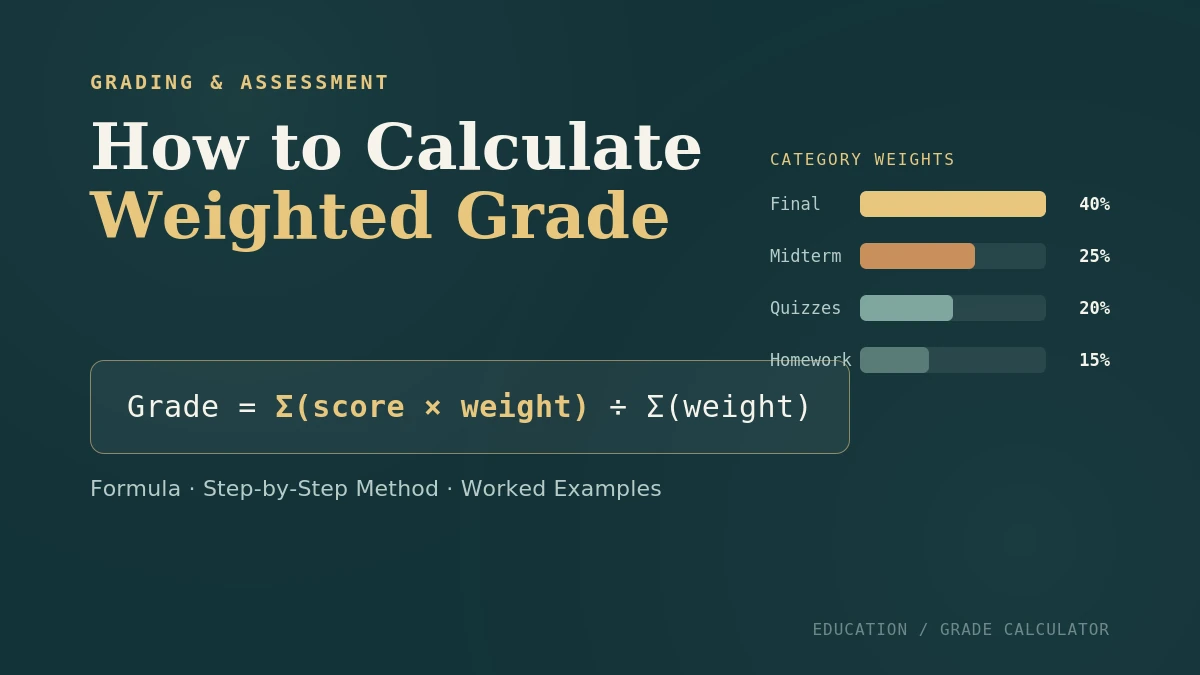
A weighted grade multiplies each score by the percentage its category is worth, adds those results together, and divides by the total weight. The formula is: Weighted Grade = Σ(Score × Weight) ÷ Σ(Weight). Unlike a simple average, it reflects that exams usually count more than homework — so a strong final can outweigh a rough quiz.
When assignments aren’t weighted equally, a simple average won’t cut it — try our weighted grade calculator instead.
What Is a Weighted Grade?
Most courses don’t treat every assignment the same. A syllabus might say homework is worth 10%, quizzes 20%, a midterm 30%, and the final exam 40%. That breakdown is the “weight,” and it’s usually set before the semester even starts.
A weighted grade takes those percentages seriously. Instead of adding up every score and dividing by how many there were, it gives more influence to the categories your instructor decided matter more. Miss that distinction, and you’ll misjudge exactly where you stand — which is the single biggest reason students get blindsided at the end of a term.
Weighted vs. Unweighted Grades
An unweighted grade treats a 5-point quiz the same as a 100-point final. That’s rarely how real grading works, and it’s rarely accurate.
Here’s the practical difference:
| Unweighted Average | Weighted Average | |
|---|---|---|
| Calculation | Sum of scores ÷ number of scores | Sum of (score × weight) ÷ sum of weights |
| Treats all assignments equally | Yes | No |
| Reflects syllabus category values | No | Yes |
| Best used for | Simple lists with no stated weights | Any course with a graded weighting scheme |
If your syllabus lists percentages next to categories like “Homework — 10%,” you need the weighted formula. Full stop.
The Weighted Grade Formula
The math itself isn’t complicated — it’s the bookkeeping that trips people up. Here’s the formula:
Weighted Grade = (Grade₁ × Weight₁ + Grade₂ × Weight₂ + … + Gradeₙ × Weightₙ) ÷ (Weight₁ + Weight₂ + … + Weightₙ)
Breaking Down Each Part of the Formula
- Grade: your average score in a given category (homework average, quiz average, exam score, etc.), usually as a percentage.
- Weight: the percentage that category counts toward your final grade, converted to a decimal (20% becomes 0.20).
- Sum of weighted grades: each grade multiplied by its weight, then added together.
- Sum of weights: all the weights added up — this should equal 1.0 (or 100%) if your syllabus weighting is complete.
That last point matters more than people think. If your weights only add up to 90% because one category isn’t finalized yet, dividing by the total weight (not just 1.0) keeps your current-grade estimate honest.
How to Calculate Weighted Grade Step by Step
Step 1 – List Every Category and Its Weight
Pull the weighting straight from your syllabus. Write it down exactly — don’t round yet. A common setup looks like this:
- Homework: 15%
- Quizzes: 20%
- Midterm: 25%
- Final Exam: 40%
Step 2 – Find Your Average Score in Each Category
Before you touch the weighted formula, calculate a simple average within each category. If you scored 88, 92, and 90 on three quizzes, your quiz average is 90.
Don’t skip this step and try to weight individual assignments one by one — it works, but it’s slower and far easier to mess up than averaging by category first.
Step 3 – Multiply Each Average by Its Weight
Convert each weight to a decimal, then multiply:
- Homework: 88 × 0.15 = 13.2
- Quizzes: 90 × 0.20 = 18.0
- Midterm: 85 × 0.25 = 21.25
- Final Exam: (not yet taken)
Step 4 – Add the Weighted Values Together
Sum the products, then divide by the total weight of the categories you’ve completed so far. This gives you your current running grade — useful for figuring out where you stand mid-semester.
Worked Example: Calculating a Real Course Grade
Let’s say a student has these final numbers at the end of the term:
| Category | Weight | Average Score | Weighted Value |
|---|---|---|---|
| Homework | 15% | 88 | 13.20 |
| Quizzes | 20% | 90 | 18.00 |
| Midterm | 25% | 85 | 21.25 |
| Final Exam | 40% | 91 | 36.40 |
Add the weighted values: 13.20 + 18.00 + 21.25 + 36.40 = 88.85
Since the weights add up to 100% (0.15 + 0.20 + 0.25 + 0.40 = 1.0), no further division is needed — the final weighted grade is 88.85%, a solid B+.
Quick Takeaway: Notice how the final exam alone contributed 36.4 points — more than homework and quizzes combined. That’s the entire point of weighting: bigger categories move your grade more, for better or worse.
How to Calculate the Grade You Need on a Final Exam
This is the calculation most students actually search for in a panic the week before finals. Rearrange the formula to solve for the missing score:
Needed Score = (Desired Grade − Sum of Completed Weighted Values) ÷ Remaining Weight
Say you want an 90% overall, you’ve earned 52.45 weighted points so far (homework + quizzes + midterm), and the final is worth 40%:
Needed Score = (90 − 52.45) ÷ 0.40 = 37.55 ÷ 0.40 = 93.9%
If that number comes out above 100, it means the grade you want is mathematically out of reach — better to know that now than after the exam.
Common Mistakes When Calculating Weighted Grades
- Using raw assignment scores instead of category averages. Averaging every quiz score into the final formula individually usually still works, but only if you weight each one by its share of the category — most people forget that step and end up over- or under-counting.
- Forgetting to convert percentages to decimals. Multiplying by 20 instead of 0.20 will wreck your numbers instantly.
- Assuming weights always total 100%. They don’t, especially mid-semester. Always divide by the actual sum of completed weights, not by 1.0.
- Mixing up weight and grade. It’s easy to swap these by accident when working quickly — double-check which number is the percentage-of-course-worth and which is the actual score.
- Pulling outdated weights from an old syllabus. Professors sometimes adjust weighting after the semester starts. Confirm you’re using the current version.
Weighted Grade vs. Weighted GPA — What’s the Difference?
These sound similar but solve different problems. A weighted grade is the percentage or letter grade for one course, based on category weighting within that course. A weighted GPA applies extra points to grades earned in harder courses (like AP or honors classes), typically adding 0.5 to 1.0 points on a 4.0 scale.
You can have a high weighted grade in a single class while your weighted GPA reflects something different across your whole transcript — they’re related concepts, but they’re not interchangeable, and mixing them up leads to confusion when comparing report cards to college applications.
Quick Reference Table: Weighted Grade Calculation
| Step | Action |
|---|---|
| 1 | List all grading categories and their syllabus weights |
| 2 | Calculate your average score within each category |
| 3 | Convert each weight to a decimal |
| 4 | Multiply each category average by its weight |
| 5 | Add all weighted values together |
| 6 | Divide by the sum of the weights used |
Calculating your grade this way takes a few minutes with a calculator, but it removes the guesswork — and it’s the same method instructors use to generate the number on your transcript.
Need help with GPA, grades, or exams? Our homepage has all the tools you need.
FAQ Section
1. What is the formula for a weighted grade?
The formula is Weighted Grade = Σ(Score × Weight) ÷ Σ(Weight). You multiply each category’s average score by its assigned weight, add those results, then divide by the total weight to get your overall percentage grade.
2. How do you calculate a weighted percentage grade?
Convert each category weight to a decimal, multiply it by your average score in that category, add all the products together, and divide by the sum of the weights. The result is your weighted percentage grade.
3. What is the difference between weighted and unweighted grades?
An unweighted grade averages all scores equally, regardless of assignment type. A weighted grade gives more influence to categories your syllabus values more heavily, like exams over homework, producing a more accurate reflection of course performance.
4. How do you calculate the grade you need on a final exam?
Use: Needed Score = (Desired Grade − Completed Weighted Points) ÷ Remaining Weight. Plug in your target grade, subtract what you’ve already earned, and divide by the final’s weight to see what score you need.
5. Do all category weights have to add up to 100%?
Ideally, yes, by the end of the course. Mid-semester, weights may total less than 100% since not every category is finished — in that case, divide by the sum of completed weights, not 1.0.
6. How do you calculate a weighted GPA?
Weighted GPA adds bonus points (often 0.5–1.0) to grades earned in advanced courses like AP or honors classes before averaging them into your overall GPA. It’s a separate calculation from a single course’s weighted grade.
7. Can you calculate a weighted grade in Excel?
Yes. Use the SUMPRODUCT function: =SUMPRODUCT(scores, weights)/SUM(weights). This multiplies each score by its weight, sums the results, and divides by the total weight automatically.
8. Why is my weighted grade different from a simple average?
Because a simple average treats every score equally, while a weighted grade reflects how much each category actually counts. A high final exam score, for instance, can pull your grade up more than an equally high homework score would.
