

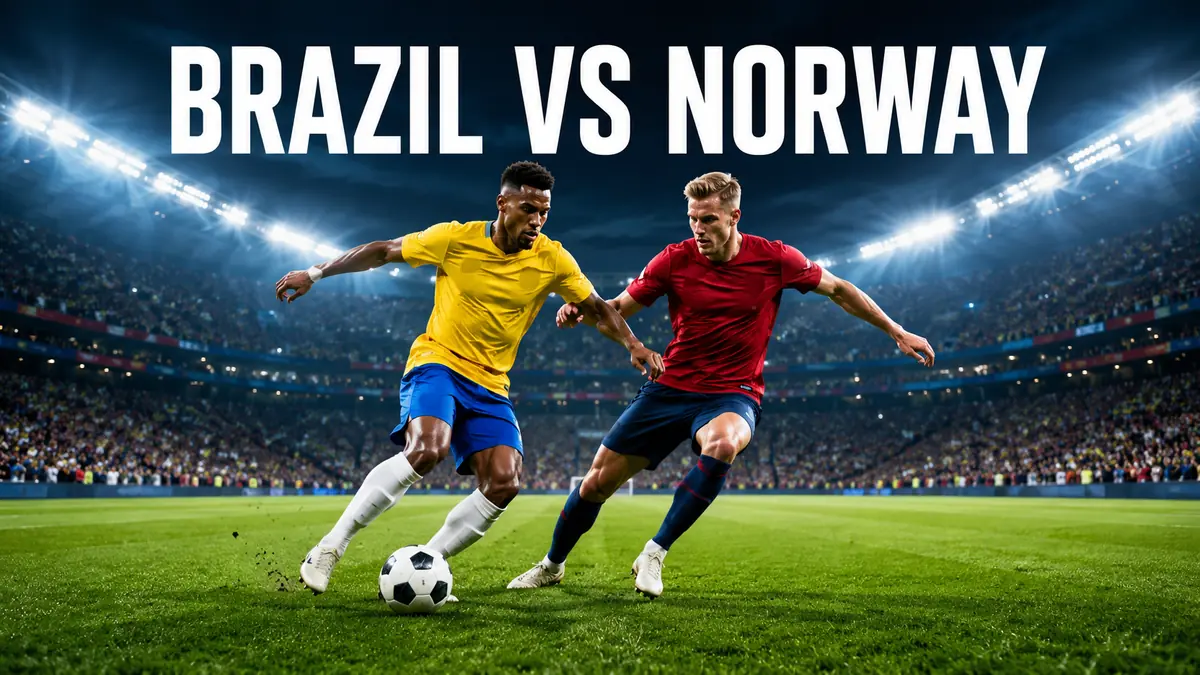
Norway’s remarkable record against Brazil continues. The Scandinavian side defeated the five-time world champions 2-1 in the 2026 FIFA World Cup Round of 16, with Erling Haaland scoring twice before Neymar converted a late penalty for Brazil.
The latest brazil vs norway match ended in a 2-1 victory for Norway on July 5, 2026. Haaland scored in the 79th and 90th minutes at New York New Jersey Stadium, while Neymar answered from the penalty spot in stoppage time. Norway advanced to its first World Cup quarter-final.
The result was not an isolated upset. Norway has now played Brazil five times at senior men’s level without losing, recording three victories and two draws. That extraordinary sequence includes two 2-1 World Cup wins separated by 28 years.
brazil vs norway 2026 Match at a Glance
The latest meeting took place in the Round of 16 at the 2026 FIFA World Cup in the United States, Canada and Mexico.
| Match detail | Information |
|---|---|
| Competition | 2026 FIFA World Cup |
| Stage | Round of 16 |
| Date | July 5, 2026 |
| Venue | New York New Jersey Stadium, East Rutherford |
| Final score | Brazil 1-2 Norway |
| Brazil scorer | Neymar, penalty, 90+10′ |
| Norway scorer | Erling Haaland, 79′, 90′ |
| Half-time score | 0-0 |
| Result | Norway advanced to the quarter-finals |
The first half remained goalless despite Brazil receiving an excellent opportunity to take control. Bruno Guimarães failed to convert an early penalty, with Norwegian goalkeeper Ørjan Nyland making a crucial save.
Norway stayed composed and increasingly controlled possession. Ståle Solbakken’s substitutions then changed the match during the final quarter.
Andreas Schjelderup created both Norwegian goals. Haaland opened the scoring with a powerful header in the 79th minute and struck again 11 minutes later. Neymar converted a stoppage-time penalty, but Brazil had too little time to find an equalizer.
The official FIFA match report confirmed Norway’s historic qualification for the quarter-finals.
brazil vs norway Match Stats
The statistics reveal an unusual tactical picture. Brazil generated the higher expected-goals figure, partly because it received two penalties, but Norway controlled much more of the ball.
| Statistic | Brazil | Norway |
|---|---|---|
| Possession | 34% | 66% |
| Expected goals | 2.61 | 1.05 |
| Total shots | 14 | 9 |
| Shots on target | 4 | 5 |
| Accurate passes | 279 | 618 |
| Passing accuracy | 84% | 91% |
| Corners | 5 | 5 |
| Goalkeeper saves | 3 | 4 |
| Fouls | 7 | 6 |
Brazil’s 34% possession was particularly striking. Carlo Ancelotti’s side deliberately allowed Norway to have the ball and attempted to attack through quick transitions, but the strategy produced few clear openings from normal play.
Norway completed more than twice as many accurate passes. Its 91% passing accuracy helped Solbakken’s team manage the tempo and prevent Brazil from establishing sustained pressure.
Brazil’s expected-goals figure should therefore be read carefully. Penalties carry a high xG value, so the 2.61 total does not mean Brazil consistently created better chances in open play.
Quick takeaway: Brazil had more shots and a higher xG total, but Norway controlled possession, passed more efficiently and produced the decisive moments.
How Norway Beat Brazil in the 2026 World Cup
Norway’s victory was built on patience rather than constant attacking pressure. The team remained organized, avoided unnecessary risks and waited until Brazil’s structure became vulnerable.
Norway controlled the midfield
Brazil is traditionally associated with possession and technical dominance, yet Norway dictated long periods of this match. Captain Martin Ødegaard helped the team retain the ball, change the direction of attacks and prevent Brazil’s midfield from controlling the rhythm.
Brazil’s defensive transition system initially restricted Norway’s chances. The problem was that it also left the Seleção with limited attacking support when Vinícius Júnior, Matheus Cunha and the other forwards moved into advanced positions.
Ørjan Nyland delivered in the decisive moments
Nyland’s penalty save from Bruno Guimarães was one of the match’s turning points. An early Brazil goal could have forced Norway to abandon its controlled approach and take greater risks.
Instead, the save maintained the goalless score and strengthened Norway’s belief. Nyland finished with four saves, offering the reliability his team needed when Brazil threatened.
Solbakken’s substitutions changed the game
Schjelderup entered as a substitute and assisted both of Haaland’s goals. His movement gave Norway fresh energy against a tiring Brazilian defense.
The adjustment demonstrated why substitutions should be judged by their tactical effect rather than the reputation of the incoming player. Schjelderup stretched the field, attacked open spaces and supplied Norway’s most dangerous finisher.
Haaland was clinical
Haaland did not need a large number of chances. His first goal came from a powerful header, while his second was a forceful finish that effectively settled the contest.
The brace took him to seven goals at the tournament at that stage. More importantly, it demonstrated his ability to influence a knockout match even when Norway was not continuously creating opportunities inside Brazil’s penalty area.
Complete Brazil vs Norway Head-to-Head Record
The senior men’s national teams have met five times. Norway has won three matches, while the remaining two ended in draws.
| Date | Competition | Result | Venue |
|---|---|---|---|
| July 28, 1988 | International friendly | Norway 1-1 Brazil | Ullevaal Stadion, Oslo |
| May 30, 1997 | International friendly | Norway 4-2 Brazil | Ullevaal Stadion, Oslo |
| June 23, 1998 | FIFA World Cup group stage | Brazil 1-2 Norway | Stade Vélodrome, Marseille |
| August 16, 2006 | International friendly | Norway 1-1 Brazil | Ullevaal Stadion, Oslo |
| July 5, 2026 | FIFA World Cup Round of 16 | Brazil 1-2 Norway | New York New Jersey Stadium |
Overall record
| Head-to-head category | Total |
|---|---|
| Matches played | 5 |
| Brazil wins | 0 |
| Draws | 2 |
| Norway wins | 3 |
| Brazil goals | 6 |
| Norway goals | 10 |
| World Cup meetings | 2 |
| Norway World Cup wins | 2 |
Brazil has never defeated Norway in senior men’s international football. Norway is also unbeaten against Brazil in competitive meetings, winning both World Cup encounters by the same 2-1 scoreline.
Three of the five matches were friendlies, so the sample is relatively small. Even so, remaining undefeated through five meetings with football’s most successful men’s World Cup nation is a notable achievement.
What Happened in Brazil vs Norway at the 1998 World Cup?
The 1998 meeting remains one of the defining matches in Norwegian football history. It was played on June 23 at Stade Vélodrome in Marseille during the final round of Group A fixtures.
Brazil had already secured qualification for the knockout stage. Norway, after drawing with Morocco and Scotland, needed a victory to guarantee progression.
Bebeto appeared to have ended Norway’s hopes when he scored for Brazil in the 78th minute. Tore André Flo equalized six minutes later, setting up a frantic finish.
Near the end of the match, Brazilian defender Júnior Baiano pulled Flo’s shirt inside the penalty area. American referee Esfandiar Baharmast awarded Norway a penalty, and Kjetil Rekdal converted it in the 89th minute.
Norway won 2-1 and advanced to the Round of 16, where it lost 1-0 to Italy.
Why was the 1998 penalty controversial?
Initial television angles did not clearly show the foul, leading many viewers and commentators to question Baharmast’s decision.
Footage from a Swedish television camera later showed Júnior Baiano holding and pulling Flo’s shirt. The additional angle supported the referee’s call and turned an apparent officiating controversy into an example of how incomplete camera coverage can shape public reaction.
The 2026 result made the 1998 match even more significant. Both World Cup meetings followed a similar script: a goalless first half, late Norwegian goals and a dramatic 2-1 victory.
The 4-2 Norway Victory Before France 1998
Norway had already shown that it could trouble Brazil before the famous World Cup encounter.
On May 30, 1997, the teams met in a friendly at Ullevaal Stadion in Oslo. Norway won 4-2 against a Brazilian squad featuring stars such as Ronaldo and Roberto Carlos.
Flo scored twice and established himself as a major international attacking threat. His performance helped inspire the nickname “Flonaldo,” a playful comparison with Brazil’s Ronaldo.
The match demonstrated the strengths of Egil “Drillo” Olsen’s Norwegian side:
- Direct forward passing
- Strong aerial play
- Disciplined defensive positioning
- Rapid attacks after regaining possession
- Effective use of Flo’s height and movement
Brazil entered that era as the reigning world champion and would reach the 1998 final. Norway’s six-goal friendly victory was therefore more than an ordinary warm-up result—it showed that its approach could expose Brazil’s defensive weaknesses.
Why Does Norway Have Such a Strong Record Against Brazil?
There is no single explanation, but several recurring tactical themes help make sense of the head-to-head record.
A difficult physical matchup
Norwegian teams have traditionally used height, strength and direct running effectively. Those qualities can challenge Brazilian defenders who prefer to control space with the ball rather than contest repeated aerial and second-ball situations.
Flo was central to that approach in the 1990s. Haaland performed a similar match-winning role in 2026, although Norway’s modern team relied much more heavily on patient possession.
Clear tactical discipline
Norway has rarely tried to imitate Brazil. Its strongest performances have come from following a specific plan suited to the available players.
Olsen’s 1990s teams emphasized organization, direct passes and quick transitions. Solbakken’s 2026 side was more comfortable controlling possession through players such as Ødegaard, yet it retained the same commitment to structure and collective responsibility.
Norway treated each meeting as a major test
For Brazil, a friendly against Norway was one match among many. For Norwegian players, facing the Seleção offered a rare opportunity to test themselves against football’s most celebrated national team.
That difference does not fully explain the results, particularly in competitive matches, but it can affect concentration and intensity in friendlies.
A small but meaningful sample
Five matches across 38 years do not prove that Norway is historically stronger than Brazil. Brazil has won five men’s World Cups, while Norway’s tournament record is far more modest.
The statistic instead shows that head-to-head football can produce unusual matchups. Style, preparation, timing and finishing can matter more than global reputation in an individual game.
How the 2026 Result Compared With the 1998 Upset
The two World Cup victories ended with identical scores, but Norway achieved them in different ways.
| Comparison | 1998 match | 2026 match |
|---|---|---|
| Stage | Group stage | Round of 16 |
| Location | Marseille, France | East Rutherford, United States |
| Norway coach | Egil Olsen | Ståle Solbakken |
| Brazil coach | Mário Zagallo | Carlo Ancelotti |
| Norway’s key striker | Tore André Flo | Erling Haaland |
| Brazil scorer | Bebeto | Neymar |
| Winning pattern | Late comeback | Two late Haaland goals |
| Consequence | Norway reached Round of 16 | Norway reached quarter-finals |
In 1998, Norway recovered after conceding first. In 2026, it scored twice before Brazil’s stoppage-time response.
The tactical contrast is equally revealing. Olsen’s team was known for direct football, while Solbakken’s side recorded 66% possession and more than 600 accurate passes. Norway did not merely defend and wait for a fortunate break; it controlled significant portions of the match.
What the Defeat Meant for Brazil
The loss ended Brazil’s attempt to win a sixth World Cup and extended its title drought beyond the 2002 triumph.
Brazil had progressed through the earlier stages with attacking options including Vinícius Júnior, Endrick, Raphinha, Matheus Cunha and Neymar. Against Norway, however, the team lacked control and did not consistently turn transitions into clear chances.
Three issues proved costly:
- The missed first-half penalty: Bruno Guimarães had the chance to put Brazil ahead but was denied by Nyland.
- Limited possession: Brazil recorded only 34%, an exceptionally low figure for the Seleção.
- Failure to stop Norway’s substitutes: Schjelderup created both goals after entering the match.
Neymar’s late penalty offered brief hope but did not change the outcome. Norway’s ability to manage the final moments ensured that Brazil could not force extra time.
The defeat also raised questions about Brazil’s tactical identity. Counterattacking can be effective, but surrendering so much control left the team dependent on isolated moments rather than sustained attacking pressure.
What the Victory Meant for Norway
For Norway, beating Brazil was both a historic result and evidence of the national team’s development.
The victory sent Norway into a men’s World Cup quarter-final for the first time. It also connected two generations of Norwegian football: Solbakken had been part of the national setup during the successful 1990s era and later guided the country to another landmark win as head coach.
Haaland provided the goals, but the result reflected a complete team performance. Nyland saved a penalty, Ødegaard helped control midfield, Schjelderup supplied two assists and the defensive unit remained composed under late pressure.
Norway’s success also proved that its unbeaten record against Brazil is no longer only a nostalgic statistic from the Flo and Rekdal era. A new generation has extended it on the largest stage.
Final Verdict on brazil vs norway
The latest brazil vs norway contest produced another historic Norwegian victory. Haaland’s late brace secured a 2-1 win in the 2026 World Cup Round of 16, while Neymar’s stoppage-time penalty arrived too late to rescue Brazil.
Norway now leads the complete head-to-head record with three wins and two draws from five matches. It has beaten Brazil in both of their World Cup meetings and scored ten goals across the series.
Brazil remains the more successful football nation by every broad historical measure. Yet in this particular fixture, Norway has repeatedly found the right tactical plan, maintained its discipline and delivered decisive moments. After victories in 1997, 1998 and 2026, the record is no longer a statistical curiosity—it is one of international football’s most fascinating head-to-head stories.
