

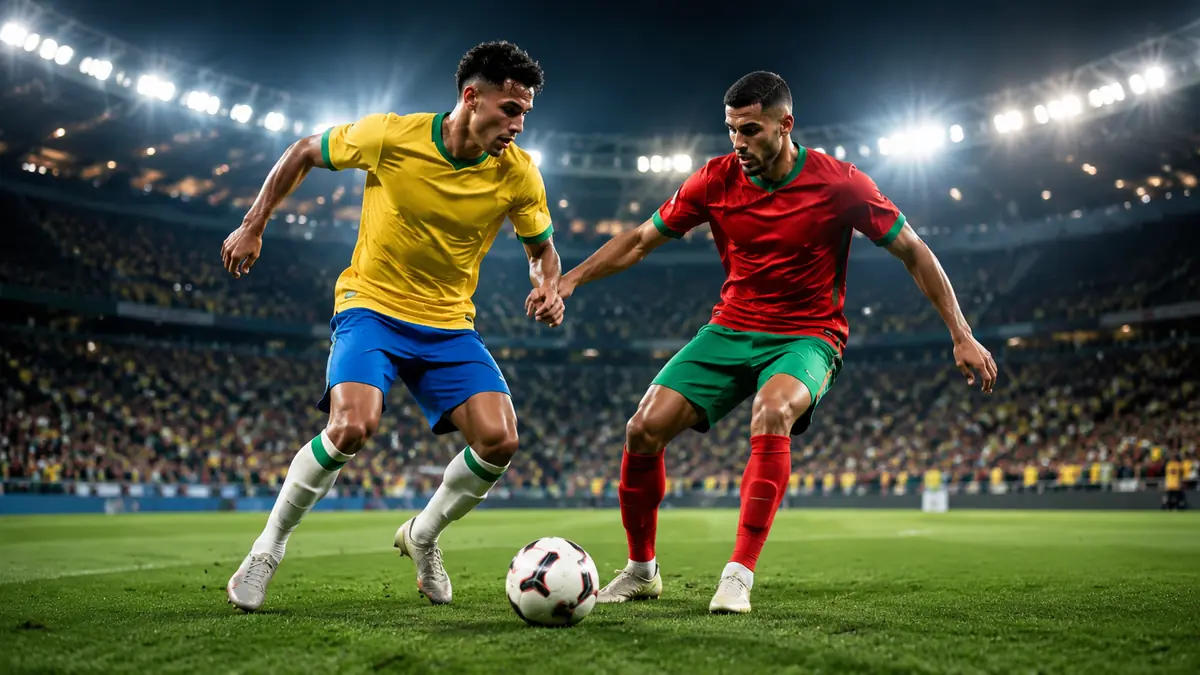
Brazil and Morocco entered the 2026 FIFA World Cup as two of international football’s strongest teams. Their Group C meeting delivered a close contest rather than a clear winner, with Morocco’s aggressive opening balanced by a moment of individual brilliance from Brazil.
The latest brazil vs morocco match ended in a 1-1 draw on June 13, 2026, at New York/New Jersey Stadium in East Rutherford. Ismael Saibari put Morocco ahead in the 21st minute before Vinícius Júnior equalized for Brazil in the 32nd. Both teams collected one point from their opening Group C fixture.
brazil vs morocco 2026 Match Result
Brazil faced Morocco in front of 80,663 spectators in its first match of the expanded 48-team World Cup. Although Brazil entered the tournament as a five-time champion, Morocco looked more settled during the opening exchanges.
| Match detail | Information |
|---|---|
| Competition | 2026 FIFA World Cup |
| Stage | Group C |
| Date | June 13, 2026 |
| Venue | New York/New Jersey Stadium, East Rutherford |
| Final score | Brazil 1-1 Morocco |
| Morocco scorer | Ismael Saibari, 21st minute |
| Brazil scorer | Vinícius Júnior, 32nd minute |
| Half-time score | 1-1 |
| Attendance | 80,663 |
| Brazil coach | Carlo Ancelotti |
| Morocco coach | Mohamed Ouahbi |
FIFA’s official match centre confirmed the 1-1 final score, while contemporary match reports described Morocco as the stronger team during much of the first half. Brazil improved after the interval but could not complete a comeback. FIFA match centre
How Morocco took the lead
Morocco began with confidence, compressing the midfield and preventing Brazil from establishing a comfortable passing rhythm. Its pressure forced hurried decisions, while quick forward runs repeatedly tested Brazil’s defensive positioning.
The opening goal arrived in the 21st minute. Brahim Díaz helped release Ismael Saibari, who took advantage of space behind the Brazilian defense and produced a composed finish beyond Alisson Becker.
The goal reflected Morocco’s approach rather than coming against the run of play. The Atlas Lions attacked with purpose, moved the ball forward quickly and committed players whenever Brazil’s defensive structure became stretched.
Brazil’s midfield initially struggled to control those transitions. Casemiro and Bruno Guimarães were forced to cover wide areas as well as the center, creating passing lanes that Morocco could exploit.
How Vinícius Júnior equalized
Brazil needed an individual action to change the momentum. It received one from Vinícius Júnior in the 32nd minute.
The Real Madrid forward collected the ball on the left, moved inside and struck an accurate finish to beat Yassine Bounou. It was Brazil’s first goal of the tournament and Vinícius Júnior’s tenth at senior international level, according to the match report published by the Associated Press. Associated Press match report
Vinícius had relatively few clear shooting opportunities, but his movement created a difficult choice for Achraf Hakimi. Morocco’s right-back wanted to advance and support attacks, yet every forward run risked leaving space for Brazil’s fastest attacker.
The equalizer demonstrated why transition defense was central to the contest. Morocco could pressure Brazil effectively, but losing possession with Hakimi high up the pitch gave Vinícius room to attack.
What happened in the second half?
Brazil became more stable after half-time. Carlo Ancelotti adjusted the team’s positioning and used substitutions to strengthen the midfield, reducing the freedom Morocco had enjoyed during the opening period.
Brazil subsequently held more controlled possession, but possession did not consistently produce clear chances. Morocco’s defensive line remained organized, with its midfielders retreating quickly whenever Brazil played around the first press.
Bounou made several important interventions to preserve the draw. At the opposite end, Alisson also had work to do as Morocco continued to threaten through direct attacks and late forward runs.
Neither team found the decisive second goal. Morocco showed enough discipline to resist Brazil’s improved play, while Brazil avoided becoming so aggressive that it exposed itself to another counterattack.
Quick takeaway: Morocco controlled much of the first half through pressure and midfield intensity. Brazil responded through Vinícius Júnior and improved structurally after the break, but neither side created enough sustained attacking pressure to earn all three points.
Why Morocco Caused Brazil So Many Problems
The 1-1 result was not simply a case of Brazil playing below its usual standard. Morocco’s tactical plan directly targeted several weaknesses in the Brazilian setup.
Compact midfield pressure
Morocco reduced the distance between its defensive and midfield lines. That compact structure limited Brazil’s ability to find Lucas Paquetá and other creative players between the lines.
When Brazil passed sideways, Morocco stayed patient. Once a pass entered a crowded central area, Moroccan players accelerated their press and attempted to force a turnover.
This pressure disrupted Brazil’s preferred rhythm. Instead of progressing through short combinations, Brazil was frequently pushed toward longer or more predictable passes.
Rapid attacking transitions
Morocco did not need long spells of possession to look dangerous. The team moved forward immediately after regaining the ball, often using Brahim Díaz as a connection between midfield and attack.
Saibari’s timing was particularly effective. Rather than remaining fixed in one position, he entered spaces created by Brazil’s shifting defenders. His goal was the clearest example of this movement.
Neil El Aynaoui and Ayyoub Bouaddi also contributed to Morocco’s midfield control. Their energy allowed the Atlas Lions to compete for second balls and sustain pressure after an initial attack had been stopped.
Hakimi’s influence on the right
Achraf Hakimi remains one of Morocco’s most important tactical weapons. His speed and willingness to overlap force opponents to defend deeper, while his combinations with the right-sided attackers create numerical advantages.
His attacking ambition carried a risk, however. Vinícius Júnior could exploit the space behind him whenever Morocco lost the ball. That individual matchup became one of the game’s defining tactical battles.
Bounou’s composure in goal
Yassine Bounou, commonly known as Bono, helped Morocco manage Brazil’s stronger periods. He organized the defense, dealt with shots under pressure and prevented Brazil from turning second-half momentum into a winning goal.
A goalkeeper’s distribution also matters against Brazil. Bounou generally avoided forcing short passes when Brazil pressed aggressively, helping Morocco escape dangerous situations rather than inviting pressure near its own penalty area.
What Brazil’s Performance Revealed
Brazil extended its unbeaten run in opening World Cup matches, but the draw raised questions about its balance and attacking fluency.
Dependence on individual attacking quality
Vinícius Júnior produced the decisive action, yet Brazil did not consistently build high-quality opportunities around him. Morocco frequently directed the Brazilian attack toward crowded areas and prevented combinations close to goal.
Brazil possessed considerable attacking talent, but recognizable names alone do not guarantee a cohesive attack. The spacing between midfield and the forward line must allow players to receive the ball while facing goal.
That connection was inconsistent against Morocco.
Midfield balance remains essential
Ancelotti’s team improved once its midfield became more compact. The first-half problems showed what can happen when Brazil’s central players are required to cover too much ground.
Casemiro provided experience and defensive awareness, while Bruno Guimarães offered passing quality. Nevertheless, Morocco’s movement repeatedly placed them in difficult two-way situations: step forward to press or retreat to protect the defense.
Brazil needs a better balance between creativity and protection, particularly against teams capable of counterattacking at speed.
Neymar’s absence changed the attack
Neymar missed the match through injury. His absence removed a player who traditionally receives the ball between midfield and attack, draws defenders and creates chances in tight spaces.
Brazil still had Vinícius Júnior and other talented forwards, but the attack lacked a consistent central organizer. That did not make Neymar’s absence the only reason for the draw; it simply changed how Brazil could break down Morocco’s compact defensive block.
Ancelotti’s adjustments worked—but only partly
Brazil looked calmer during the second half after positional and personnel changes. Its midfield protection improved, and Morocco found fewer uncontested routes toward Alisson’s goal.
The adjustments prevented the game from slipping away. They did not, however, generate the volume of clear chances needed to win.
For Ancelotti, the practical lesson was straightforward: Brazil could recover control through tactical changes, but its initial structure needed greater stability.
brazil vs morocco Head-to-Head Record
Brazil and Morocco have played four recognized senior men’s internationals. Brazil leads the series with two victories, while Morocco has one win and the teams have drawn once.
| Date | Competition | Match | Result |
|---|---|---|---|
| October 9, 1997 | International friendly | Brazil vs Morocco | Brazil won 2-0 |
| June 16, 1998 | FIFA World Cup | Brazil vs Morocco | Brazil won 3-0 |
| March 25, 2023 | International friendly | Morocco vs Brazil | Morocco won 2-1 |
| June 13, 2026 | FIFA World Cup | Brazil vs Morocco | Draw, 1-1 |
Across those four meetings, Brazil has scored seven goals and Morocco has scored three. The complete record is:
- Brazil wins: 2
- Morocco wins: 1
- Draws: 1
- Brazil goals: 7
- Morocco goals: 3
- Total goals: 10
The record shows a notable change over time. Brazil won the first two encounters by a combined score of 5-0, but it failed to beat Morocco in either of their next two meetings.
Has Morocco ever beaten Brazil?
Yes. Morocco recorded its first senior international victory over Brazil on March 25, 2023, winning 2-1 at the Grand Stade de Tanger in Tangier.
Sofiane Boufal opened the scoring in the 29th minute. Casemiro equalized for Brazil in the 67th before Abdelhamid Sabiri restored Morocco’s lead in the 79th.
The victory was historically significant because Morocco had lost both previous meetings without scoring. It also came only a few months after the Atlas Lions became the first African and Arab men’s team to reach a World Cup semifinal.
Has Morocco beaten Brazil at the World Cup?
Morocco has not beaten Brazil at the men’s FIFA World Cup. The teams have met twice in the competition:
- Brazil won 3-0 in the 1998 group stage.
- Brazil and Morocco drew 1-1 in the 2026 group stage.
Brazil therefore holds one World Cup win, one draw and no defeats against Morocco. Across the two tournament meetings, Brazil has scored four goals and conceded one.
Brazil vs Morocco 1998 World Cup Match
The first competitive meeting took place on June 16, 1998, at Stade de la Beaujoire in Nantes, France.
Brazil entered as the defending world champion and controlled the Group A contest from an early stage. Ronaldo opened the scoring in the ninth minute with his first World Cup goal.
Rivaldo added a second in first-half stoppage time, leaving Morocco with a difficult task after the interval. Bebeto completed the 3-0 victory in the 50th minute.
| Goalscorer | Team | Minute |
|---|---|---|
| Ronaldo | Brazil | 9 |
| Rivaldo | Brazil | 45+2 |
| Bebeto | Brazil | 50 |
The result helped Brazil secure control of its group. The Seleção later reached the final, where host nation France won 3-0. Morocco did not progress from the group despite defeating Scotland in its final match.
The contrast between 1998 and 2026 is striking. Brazil dominated the earlier meeting through its superior attacking quality. Twenty-eight years later, Morocco competed on equal terms and led before settling for a draw.
Morocco vs Brazil 2023: A Historic Turning Point
The 2023 friendly changed perceptions of this matchup. Morocco was no longer approaching Brazil merely as an underdog trying to survive; it played with the confidence of a team capable of winning.
More than 63,000 spectators attended the match in Tangier. Morocco defended aggressively, attacked with speed and responded positively after Casemiro’s equalizer.
Sky Sports recorded Morocco making 15 interceptions compared with Brazil’s six, illustrating the effectiveness of its anticipation and defensive pressure. Sky Sports match statistics
Sabiri’s winning goal produced Morocco’s first victory over the five-time world champion. It also established the psychological foundation for the 2026 meeting: Morocco knew it could disrupt and hurt Brazil, while Brazil understood that reputation would not be enough.
Quick takeaway: The 2023 result was not an isolated historical curiosity. It revealed tactical qualities—compact defending, fast transitions and confidence under pressure—that Morocco used again during the 2026 World Cup draw.
How the Footballing Styles Compare
Brazil and Morocco share strong technical foundations, but their international identities remain distinct.
| Area | Brazil | Morocco |
|---|---|---|
| Traditional identity | Creative, possession-oriented attacking football | Structured defense and rapid transitions |
| Primary attacking threat | Individual dribbling and combinations in wide areas | Direct breaks supported by advancing full-backs |
| Key wide figure | Vinícius Júnior | Achraf Hakimi |
| Goalkeeper | Alisson Becker | Yassine Bounou |
| Defensive challenge | Protecting space during turnovers | Maintaining width without exposing the flanks |
| Historical World Cup peak | Five-time champion | Semifinalist in 2022 |
Brazil traditionally seeks to control matches through technical quality, positional movement and one-on-one attacking skill. The team’s reputation for jogo bonito remains part of its identity, even though modern Brazilian sides also place greater emphasis on pressing and defensive organization.
Morocco’s strongest performances combine tactical discipline with quick, technically secure counterattacks. The Atlas Lions can defend compactly without becoming completely passive. Hakimi, Díaz, Saibari and other mobile players allow them to turn a defensive recovery into an attacking opportunity within seconds.
The matchup is compelling because each side can expose the other’s preferred risk. Brazil’s attacking numbers can leave transition space. Morocco’s adventurous full-backs can leave room for elite Brazilian wingers.
What the 1-1 Draw Meant for Group C
Both teams earned one point from their opening 2026 World Cup match. That kept Group C open and increased the importance of their remaining fixtures against Haiti and Scotland.
A draw was more comfortable for Morocco than it initially appeared. The team had competed successfully against a tournament favorite and demonstrated that its 2022 semifinal run was not the limit of its international ambitions.
For Brazil, the point prevented a damaging opening defeat, but expectations were naturally higher. The Seleção entered the tournament seeking its first World Cup title since 2002, making attacking improvement essential in the subsequent group matches.
The result also extended Brazil’s unbeaten sequence in World Cup openers to 21 matches. Yet the performance supplied a warning: elite opponents could disrupt Brazil’s midfield and create chances when its defensive positioning became stretched.
Morocco’s challenge was different. It had proved it could trouble Brazil, but converting strong periods into more goals remained crucial. The Atlas Lions created enough pressure to make victory possible and therefore had reason to view the draw as both encouraging and slightly frustrating.
Final Assessment
The latest brazil vs morocco meeting confirmed that this is now a competitive international matchup rather than a predictable contest between an established champion and an outsider.
Brazil still leads the overall head-to-head record with two wins from four games. Morocco, however, is unbeaten in the two most recent meetings: a historic 2-1 victory in 2023 and a 1-1 World Cup draw in 2026.
Morocco’s midfield pressure, compact defensive structure and fast transitions caused Brazil persistent problems in East Rutherford. Brazil relied on Vinícius Júnior to equalize before Ancelotti’s second-half adjustments restored greater control.
The clearest conclusion is found in the changing results. Brazil won the first two encounters 2-0 and 3-0. Morocco then won 2-1 and earned a 1-1 draw. History still favors Brazil, but the modern rivalry is far more balanced—and any future meeting should be judged on current form and tactical execution, not reputation alone.
