

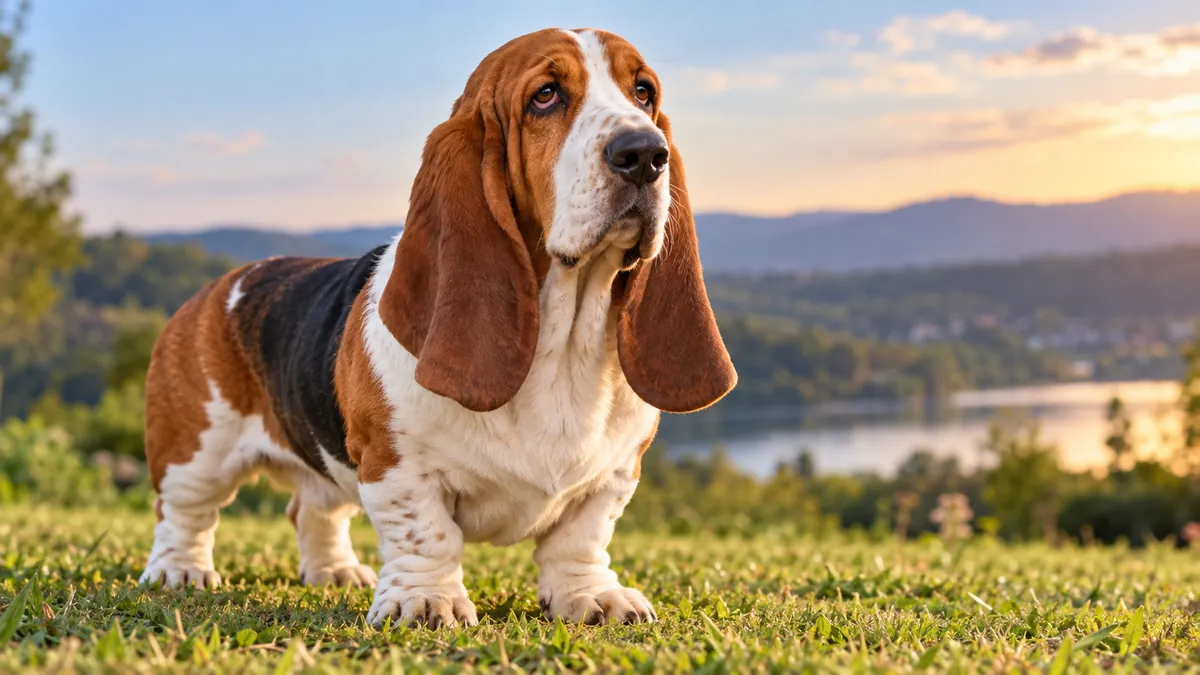
With long velvety ears, short legs, a powerful nose, and an unmistakably solemn expression, the basset hound is one of the most recognizable dog breeds in the world. Behind that laid-back appearance is a determined scent hound originally developed to follow game over long distances.
A basset hound is a low-slung, heavy-boned scent hound known for a calm temperament, exceptional sense of smell, long ears, and independent personality. Adults generally stand no more than 15 inches tall and commonly weigh about 40–65 pounds. With suitable nutrition, exercise, preventive veterinary care, and weight management, the typical lifespan is around 12–13 years.
basset hound Breed Overview
The basset hound belongs to the hound group and was developed as a scent-trailing hunting dog. Its body may sit close to the ground, but this is not a delicate little dog. Bassets have substantial bone, large paws, muscular bodies, and considerably more weight than their height suggests.
Here is a quick overview:
| Characteristic | Typical Basset Hound |
|---|---|
| Breed group | Hound |
| Height | Up to 15 inches |
| Weight | About 40–65 pounds |
| Life expectancy | Around 12–13 years |
| Coat | Short and smooth |
| Temperament | Patient, calm, friendly, independent |
| Exercise needs | Moderate |
| Grooming | Moderate |
| Shedding | Regular |
| Training | Can be challenging |
| Vocalization | Often vocal |
| Notable instinct | Scent tracking |
The American Kennel Club describes the breed as patient, low-key, and charming. Despite their relaxed behavior at home, Bassets retain the persistence expected of a working scent hound.
Why Is It Called a Basset Hound?
The name reflects the dog’s characteristic low stature. “Basset” comes from French terminology associated with being short or low-set. The breed has French roots and was developed for scent-based hunting, particularly the pursuit of rabbits and hares.
That history explains several modern Basset traits that can otherwise seem unusual: a nose constantly searching for interesting smells, determination once a scent has been discovered, an independent approach to commands, and a powerful voice.
What Does a basset hound Look Like?
Few breeds are mistaken for a Basset.
The combination of a long body, remarkably short legs, loose skin, drooping ears, large feet, domed head, and soulful eyes creates its characteristic appearance. Although the dog’s height is limited, its heavy frame means an adult can be surprisingly difficult to lift.
Common coat colors and combinations recognized by the AKC include black and white, lemon and white, red and white, brown and white, and several tricolor combinations.
Long Ears
The exceptionally long ears are more than an aesthetic characteristic. They are associated with the breed’s scent-hound heritage, but they also create an important care responsibility.
Limited airflow around long, hanging ears can contribute to conditions favorable for ear problems. Owners should therefore make ear inspection part of routine care rather than waiting until obvious symptoms develop.
Short Legs and Heavy Body
A Basset’s short legs can create the impression of a small dog. In practical terms, however, it is better to think of the breed as a substantial dog on very short legs.
That body structure also means maintaining a healthy weight matters. Excess body weight adds unnecessary stress to the joints and spine.
basset hound Temperament and Personality
Basset Hounds tend to combine two seemingly contradictory characteristics: relaxed companionship at home and remarkable determination when their noses become involved.
They are generally described as patient, good-natured, devoted, and relatively easygoing. The official AKC temperament description characterizes the breed as charming, patient, and low-key and states that a typical Basset should not be timid or aggressive.
Are Basset Hounds Affectionate?
Yes, although affection does not always look the same as it does in highly demonstrative breeds.
Many Bassets enjoy spending substantial time around their families and form strong attachments to them. Some are happy lounging close to their owners without constantly demanding interaction.
This makes them appealing to people who want a companion dog with a generally relaxed household personality.
Are Basset Hounds Stubborn?
They can certainly appear stubborn.
The better explanation is often independence.
Scent hounds were developed to follow trails and continue working rather than constantly looking to a handler for instructions. A Basset that suddenly ignores a command after discovering an interesting smell is displaying exactly the kind of persistence historically valued in scent-trailing dogs.
That independence can make training slower, but it does not mean Bassets cannot learn.
Do Basset Hounds Bark a Lot?
Bassets can be vocal.
They have a deep, carrying bark and may also bay or vocalize when excited, frustrated, alert, or stimulated by an interesting scent. The AKC specifically identifies the breed as having a loud, ringing voice.
This is worth considering before bringing one into an apartment or another home where noise travels easily.
Are Basset Hounds Good Family Dogs?
For many households, yes.
Their generally patient and friendly temperament can make Basset Hounds pleasant family companions. Many also interact successfully with children and other dogs when properly socialized. Their moderate activity requirements can suit households that do not want an extremely high-energy working breed.
However, breed tendencies never guarantee the behavior of an individual dog.
Interactions between dogs and young children should always be supervised. Children should also learn not to pull long ears, climb on the dog, disturb it while eating, or interfere while it sleeps.
Are Basset Hounds Good With Other Dogs?
Often, yes.
Historically, Bassets worked alongside other hounds, so sociability with dogs is consistent with their original working role. The AKC notes that many enjoy canine company.
Individual temperament, previous experiences, socialization, age, and the behavior of the other dog still matter.
Can Basset Hounds Live With Cats?
Some can live peacefully with cats, particularly when introduced carefully and socialized with them from an early age.
Their hunting background should still be remembered. Reactions to smaller animals vary between individuals, so introductions should be controlled rather than assuming every Basset will behave identically.
Training a basset hound
Training is one of the areas where new owners frequently underestimate this breed.
A Basset is capable of learning household manners and obedience cues, but repetitive drilling or harsh handling is unlikely to produce the best results.
Positive reinforcement, consistency, patience, and worthwhile rewards are much more useful.
Start Training Early
Begin basic training while the dog is young.
Useful early priorities include:
- Responding to its name.
- Reliable recall foundations.
- Loose-leash walking.
- House training.
- Calm handling of ears, paws, and mouth.
- Appropriate behavior around food.
- Settling quietly when asked.
- Socialization with people, dogs, environments, sounds, and surfaces.
Short training sessions usually work better than repeatedly practicing the same behavior until the dog loses interest.
Food rewards can be particularly motivating, but calories from treats still count toward the dog’s daily intake.
Recall Requires Special Attention
A strong nose creates a predictable problem: smells can become more interesting than people.
Once a Basset starts following a trail, getting its attention back can be difficult. AKC guidance therefore emphasizes recall training and the use of secure leashes or fenced areas.
Even a well-trained Basset should not automatically be trusted off-leash in an unsecured area.
Avoid Punishment-Based Training
Independent behavior should not be confused with defiance requiring punishment.
Rewarding desired behavior, preventing opportunities to rehearse unwanted behavior, and maintaining consistent household rules usually produces a clearer learning environment.
If progress stalls, changing the reward or shortening the session can work better than simply repeating a command louder.
How Much Exercise Does a basset hound Need?
Basset Hounds are not endurance-running partners, but neither should they spend their entire lives on the sofa.
Regular moderate exercise helps maintain muscle, supports cardiovascular health, provides mental stimulation, and—particularly important for this breed—helps control body weight.
The AKC recommends regular moderate exercise and notes that a daily walk at a moderate pace can help keep a Basset fit. PetMD likewise reports that daily walking is recommended for the breed.
Good Activities for Basset Hounds
Suitable activities can include moderate walks, controlled play, scent games, food-search activities, and exploring safe outdoor areas on leash.
Scent work is particularly valuable because it allows the dog to use one of its strongest natural abilities.
Rather than trying to exhaust a Basset with intense exercise, combine physical movement with opportunities to sniff and investigate.
Exercise and Puppies
Growing puppies should not simply follow an adult exercise routine.
Their developing bodies need appropriately managed activity. Excessive jumping, repetitive high-impact exercise, or strenuous running is unnecessary.
Ask a veterinarian for age-appropriate exercise guidance if you are uncertain about a puppy’s activity level.
Feeding and Weight Management
Weight management deserves special attention with Basset Hounds.
Their enthusiasm for food combined with relatively modest energy requirements can make weight gain easy. Excess weight then places additional stress on joints and the spine and can make existing mobility problems more difficult to manage.
PetMD specifically identifies obesity as an important concern and recommends measured feeding rather than estimating portions.
How Much Should a Basset Hound Eat?
There is no single correct quantity for every Basset.
Food requirements depend on age, body weight, body condition, activity level, reproductive status, health conditions, and the calorie density of the particular food.
Use the food manufacturer’s recommendation as a starting point rather than an absolute rule. Monitor body condition and discuss appropriate intake with your veterinarian.
Treats Still Count
Training treats can accumulate quickly.
If you regularly use food during training, include those calories when considering the dog’s total daily intake.
A few extra calories each day may seem insignificant, but repeated over months they can contribute to gradual weight gain.
basset hound Grooming and Coat Care
The short coat looks extremely easy to maintain—and compared with long-haired breeds, it is—but Bassets are not maintenance-free.
They shed regularly, can drool considerably, and require particular attention around their ears and skin.
Brushing
Weekly brushing is a useful baseline.
It removes loose hair, distributes natural skin oils, provides an opportunity to examine the skin, and reduces the amount of shedding around the house.
The AKC recommends going over the coat at least weekly with an appropriate brush or shedding tool.
Bathing
Bathe as necessary using dog-appropriate products.
The frequency will vary according to the individual dog’s skin, lifestyle, odor, and veterinary recommendations. Dogs with recurrent dermatological problems may need a specific bathing schedule or medicated products prescribed by a veterinarian.
Ear Care
Those famous ears require consistent monitoring.
Check them for redness, unusual discharge, strong odor, irritation, or excessive debris. Head shaking and repeated ear scratching can also indicate discomfort.
PetMD notes that Basset Hounds are particularly susceptible to ear infections and recommends routine ear care.
Never assume that persistent odor or discharge is simply normal for the breed. Recurrent ear problems deserve veterinary evaluation.
Skin Folds
Loose skin can trap moisture and debris.
Check folds regularly, particularly if your dog has pronounced wrinkles. Redness, itching, odor, soreness, or discharge can indicate irritation or infection.
PDSA identifies skin-fold dermatitis and skin infections among relevant concerns in the breed.
Nails and Teeth
Keep nails at a comfortable length and make dental care part of the routine.
Long nails can affect comfortable movement, while regular tooth brushing with dog-safe toothpaste supports oral health. Human toothpaste should not be used for dogs.
Common basset hound Health Problems
No individual Basset is guaranteed to develop a particular disease, but understanding breed-associated risks helps owners recognize warning signs and make better decisions about preventive care.
Health concerns discussed by veterinary and breed organizations include ear and skin disease, joint disorders, spinal problems, glaucoma, certain inherited disorders, and gastric dilatation-volvulus.
Ear and Skin Problems
Long hanging ears, skin folds, allergies, and other factors can contribute to recurrent skin and ear trouble.
Possible warning signs include:
- Persistent scratching
- Head shaking
- Red or inflamed skin
- Unpleasant odor
- Ear discharge
- Moist or irritated skin folds
- Recurrent sores
Persistent symptoms should be evaluated rather than repeatedly treated at home without identifying the underlying problem.
Hip and Elbow Problems
Abnormal joint development can contribute to discomfort, lameness, reduced mobility, and eventually arthritis.
Watch for stiffness, reluctance to exercise, difficulty getting up, limping, or changes in normal movement.
Keeping the dog lean is particularly valuable because additional body weight increases the mechanical load carried by already vulnerable joints.
Patellar Luxation
Patellar luxation occurs when the kneecap moves out of its normal position.
Affected dogs may intermittently skip a step, limp, or temporarily carry a hind leg. Severity varies considerably, and treatment depends on the individual case.
Intervertebral Disc Disease
Bassets’ long-backed, short-legged body shape makes spinal health an important consideration.
Intervertebral disc disease, commonly abbreviated IVDD, can cause back pain and neurological problems. Severe cases can result in significant weakness or paralysis.
Difficulty walking, sudden weakness, severe back pain, or loss of normal movement requires prompt veterinary attention.
Glaucoma
Glaucoma involves damaging pressure and changes within the eye and can threaten vision.
Primary open-angle glaucoma is among the conditions for which genetic testing is relevant in Basset Hounds. The Basset Hound Club of America also notes that another form, primary closed-angle glaucoma, does not currently have the same genetic-test availability.
Sudden eye pain, cloudiness, redness, enlargement, abnormal pupils, or vision changes deserve urgent veterinary evaluation.
Gastric Dilatation-Volvulus
Gastric dilatation-volvulus, or GDV, is an emergency in which the stomach becomes distended and can twist.
Warning signs can include unsuccessful attempts to vomit, excessive drooling, pacing or restlessness, and abdominal enlargement.
Suspected GDV requires immediate emergency veterinary care. This is not a condition to monitor at home while waiting to see whether symptoms improve.
Inherited Conditions and Health Testing
Responsible breeding involves more than simply choosing two dogs that look healthy.
The Basset Hound Club of America discusses breed-relevant genetic conditions including thrombopathia, Lafora disease, primary open-angle glaucoma, mucopolysaccharidosis I (MPS I), and others.
The AKC lists these recommended breed-club health tests for Basset Hounds:
- Ophthalmologist evaluation
- MPS I DNA testing
- Basset Hound thrombopathia DNA testing
- Lafora disease DNA testing
- Primary open-angle glaucoma DNA testing
Health screening cannot guarantee that a puppy will never become ill, but it provides meaningful information for responsible breeding decisions.
How Long Do Basset Hounds Live?
The commonly cited basset hound lifespan is approximately 12–13 years.
That number is a general breed estimate rather than a prediction for an individual dog.
Genetics, body condition, dental care, nutrition, exercise, preventive medicine, accident prevention, and timely treatment of illness can all affect longevity and quality of life.
One of the most practical things an owner can control is body weight. Keeping a Basset lean reduces unnecessary strain on its joints and can make regular activity easier.
Living With a Basset Hound
Understanding everyday life with the breed is just as important as learning its physical characteristics.
Expect a dog that may happily spend hours relaxing but suddenly become remarkably determined when an interesting smell appears.
You should also expect shedding.
And drool.
And a surprisingly powerful voice.
None of these characteristics necessarily makes the breed difficult, but they can become frustrating when an owner chooses a Basset based entirely on appearance.
Can Basset Hounds Live in Apartments?
Potentially.
Their moderate activity requirements can make apartment living possible when owners consistently provide exercise, enrichment, toilet breaks, and companionship.
Noise is the bigger consideration.
Bassets can bark and bay loudly, which may create problems in buildings with thin walls or strict noise policies.
Can They Be Left Alone?
Dogs vary in how comfortably they tolerate time alone.
Because Bassets tend to enjoy companionship, gradually teaching calm independence is preferable to suddenly leaving a young dog alone for long periods.
Mental enrichment, predictable routines, adequate exercise, and gradual alone-time training can help.
Persistent destructive behavior, distress vocalization, attempts to escape, or other signs of anxiety should not simply be dismissed as stubbornness.
Choosing a Basset Hound Puppy
If you decide the breed suits your household, focus on health and temperament rather than selecting a puppy primarily for color or exaggerated physical features.
A responsible breeder should be willing to discuss the parents’ temperaments, health screening, inherited conditions, puppy socialization, and the realities of owning the breed.
Ask to see documentation rather than relying only on statements that the parents are “healthy.”
Breed-club health recommendations provide a useful reference when discussing testing.
Avoid Exaggerated Features
Extremely long ears, excessive skin, very low bodies, or other exaggerated characteristics may look dramatic, but appearance should never be prioritized over comfortable movement and health.
PDSA notes that exaggerated features in Basset Hounds can contribute to problems involving skin, ears, body structure, and general welfare.
A healthy dog should be able to move comfortably, breathe normally, see adequately, and participate in ordinary canine activities.
Consider Rescue Too
Adult Basset Hounds and Basset mixes also enter breed rescues and general shelters.
An adult can be a particularly useful option for someone who wants a clearer idea of eventual size, personality, activity level, and behavior than is possible with a very young puppy.
Is a basset hound Right for You?
The breed can work particularly well for people who appreciate a calm companion but understand that “low-key” does not mean “zero maintenance.”
A Basset may suit you if you are comfortable with moderate daily walks, regular ear and skin care, shedding, drooling, consistent positive training, and careful weight management.
Think more carefully if you want a highly obedient off-leash dog, dislike vocal dogs, cannot provide routine grooming and veterinary care, or want an athletic companion for strenuous running.
The biggest mistake is judging the breed entirely by its sleepy expression. Underneath that relaxed exterior is a genuine scent hound with powerful instincts and an independent mind.
Everyday Care Checklist
A practical routine does not need to be complicated.
Daily: provide appropriate meals, fresh water, moderate exercise, opportunities to sniff and explore, companionship, and brief training or enrichment.
Weekly: brush the coat, examine the ears and skin, monitor nails, and pay attention to body condition.
Regularly: maintain dental hygiene, trim nails as needed, bathe appropriately, keep parasite prevention current according to veterinary guidance, and attend recommended veterinary examinations.
Pay particular attention to changes in appetite, mobility, weight, eyes, ears, skin, breathing, or behavior. Knowing what is normal for your individual dog makes abnormal changes easier to notice.
Final Thoughts on the basset hound
The basset hound combines an unmistakable appearance with a personality shaped by generations of scent work. It is generally patient, friendly, devoted, and relaxed at home, but its strong nose and independent nature can make training more demanding than its easygoing expression suggests.
Successful ownership comes down to understanding that combination.
Provide moderate daily exercise, maintain a healthy body weight, use patient positive-reinforcement training, keep ears and skin clean and monitored, and stay alert to breed-associated joint, spinal, eye, and gastrointestinal problems. With appropriate care and realistic expectations, a Basset Hound can be a deeply enjoyable companion for many years.
