

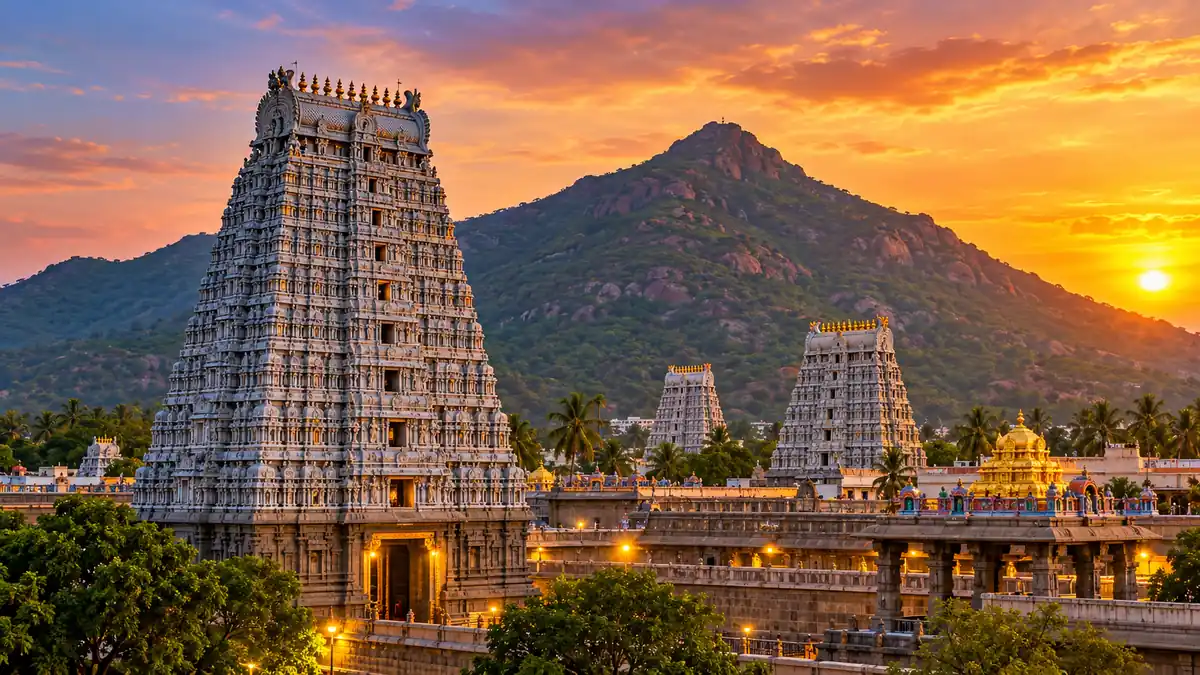
At the foot of the sacred Arunachala Hill in Tamil Nadu stands one of India’s most revered temples dedicated to Lord Shiva. Every year, countless devotees visit this ancient pilgrimage destination to experience its spiritual traditions, impressive architecture, and famous Girivalam pilgrimage.
The arunachalam temple, officially known as Arunachaleswarar Temple or Annamalaiyar Temple, is located in Tiruvannamalai, Tamil Nadu. Dedicated to Lord Shiva in his fire-element form, it is one of the five Pancha Bhoota Sthalams. Visitors come for darshan, worship, the 14-kilometre Girivalam pilgrimage, and the spectacular Karthigai Deepam festival.
This guide explains the temple’s history, religious significance, current visiting hours, important rituals, architectural features, festivals, and practical information for first-time visitors.
Where Is arunachalam temple Located?
Arunachaleswarar Temple is situated in Tiruvannamalai, a historic pilgrimage town in northern Tamil Nadu, India. The temple stands at the eastern base of Arunachala Hill, a mountain considered sacred in the Shaivite tradition.
The temple is also commonly called Annamalaiyar Kovil, Tiruvannamalai Temple, and Arunachalam Shiva Temple.
| Detail | Information |
|---|---|
| Official name | Arulmigu Arunachaleswarar Temple |
| Common names | Arunachalam Temple, Annamalaiyar Temple |
| Location | Tiruvannamalai, Tamil Nadu, India |
| Main deity | Lord Shiva (Arunachaleswarar) |
| Goddess | Unnamulai Amman |
| Religious tradition | Hinduism, Shaivism |
| Sacred element | Fire (Agni) |
| Architectural style | Dravidian |
| Temple complex | Approximately 25 acres |
| Girivalam distance | Approximately 14 km |
| Main festival | Karthigai Deepam |
| Administration | Tamil Nadu Hindu Religious and Charitable Endowments Department |
The temple is approximately 190 kilometres from Chennai by road, although the exact distance depends on the starting point and route.
Its setting is particularly significant because devotees regard Arunachala Hill itself as a manifestation of Lord Shiva, rather than simply the natural landscape surrounding the shrine. Arunachalam Temple+1
History of Arunachaleswarar Temple
The history of Arunachaleswarar Temple combines ancient Tamil religious literature, centuries of royal patronage, and traditions that continue today.
Although the temple’s precise founding date is uncertain, its religious importance is documented in early medieval Tamil Shaivite literature. The surviving buildings reflect construction and expansion across several historical periods.
Early Religious Origins
The temple is associated with the Tamil Shaivite devotional movement and the sacred hymns known as the Tevaram.
Shaivite saints, including Appar, Sambandar, and Sundarar, celebrated Lord Shiva through devotional poetry. Their compositions helped establish numerous temples as important religious centres across Tamil-speaking regions.
Arunachala became particularly significant because of the belief that Shiva manifested here as an infinite column of fire.
The temple’s religious identity therefore developed around both the worship of the Shiva Lingam and the sacred mountain.
Contributions of the Chola Dynasty
The Chola rulers played an important role in developing stone temples across Tamil Nadu.
During their period, Arunachaleswarar Temple received architectural additions, endowments, and religious patronage.
Stone inscriptions associated with the temple provide evidence of donations, land grants, and arrangements supporting temple worship.
These records are valuable because they reveal how the temple functioned not only as a religious centre but also as an institution connected with the region’s social and economic life.
Vijayanagara and Nayak Periods
Major architectural expansion occurred under later South Indian dynasties, especially the Vijayanagara rulers and their successors.
Large entrance towers, pillared halls, and expanded ceremonial spaces helped shape the temple complex visible today.
The eastern Rajagopuram and the thousand-pillared hall are particularly associated with the grand architectural traditions of this period.
The temple continued to undergo renovation and development in subsequent centuries.
Today, the complex preserves multiple layers of South Indian architectural history rather than representing a single construction period. Tamil Nadu Tourism+2
Why Is arunachalam temple Famous?
The temple’s importance comes from its distinctive connection with fire, the sacred Arunachala Hill, and Hindu teachings about the infinite nature of Shiva.
Unlike many Shiva temples where a particular legend is associated primarily with the shrine, the religious identity of Arunachaleswarar Temple extends to the entire mountain.
The Legend of Shiva’s Infinite Column of Fire
According to a well-known Hindu tradition, Lord Brahma and Lord Vishnu once disputed which of them was supreme.
Lord Shiva appeared before them as an immense column of fire without a visible beginning or end.
Brahma attempted to discover its summit, while Vishnu sought its base. Neither could establish the full extent of the fiery manifestation.
The story illustrates the belief that the divine is infinite and cannot be fully understood through pride or ordinary perception.
In Shaivite tradition, the sacred Arunachala Hill represents this manifestation of Shiva.
This association explains why fire, light, and the mountain are central to worship at Tiruvannamalai.
Arunachalam and the Five Elements
Arunachaleswarar Temple belongs to the group of five sacred Shiva temples called the Pancha Bhoota Sthalams.
Each temple symbolically represents one of the five fundamental elements in Hindu philosophy.
| Sacred element | Temple | Location |
|---|---|---|
| Earth (Prithvi) | Ekambareswarar Temple | Kanchipuram |
| Water (Jala) | Jambukeswarar Temple | Thiruvanaikaval |
| Fire (Agni) | Arunachaleswarar Temple | Tiruvannamalai |
| Air (Vayu) | Srikalahasti Temple | Srikalahasti |
| Space (Akasha) | Nataraja Temple | Chidambaram |
Arunachalam represents Agni, or fire, which is associated with illumination, purification, and spiritual transformation.
The symbolism of fire is reflected in the temple’s legends and especially in the annual Maha Deepam ceremony.
Spiritual Significance of Arunachala Hill
Arunachala Hill rises approximately 800 metres above sea level and dominates the surrounding landscape.
Devotees traditionally consider the hill a sacred manifestation of Shiva.
Walking around it, meditating near it, or simply contemplating it is regarded as spiritually meaningful within the Arunachala tradition.
The hill also became closely associated with the teachings of Sri Ramana Maharshi, the influential spiritual teacher who spent much of his life in Tiruvannamalai.
His emphasis on self-inquiry attracted spiritual seekers from India and around the world. Tamil Nadu Tourism+2
arunachalam temple Timings and Darshan Information
Understanding the temple’s visiting hours helps pilgrims avoid unnecessary waiting and plan their worship comfortably.
According to the Tamil Nadu HR&CE temple website, the published general darshan hours are 5:30 AM to 8:00 PM.
| Activity | Timing or information |
|---|---|
| Temple opening | 5:30 AM |
| General darshan | 5:30 AM–8:00 PM |
| Busy-day entry cutoff | Around 7:30 PM |
| General entry fee | Free |
| Special-entry darshan | Subject to current temple arrangements |
| Festival timings | May differ from regular hours |
The official temple website lists entry through the eastern Rajagopuram and northern Ammani Amman Gopuram. On Saturdays, Sundays, full moon days, holidays, and other crowded occasions, entry may be restricted earlier than the regular closing time.
Some older tourism websites publish different morning and evening schedules. For planning purposes, the temple administration’s current notice should take precedence. Annamalaiyar Temple+1
Daily Poojas and Worship
The temple follows a traditional schedule of daily worship ceremonies.
Commonly listed rituals include:
- Ushakala Pooja: Early morning worship.
- Kalasandhi Pooja: Morning worship and offerings.
- Uchikala Pooja: Midday worship.
- Sayaraksha Pooja: Evening worship.
- Irandam Kala Pooja: Later evening worship.
- Ardhajama Pooja: Final worship ceremony of the day.
Ritual schedules may vary, and some published pooja times extend beyond the general visitor-entry hours. Devotees wishing to attend a particular ceremony should confirm its timing with the temple administration.
Is Darshan Free at Arunachalam Temple?
Yes. General darshan is free.
The temple may provide paid special-entry arrangements or particular religious services, depending on its current administrative policies.
Paid entry does not necessarily eliminate waiting, especially during major festivals.
For reliable information, consult the official Arunachaleswarar Temple website rather than relying on unofficial booking agents.
Best Time of Day for Darshan
For a comparatively peaceful visit, weekday mornings shortly after opening are generally preferable.
Weekends, public holidays, full moon days, and important religious observances usually attract larger crowds.
Visitors should allow extra time for security procedures, queues, and walking through the extensive temple complex.
Girivalam at Arunachalam Temple: Distance, Route and Rituals
Girivalam is one of the most distinctive pilgrimage traditions associated with Tiruvannamalai.
Also called Giri Pradakshina, it involves walking around Arunachala Hill as an act of devotion.
The word giri means hill, while valam refers to going around or circumambulating.
The complete Girivalam route measures approximately 14 kilometres, according to the Tiruvannamalai district administration.
Devotees usually walk clockwise, keeping the sacred hill on their right. India+1
How Long Does Girivalam Take?
Most pilgrims should allow approximately four to six hours, including short breaks and visits to shrines.
The actual time depends on walking speed, crowd levels, weather, and the number of stops.
| Walking style | Approximate duration |
|---|---|
| Brisk walking with few stops | 3–4 hours |
| Moderate walking with shrine visits | 4–5 hours |
| Relaxed pilgrimage with frequent breaks | 5–6 hours or longer |
These are planning estimates, not fixed completion times.
The route can be physically demanding during hot weather. Visitors should assess their fitness and avoid treating the pilgrimage as a race.
Eight Lingams Along the Girivalam Route
One of the most important features of Girivalam is the presence of eight directional Shiva Lingams, collectively known as the Ashta Lingams.
| Lingam | Direction |
|---|---|
| Indra Lingam | East |
| Agni Lingam | Southeast |
| Yama Lingam | South |
| Niruthi Lingam | Southwest |
| Varuna Lingam | West |
| Vayu Lingam | Northwest |
| Kubera Lingam | North |
| Esanya Lingam | Northeast |
These shrines form an important part of the traditional pilgrimage.
Devotees may stop at each shrine to offer prayers before continuing around the mountain.
The eight directions also reflect a broader Hindu cosmological tradition in which directional guardians are associated with different parts of the universe. Incredible India+1
Why Is Girivalam Performed on Full Moon Days?
Full moon days, called Pournami or Purnima, are considered particularly auspicious for circumambulating Arunachala Hill.
Large numbers of devotees undertake the walk during these periods, often in the evening or overnight.
The practice is associated with prayer, reflection, devotion, and spiritual discipline.
However, Girivalam is not restricted to full moon days. Pilgrims may undertake the circumambulation on other days as well.
A quieter weekday may be more comfortable for elderly visitors, families with children, or anyone who prefers smaller crowds.
Practical Tips for Completing Girivalam
- Begin early in the morning or during cooler evening hours.
- Carry sufficient drinking water and take regular breaks.
- Wear comfortable clothing suitable for walking.
- Respect the traditional clockwise direction.
- Avoid littering along the pilgrimage route.
- Keep important belongings secure in crowded areas.
- Stop walking if you experience dizziness, unusual weakness, or significant discomfort.
Many devotees traditionally walk barefoot. However, the route includes paved roads and surfaces that may become extremely hot.
Anyone with foot problems, diabetes-related sensory loss, or other medical concerns should prioritize safety and seek appropriate advice rather than walking barefoot when doing so could cause injury.
The main purpose of Girivalam is devotional participation, not physical endurance.
Architecture and Main Attractions of Arunachaleswarar Temple
Arunachaleswarar Temple is one of the most impressive examples of Dravidian temple architecture in Tamil Nadu.
The complex covers approximately 25 acres and contains towering gateway structures, courtyards, pillared halls, sacred tanks, and numerous shrines.
Its architectural arrangement reflects centuries of religious and artistic development.
Rajagopuram: The Main Entrance Tower
The eastern Rajagopuram is among the temple’s most recognizable landmarks.
Standing approximately 66 metres (217 feet) high, this eleven-tiered gateway tower dominates the surrounding townscape.
Its exterior features elaborate sculptures and decorative elements associated with Hindu religious traditions.
The Rajagopuram also serves as a prominent entrance for pilgrims approaching the temple.
Thousand-Pillared Hall
The thousand-pillared hall, commonly called the Ayiram Kaal Mandapam, is another major architectural feature.
Its stone columns reflect the craftsmanship associated with Vijayanagara-period temple construction.
The hall demonstrates how large South Indian temples were designed to accommodate religious gatherings, ceremonies, and artistic expression.
Visitors can appreciate the architectural symmetry and sculptural details while respecting any access restrictions.
Sacred Temple Tanks
Water has an important role in traditional Hindu temple rituals.
Arunachaleswarar Temple contains sacred water features, including the Brahma Theertham and Sivaganga tank.
These tanks are associated with religious observances and the temple’s ceremonial traditions.
Visitors should not assume that bathing or entering the water is permitted. Local restrictions and temple instructions should always be followed.
Important Shrines Within the Complex
The principal shrine houses Arunachaleswarar, worshipped in the form of a Shiva Lingam.
Another major shrine is dedicated to Unnamulai Amman, also known as Apithakuchambal, a manifestation of Goddess Parvati.
Other notable religious features include the Pathala Lingam, Kambathu Ilaiyanar shrine, and representations of Nandi, Shiva’s sacred bull.
The Pathala Lingam has particular significance because it is associated with the early spiritual life of Sri Ramana Maharshi.
The combination of architectural monuments and active places of worship makes the temple both a heritage landmark and a living religious institution. Arunachalam Temple+1
Major Festivals Celebrated at Arunachalam Temple
Festivals form an essential part of the religious calendar at Tiruvannamalai.
Although worship continues throughout the year, certain occasions attract especially large gatherings.
Karthigai Deepam Festival
Karthigai Deepam is the temple’s most celebrated annual festival.
Held during the Tamil month of Karthigai, usually in November or December, it commemorates Shiva’s manifestation as an infinite column of light.
The festival includes religious ceremonies, processions, and the lighting of sacred lamps.
Its most famous event is Maha Deepam, when an enormous flame is lit on the summit of Arunachala Hill.
The flame represents the divine light associated with Lord Shiva.
The festival also includes Bharani Deepam, a significant ceremony performed earlier on the main festival day.
For 2026, published festival calendars identify Tuesday, November 24, 2026, as Karthigai Deepam, with Maha Deepam expected around 6:00 PM IST. The precise arrangements and access restrictions should be confirmed through the temple administration. Arunachalam Temple+1
Maha Shivaratri
Maha Shivaratri is another important occasion dedicated to Lord Shiva.
Devotees observe the festival through prayer, fasting, chanting, and night-time worship.
At Arunachaleswarar Temple, special religious observances may attract substantial crowds.
Visitors planning to attend should check the festival-specific darshan arrangements.
Pournami and Pradosham
Pournami refers to the full moon, when the Girivalam pilgrimage is especially popular.
Pradosham is a recurring Shaivite observance associated with worship of Lord Shiva during a particular period of the lunar fortnight.
Both occasions are significant in the temple’s religious calendar.
Pilgrims seeking quieter conditions should generally avoid these dates, while those interested in traditional devotional gatherings may find them especially meaningful.
Other Annual Celebrations
The temple also observes festivals such as Panguni Uthiram, Aadi Pooram, Arudra Darisanam, and Navaratri.
These occasions feature different forms of worship, processions, and ceremonies connected with Shiva, Parvati, and the wider Hindu religious tradition.
The schedule follows the Tamil calendar, so Gregorian dates change each year.
How to Reach Arunachalam Temple
Tiruvannamalai is accessible by road and rail, with Chennai serving as a major air-travel gateway.
By Air
Chennai International Airport is the nearest major international airport, approximately 175–190 kilometres away depending on the route.
Travellers can continue to Tiruvannamalai by road using a taxi, hired vehicle, or bus connection.
By Train
Tiruvannamalai has its own railway station.
Rail connections through Villupuram and Katpadi provide access to the wider railway network.
Travellers should check current train schedules before departure because direct services vary by origin and travel date.
By Road
Tiruvannamalai is connected with several major cities in Tamil Nadu and neighbouring states.
| Starting city | Approximate road distance |
|---|---|
| Chennai | 190 km |
| Bengaluru | 200 km |
| Vellore | 85–90 km |
| Puducherry | 105–115 km |
| Villupuram | 65–75 km |
Road distances are approximate and depend on the selected route.
Government buses, private buses, taxis, and personal vehicles are common transport options.
From Chennai, a typical road journey takes around four to five hours in normal conditions, although festival traffic may increase travel time. India+2
Best Time to Visit Arunachalam Temple
The most comfortable months for exploring Tiruvannamalai are generally November through February.
Temperatures are usually more manageable during this period than in the hottest months of the year.
| Season | Conditions | Visitor considerations |
|---|---|---|
| November–February | Generally cooler | Comfortable for temple exploration and walking |
| March–May | Hot weather | Early morning visits are preferable |
| June–September | Warm, with variable rainfall | Carry water and monitor weather |
| October–December | Northeast monsoon may bring rain | Check forecasts and road conditions |
The best time depends on the purpose of the visit.
For architecture and a comparatively relaxed darshan, a regular weekday during the cooler season is a practical choice.
For experiencing the temple’s largest religious celebration, Karthigai Deepam is especially significant, but visitors must prepare for major crowds and possible travel restrictions.
For Girivalam, cooler weather and less crowded days can make the long walk more manageable.
Arunachalam Temple Dress Code and Visitor Rules
As an active Hindu place of worship, Arunachaleswarar Temple expects visitors to dress respectfully and follow established customs.
What Should Visitors Wear?
Modest clothing that covers the shoulders and knees is generally appropriate.
Traditional Indian clothing, such as sarees, salwar kameez, dhotis, and suitable long trousers with shirts, is commonly worn.
Visitors should avoid clothing that may be considered inappropriate for a religious setting, including very short garments and revealing tops.
Footwear must be removed before entering designated temple areas.
Are Mobile Phones and Cameras Allowed?
Photography and electronic-device restrictions can apply within the temple.
Visitors should not assume that cameras or mobile phones are permitted inside the main worship areas.
Rules may be updated by the temple administration, particularly during major festivals.
Follow posted instructions and use designated storage facilities where available.
Can Foreign Tourists Visit?
Foreign visitors can generally visit the temple, subject to the same applicable entry rules and any restrictions governing particular sacred areas.
The temple is primarily a place of worship, so visitors should avoid disturbing rituals or photographing devotees without permission.
A respectful approach is especially important around the main sanctum and during religious ceremonies.
Places to Visit Near Arunachalam Temple
Tiruvannamalai has several important religious and cultural sites beyond the main temple complex.
Sri Ramanasramam
Sri Ramanasramam is closely associated with Sri Ramana Maharshi, whose teachings emphasize self-inquiry and the question of one’s true identity.
The ashram attracts spiritual seekers interested in meditation, silence, and Advaita philosophy.
It is situated near Arunachala Hill and remains an important spiritual destination.
Virupaksha Cave
Virupaksha Cave is associated with the life of Sri Ramana Maharshi and earlier ascetic traditions.
Located on the slopes of Arunachala Hill, the cave is visited by people interested in the region’s meditation heritage.
Access may involve walking uphill over uneven terrain.
Skandashram
Skandashram is another site associated with Ramana Maharshi.
It lies on Arunachala Hill and is known for its peaceful setting and historical spiritual associations.
Visitors should check current access rules and avoid attempting restricted or unsafe hill routes.
Arunachala Hill
The hill itself remains the central sacred landmark of Tiruvannamalai.
Visitors can admire it from the town, temple surroundings, and permitted pilgrimage routes.
Climbing to the summit is not the same as undertaking Girivalam. Hill access is regulated, and restrictions may apply for environmental protection, safety, or festival crowd management.
Visitors should not attempt summit climbs without confirming permission from the relevant authorities.
How to Plan a One-Day Arunachalam Temple Visit
A one-day visit is possible, especially for travellers staying in Tiruvannamalai or arriving early.
A practical itinerary should allow enough time for darshan, meals, rest, and travel between sites.
| Time | Suggested activity |
|---|---|
| 5:30–7:30 AM | Morning darshan at Arunachaleswarar Temple |
| 7:30–9:00 AM | Breakfast and rest |
| 9:00–10:30 AM | Explore accessible temple architecture |
| 10:30 AM–12:00 PM | Visit Sri Ramanasramam, subject to opening hours |
| 12:00–3:30 PM | Lunch and rest |
| 3:30–5:30 PM | Explore the town or return for darshan |
| Evening | Dinner or a short permitted walk near Arunachala Hill |
Visitors wishing to complete the full Girivalam should reserve an additional four to six hours or more.
Trying to combine the full pilgrimage, several hill sites, and an extensive temple visit into one day can be exhausting.
An overnight stay offers greater flexibility, especially during festivals.
Common Mistakes to Avoid During Your Visit
First-time visitors sometimes underestimate the scale of the temple complex and the amount of walking involved.
One common mistake is arriving on a full moon day expecting a short darshan queue. Pournami attracts many pilgrims, and waiting times can be considerably longer than on ordinary weekdays.
Another is beginning Girivalam during the hottest part of the day without sufficient water or rest.
Visitors should also avoid relying on outdated online opening hours. Temple schedules can change during festivals, and some independent websites still display older timings.
It is equally important to distinguish between temple entry, Girivalam, and hill climbing. These are different activities with different practical requirements.
Finally, visitors should be cautious about unofficial intermediaries promising guaranteed darshan or special access. Temple services and any applicable payments should be verified through authorized channels.
Is Arunachalam Temple Worth Visiting?
Arunachaleswarar Temple is significant for several reasons.
For Hindu devotees, it is a major centre of Shiva worship and one of the five sacred elemental temples.
For visitors interested in history, it offers an opportunity to examine the architectural legacy of several South Indian dynasties.
For those interested in spiritual philosophy, the association with Arunachala Hill and Sri Ramana Maharshi adds another dimension to the experience.
The temple’s continued religious activity is also important. It is not simply an archaeological monument; it remains a functioning place of worship where centuries-old traditions continue.
Visitors who approach the site with sufficient time and respect can appreciate its historical, architectural, cultural, and spiritual significance.
Final Thoughts on arunachalam temple
The arunachalam temple is among Tamil Nadu’s most important Shiva pilgrimage destinations, bringing together ancient legends, Dravidian architecture, sacred rituals, and the spiritual traditions surrounding Arunachala Hill.
Its association with the fire element, the 14-kilometre Girivalam pilgrimage, and the Karthigai Deepam festival makes it distinctive among India’s major religious sites.
For a comfortable first visit, choose a cooler weekday, arrive early for darshan, wear appropriate clothing, and allow sufficient time to explore the temple without rushing.
Before travelling, confirm the latest visiting hours, festival schedules, and access restrictions through the official Tamil Nadu HR&CE temple website.
