

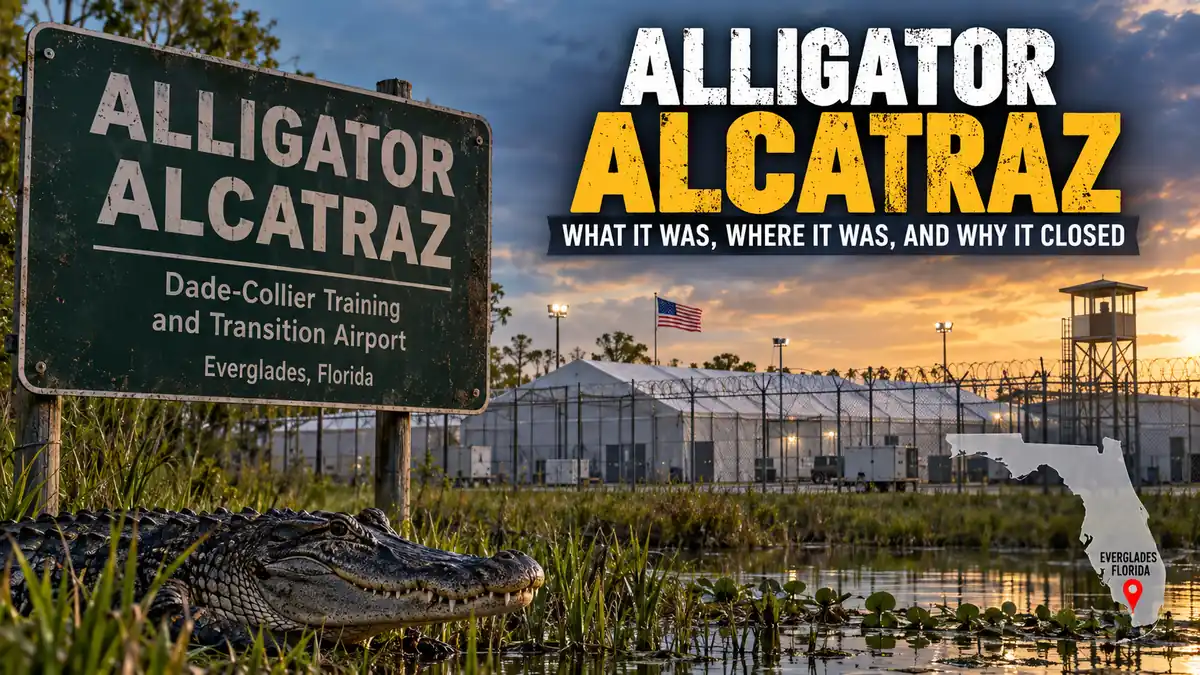
The name alligator alcatraz became attached to one of the most controversial immigration detention projects in Florida. Built rapidly in the Everglades region in 2025, the temporary facility drew national attention over immigration enforcement, detainee conditions, environmental concerns, legal access, costs, and the unusual location chosen for the site.
The detention operation ended in June 2026, but legal disputes and investigations continued afterward. A September 2026 report from the U.S. Department of Homeland Security’s Office of Inspector General added significant new information about conditions inside the facility, including cramped housing and the use of small metal enclosures.
Quick answer: alligator alcatraz was the nickname for a temporary immigration detention facility established by Florida at the Dade-Collier Training and Transition Airport in the Everglades region. It began receiving detainees in July 2025 and stopped detention operations on June 25, 2026, after becoming the subject of environmental, civil-rights, and legal challenges.
What Was alligator alcatraz?
Alligator Alcatraz was a nickname used for an immigration detention facility in southern Florida. Official descriptions have referred to the site as the Everglades Detention Facility or Florida Soft-Sided Facility.
It was constructed on the grounds of the Dade-Collier Training and Transition Airport, a remote airfield in the Everglades region near Ochopee, Florida. The facility consisted largely of temporary infrastructure rather than a conventional permanent jail.
Its nickname combined two ideas: the alligators associated with the Florida Everglades and Alcatraz, the former federal prison on an island in San Francisco Bay. Florida officials publicly embraced the name as the project became part of the state’s immigration-enforcement strategy.
The facility was developed as the federal government and Florida expanded detention capacity associated with immigration arrests and removals. Florida Governor Ron DeSantis’s administration described the project as part of the state’s cooperation with federal immigration authorities.
Where Was alligator alcatraz Located?
The facility was built at the Dade-Collier Training and Transition Airport in South Florida, west of the Miami metropolitan area.
The location matters because the surrounding landscape is environmentally sensitive. The airport property lies within the broader Everglades ecosystem and in the Big Cypress National Preserve area.
That put the project close to wetlands and habitat used by protected wildlife, including the endangered Florida panther.
The isolated setting also became part of the public discussion surrounding the facility. Its remoteness made access, transportation, environmental protection, emergency planning, and communication with lawyers important practical questions.
Environmental organizations argued that rapidly constructing a large detention complex in such a sensitive area required environmental review under federal law. The Justice Department, however, argued in July 2025 that the plaintiffs had not established the federal agency action needed for their claims and opposed efforts to halt construction.
Why Was alligator alcatraz Built?
The stated purpose was straightforward: increase immigration detention capacity.
During the Trump administration’s expanded immigration-enforcement effort, federal, state, and local authorities were looking for additional space to hold people in immigration custody while their cases or removals were processed.
Florida developed the temporary Everglades facility as part of its participation in those efforts.
Governor DeSantis later said the center had accomplished its intended mission and connected Florida’s detention support to increased immigration arrests and deportations. His administration said detainees remaining at the site were transferred to other federal facilities as the center was demobilized in June 2026.
Critics disputed broader claims about the project’s effectiveness and argued that its costs, conditions, environmental consequences, and legal problems made the facility an inappropriate model for immigration detention.
Those competing views explain why the site became much more than a temporary detention center. It became part of a wider national debate about how immigration enforcement should operate and what standards should govern state participation in federal immigration policy.
How Did the Facility Operate?
The detention center relied heavily on temporary structures, fencing, trailers, tents, and other rapidly installed infrastructure.
People detained there were held while immigration authorities dealt with their custody, immigration proceedings, transfers, or removal from the United States.
The facility was state-run, while U.S. Immigration and Customs Enforcement personnel also had a presence there. That unusual operational structure contributed to disputes over responsibility and oversight.
One legal challenge questioned whether Florida had authority to operate an immigration detention center through agreements made under Section 287(g) of the Immigration and Nationality Act. The plaintiffs argued that these agreements did not authorize Florida to independently operate the detention facility in the manner challenged in the case.
The relationship between state and federal authorities consequently became one of the central legal questions surrounding alligator alcatraz.
What Were Conditions Like Inside alligator alcatraz?
Conditions inside the facility became a major source of controversy while it operated, and a federal watchdog subsequently documented multiple deficiencies.
The Department of Homeland Security Office of Inspector General conducted an unannounced inspection in January 2026. Its findings, publicly reported in September, identified problems involving environmental health and safety, medical services, food services, hygiene, recreation, and living conditions. Inspectors also found that the facility met some requirements, including certain intake and use-of-force standards.
Cramped living space
The inspector general found that detainees were living in unusually crowded conditions.
According to reporting on the watchdog investigation, the general housing arrangement provided approximately 28 square feet per detainee, below the space required by the detention standards applied by inspectors.
Crowding was therefore not simply an aesthetic concern. Space requirements affect movement, privacy, sanitation, safety, and the basic functioning of a detention facility.
Small metal enclosures
One of the most widely reported findings concerned small metal enclosures located in outdoor recreation areas.
Staff reportedly called these structures “calming areas.”
The watchdog found that 79 detainees had been placed in the enclosures between July 2025 and January 2026, sometimes for periods approaching two hours. Investigators also found evidence that at least one enclosure may have been used for disciplinary purposes.
The DHS inspector general concluded that the practice did not conform to standards for humane treatment.
Hygiene, medical care, and sanitation
Inspectors also documented problems involving showers, sanitation, medical services, food operations, and access to basic hygiene.
The findings are significant because detention standards address more than physical security. They also establish expectations concerning healthcare, cleanliness, food safety, personal hygiene, recreation, and environmental conditions.
DHS disputed allegations that detainees had been treated inhumanely, while Florida officials defended the facility and their immigration-enforcement efforts.
Why Was Access to Lawyers a Major Issue?
Legal access became another central dispute.
People in immigration detention can face complicated proceedings involving removal, asylum, bond, custody determinations, and other immigration-law questions. Although immigration proceedings are civil rather than criminal, access to legal counsel can substantially affect a person’s ability to understand and participate in the process.
A lawsuit brought by detainees, legal-service providers, and law firms alleged that people at alligator alcatraz lacked meaningful confidential access to attorneys.
According to the ACLU of Florida, detainees initially had access to limited telephone calls that could be timed, monitored, or recorded, creating problems for confidential attorney-client communications.
On March 27, 2026, a federal court issued a preliminary injunction and ordered state and federal authorities to provide meaningful access to legal counsel for detainees covered by the case.
This dispute illustrates an important distinction: arguments surrounding the facility were not limited to whether immigration laws should be enforced. Courts were also asked to consider how detention and legal proceedings were being administered.
Why Did Environmental Groups Oppose alligator alcatraz?
The Everglades location produced a separate set of controversies unrelated to individual immigration cases.
Environmental organizations including Friends of the Everglades, the Center for Biological Diversity, and Earthjustice-backed plaintiffs challenged construction and operation of the facility.
Their concerns included habitat disruption, artificial lighting, new pavement, fencing, pollution, and the absence of what they argued should have been a federal environmental review.
One of the central laws involved was the National Environmental Policy Act (NEPA).
The initial environmental lawsuit alleged that government agencies had moved forward without conducting legally required environmental analysis. The Justice Department disputed that argument, maintaining in July 2025 that there was no qualifying federal final agency action at that stage and that the plaintiffs had not satisfied the requirements for emergency relief.
Environmental litigation continued even after detention operations ended.
In an amended lawsuit filed in August 2026, conservation groups argued that information concerning federal funding strengthened their position that federal environmental review should have occurred. Those allegations remained part of ongoing litigation rather than a final judicial determination of all disputed issues.
Air pollution became a separate concern
Another lawsuit focused specifically on air pollution.
The Center for Biological Diversity alleged that diesel generators and other equipment used to support the facility produced pollution without required permits. The organization sued the Florida Division of Emergency Management over those alleged violations in May 2026.
The environmental debate therefore covered several distinct issues rather than a single claim: construction impacts, wildlife habitat, federal review requirements, air pollution, and restoration of the site.
What Lawsuits Were Filed Over alligator alcatraz?
The litigation can be divided into several major categories.
| Legal issue | Main question |
|---|---|
| Environmental review | Was legally required environmental analysis completed before construction? |
| Access to counsel | Could detainees communicate meaningfully and confidentially with lawyers? |
| State authority | Did Florida have legal authority to operate this form of immigration detention facility? |
| Pollution | Did generators and other equipment comply with environmental requirements? |
| Detention treatment | Did particular practices or conditions violate applicable rights or standards? |
These cases should not be treated as interchangeable.
For example, an environmental lawsuit about NEPA addresses different legal questions from a case concerning attorney access. Likewise, a challenge to Florida’s authority to detain people is different from an investigation into whether facility conditions complied with detention standards.
Some legal disputes also continued after the detention center stopped operating. In August 2026, environmental plaintiffs amended their case concerning federal funding and environmental review.
When Did alligator alcatraz Close?
The facility stopped holding immigration detainees on June 25, 2026.
Earthjustice described that date as the end of detention operations at the site. Florida’s governor also announced that remaining detainees awaiting deportation had been transferred to other federal facilities and that demobilization was underway.
The closure did not mean every dispute surrounding the site disappeared.
Environmental litigation continued, questions remained about restoring the affected area, and investigations produced additional information about how detainees had been treated.
That distinction is important when reading older articles about alligator alcatraz. Pages published while the center was operating may describe it in the present tense, but those descriptions are now outdated.
As of September 2026, alligator alcatraz is no longer operating as an immigration detention center.
What Did the Federal Watchdog Find After the Closure?
The DHS Office of Inspector General’s findings substantially expanded the public record about the facility.
The watchdog’s unannounced January inspection examined housing, showers, food operations, medical services, recreation, and other parts of the center.
Its September 2026 findings described multiple failures to comply with applicable detention standards. Among the most notable were inadequate living space and the use of small metal enclosures for detainees.
At the same time, the inspection did not find failure in every category. Reporting on the report noted compliance with some standards, including intake and use-of-force requirements.
That makes the inspector general’s report particularly useful for understanding the facility: it provides a federal oversight assessment rather than relying exclusively on claims made by either Florida officials or advocacy organizations.
Was alligator alcatraz an ICE Facility?
The answer requires some nuance.
The center held people in immigration custody and ICE personnel were involved at the site, but Florida operated the facility. That state-federal arrangement became a central source of legal disagreement.
Detainee advocates challenged Florida’s authority to operate the center, while state officials characterized Florida’s actions as cooperation with the federal government’s immigration-enforcement program.
This distinction also affected arguments over which government entities were responsible for conditions, funding, legal access, and compliance with detention standards.
Why Did alligator alcatraz Become So Controversial?
No single issue explains the controversy.
The facility brought several politically and legally sensitive questions together in one place: immigration enforcement, federal-state authority, detainee rights, environmental protection, public spending, detention standards, and access to attorneys.
Supporters in Florida’s state government presented the project as a way to rapidly expand detention capacity and support federal immigration enforcement. Governor DeSantis’s administration later characterized the operation as successful and said its mission had been completed.
Civil-rights and immigrant-advocacy organizations focused on legal access, custody procedures, and treatment of detainees. Environmental organizations focused on the decision to construct the facility in the Everglades ecosystem without the environmental review they argued federal law required.
The DHS inspector general later added independent federal scrutiny of detention conditions, documenting shortcomings across multiple operational areas.
What Happened to the Detainees After the Facility Closed?
Florida officials said detainees still awaiting deportation were transferred to other federal facilities as operations wound down.
Closing the physical detention center did not itself resolve each person’s immigration case. Immigration proceedings, detention, transfer, release, or removal could continue elsewhere depending on the circumstances of the individual case.
This is another reason “closed” and “released” should not be treated as synonymous when discussing the facility.
The former means detention operations ended at that particular site. It does not mean everyone previously detained there was released from immigration custody.
What Is the Current Status of alligator alcatraz?
As of September 2026, the original Everglades detention center is closed to detainees.
Its legacy, however, remains active in several areas.
Litigation concerning environmental review and the consequences of the site’s construction has continued. Former guards have also faced separate criminal allegations; as of September 4, 2026, Collier County battery cases against two former guards remained pending, meaning those allegations had not been finally adjudicated.
Meanwhile, the September DHS inspector general findings have provided a more detailed official record of conditions during the facility’s operation.
For readers researching alligator alcatraz, dates therefore matter. Information from mid-2025 describes a newly opened facility; early-2026 reports concern an operating detention center; and material published after June 25, 2026 should reflect that detention operations have ended.
The Bigger Picture
The history of alligator alcatraz is ultimately about more than its unusual nickname.
The Everglades facility demonstrated how quickly governments can create temporary immigration detention capacity—and how rapidly questions about oversight, environmental law, detention standards, legal representation, state authority, and public accountability can follow.
It began operating in 2025 as a prominent part of Florida’s cooperation with federal immigration enforcement. By June 25, 2026, detention operations had ended and remaining detainees were being transferred elsewhere. Subsequent federal oversight findings documented serious shortcomings in several aspects of the facility’s operation.
Anyone researching alligator alcatraz now should therefore distinguish between three things: the political arguments surrounding its creation, the allegations and defenses raised while it operated, and the later findings of courts and government investigators. That separation provides a clearer picture of what the facility was, why it attracted national attention, and why its effects continue to be debated even after its closure.
