

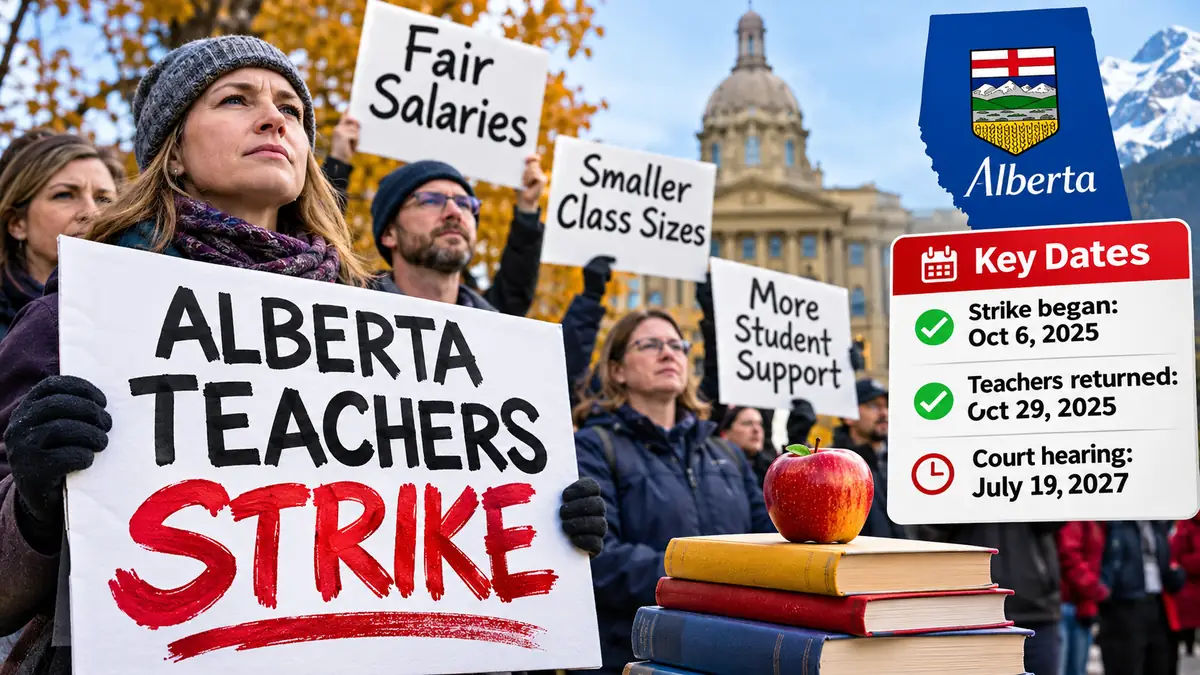
The alberta teachers strike disrupted public education across the province in October 2025, leaving hundreds of thousands of students without regular classroom instruction and raising serious questions about teacher compensation, classroom conditions, and collective bargaining rights.
Although teachers returned to classrooms, the dispute did not end with a negotiated agreement. Government legislation brought the strike to an end, while the Alberta Teachers’ Association continued challenging the decision through the courts.
The alberta teachers strike began on October 6, 2025, and ended after the provincial government passed the Back to School Act. Teachers returned to classrooms on October 29, 2025. As of November 11, 2026, the provincewide strike is over, but a constitutional challenge to the legislation remains unresolved, with a hearing scheduled for July 2027. Alberta.ca+2
Latest alberta teachers strike Update: Is the Strike Over?
Yes. The provincewide teachers’ strike ended in October 2025 after Alberta’s government introduced Bill 2, the Back to School Act.
The legislation required teachers to return to work, established employment terms through August 31, 2028, and restricted further strike or lockout action during that period.
Edmonton Public Schools confirmed that regular classes resumed on Wednesday, October 29, 2025. Alberta.ca+1
STATUS AS OF NOVEMBER 11, 2026
| Strike status | Ended |
| Strike began | October 6, 2025 |
| Teachers returned | October 29, 2025 |
| Back-to-work legislation | Bill 2 |
| Employment terms expire | August 31, 2028 |
| Next scheduled court hearing | Week of July 19, 2027 |
The distinction between the end of the strike and the resolution of the underlying dispute matters.
Teachers returned because legislation required them to do so, not because union members voted to accept a new agreement after the walkout.
The Alberta Teachers’ Association (ATA) has continued to oppose the imposed settlement and pursue legal action concerning teachers’ constitutional rights. Alberta Teachers’ Association+1
Why Did Alberta Teachers Go on Strike?
The dispute developed from negotiations over compensation, working conditions, and the resources available to support students.
The previous collective agreement expired in August 2024. Negotiations between the ATA and the Teachers’ Employer Bargaining Association (TEBA) failed to produce an agreement acceptable to teachers.
Three major issues shaped the disagreement.
Teacher Salaries and Cost of Living
Compensation was a central concern during bargaining.
Teachers argued that salary increases needed to reflect rising living costs and the demands of their profession.
Salary negotiations also involved differences between existing local pay grids and proposals for a more consistent provincial structure.
The government maintained that its compensation package offered meaningful increases, while union members rejected the proposed settlement.
This disagreement became especially significant when teachers voted against a tentative agreement shortly before the strike began.
Classroom Sizes and Student Needs
The dispute extended beyond wages.
Teachers raised concerns about increasingly demanding classroom environments, including large classes, complex learning needs, and the availability of specialized support.
A classroom with many students may include children requiring individualized instruction, language assistance, behavioral support, or additional learning accommodations.
When sufficient resources are unavailable, teachers may struggle to provide every student with the attention they need.
For educators, classroom conditions were therefore closely connected to student learning outcomes.
Workload and Education Funding
Teachers also expressed frustration about the amount of work required outside regular instructional hours.
Lesson planning, grading, parent communication, student assessment, and administrative responsibilities can significantly increase workload.
The union argued that meaningful improvements required attention to staffing and educational resources, not simply changes to salary schedules.
The government and union differed over how these issues should be addressed through collective bargaining and broader education policy.
The ATA’s account of the rejected agreement emphasized that teachers wanted concrete improvements in classroom conditions alongside compensation changes. Alberta Teachers’ Association+1
alberta teachers strike Timeline: Key Dates and Events
The October walkout followed more than a year of negotiations, mediation, and voting.
Understanding the sequence explains why the dispute escalated and how government intervention eventually ended it.
| Date | Major development |
|---|---|
| August 2024 | Previous teachers’ collective agreement expired |
| January 2025 | Negotiations moved into mediation |
| May 2025 | Teachers rejected mediator-recommended terms |
| June 5–8, 2025 | Teachers voted overwhelmingly to authorize strike action |
| September 10, 2025 | ATA announced its intended October strike date |
| September 24, 2025 | Tentative agreement reached |
| September 29, 2025 | Teachers rejected the tentative agreement |
| October 6, 2025 | Provincewide strike began |
| October 9, 2025 | Employer lockout began |
| October 27, 2025 | Government introduced Bill 2 |
| October 28, 2025 | Back-to-work legislation passed |
| October 29, 2025 | Teachers returned to classrooms |
| April 2026 | ATA announced a delay in its full court hearing |
| July 2027 | Constitutional hearing scheduled |
Parkland School Division+3
The June 2025 Strike Authorization Vote
In June 2025, ATA members voted on whether to authorize strike action.
The union reported that 36,862 teachers supported strike action, representing 94.5% of the valid votes cast.
This result demonstrated substantial support among participating teachers for escalating the labour dispute if negotiations failed. Alberta Teachers’ Association
Importantly, a strike authorization vote does not automatically mean a walkout begins immediately.
It gives union leadership the authority to initiate lawful strike action subject to applicable labour requirements.
Rejection of the September Agreement
Negotiators reached a tentative agreement in September 2025.
However, teachers rejected it during a membership vote held from September 27 to 29.
According to the ATA, 89.5% voted against the proposed agreement, with more than 43,000 teachers participating.
The rejection showed that the proposed terms did not adequately address the concerns of most voting members.
With no ratified settlement, the planned October strike proceeded. Alberta Teachers’ Association
October 6: Teachers Begin Strike Action
The provincewide walkout began on Monday, October 6, 2025.
Schools affected by the strike suspended regular classroom instruction.
The labour disruption involved public, separate Catholic, and Francophone school systems covered by the provincial bargaining process.
TEBA subsequently implemented a lockout beginning October 9, further formalizing the interruption in teaching services.
October 27–29: Government Intervention
On October 27, the Alberta government introduced legislation to end the labour dispute.
Bill 2 passed on October 28, and teachers were required to return on October 29.
The strike had lasted 16 instructional days, according to the ATA. Alberta Teachers’ Association
The return to work restored classroom instruction, but it also triggered a separate legal controversy over the government’s use of legislative powers.
What Is Bill 2, the Back to School Act?
Bill 2 was the Alberta government’s legislative response to the October 2025 teachers’ strike.
Rather than allowing negotiations and labour action to continue, the government imposed employment terms and required teachers to resume their duties.
The legislation covered the provincial bargaining cycle from September 1, 2024, through August 31, 2028.
Its main provisions included:
- Requiring teachers to return to work.
- Establishing salary and employment conditions.
- Restricting additional strikes and lockouts during the agreement period.
- Preserving existing local employment terms under the legislation.
- Creating financial penalties for prohibited labour action.
The government argued that intervention was necessary to protect students from prolonged educational disruption.
The ATA opposed the legislation, arguing that it undermined teachers’ collective bargaining rights and imposed terms that members had rejected. Alberta.ca+2
Why Did Alberta Use the Notwithstanding Clause?
One of the most controversial features of Bill 2 was the government’s use of Section 33 of the Canadian Charter of Rights and Freedoms.
Commonly called the notwithstanding clause, Section 33 allows federal or provincial legislatures to enact certain laws that operate despite specified Charter protections.
In this case, Alberta invoked the clause to protect aspects of its back-to-work legislation from challenges based on particular constitutional rights.
The dispute raises questions about freedom of association, collective bargaining, and the constitutional limits of government intervention in labour disputes.
The government’s position was that restoring classroom instruction justified extraordinary legislative action.
The union’s position was that teachers’ constitutionally protected labour rights should not be overridden in this manner.
The legal challenge is therefore about more than salary negotiations. It also concerns how governments can exercise legislative authority during major labour disputes. CBA Alberta+1
What Penalties Did the Legislation Introduce?
The Back to School Act established significant penalties for prohibited strike activity.
Under the legislation, individuals engaging in prohibited labour action could face fines of up to $500 per day.
For other violations, including those involving the union, penalties could reach $500,000 per day.
These provisions were designed to enforce the return-to-work requirement and prevent further prohibited labour disruptions during the legislated period. Alberta.ca
How Did the Strike Affect Alberta Students and Parents?
The strike had immediate consequences for families across Alberta.
Students lost access to regular classroom instruction, while parents and caregivers had to adjust work schedules, childcare arrangements, and daily routines.
The effects differed depending on students’ ages, educational needs, and individual school circumstances.
School Closures and Interrupted Learning
During the strike, affected schools suspended in-person classes.
For example, Edmonton Public Schools confirmed that classes were paused beginning October 6 and resumed October 29.
School divisions also advised families that normal instructional activities would not continue during the labour disruption. Edmonton Public Schools+1
The interruption created particular concerns for students preparing for examinations or completing important coursework.
Older students faced uncertainty about assignment deadlines, assessments, and academic schedules.
Younger children experienced interruptions to established classroom routines.
Students requiring specialized educational support could also face challenges when their usual school-based services were unavailable.
Childcare Challenges for Working Parents
School closures created practical difficulties for families that relied on regular school schedules.
Parents needed alternative supervision arrangements during hours when children would ordinarily be in class.
Some families could rely on relatives or existing childcare providers. Others had fewer options.
For households with limited flexibility at work, unexpected school closures could create financial and scheduling pressure.
The Alberta government announced support measures for parents during the disruption, while school divisions distributed information about childcare and related resources. Labour Relations
Extracurricular Activities and School Services
The effects extended beyond academic lessons.
Affected schools suspended activities such as clubs, school sports, field trips, and other organized events.
School divisions also warned families not to assume that normal student supervision or school transportation arrangements would continue.
These operational changes mattered because many students depend on schools for more than classroom instruction.
Schools provide social interaction, structured routines, extracurricular opportunities, and access to educational support.
Did Students Have to Make Up Missed School Days?
The return to classes did not automatically mean that every missed instructional day would be replaced.
School calendars, assessment arrangements, and academic recovery measures depend on decisions made by the province and individual school authorities.
Parents should distinguish between a general announcement that classes have resumed and specific instructions about missed coursework.
For accurate information about a particular school, families should consult their school division’s official calendar, assessment notices, and communications.
Students who experienced learning difficulties following the interruption may also benefit from discussing academic support options with their teachers.
What Salary Increases Did Alberta Teachers Receive?
Bill 2 established compensation terms for the 2024–2028 bargaining period.
The imposed settlement included annual salary adjustments and a transition toward a unified provincial salary grid for most bargaining units.
According to the ATA’s explanation of the legislation, the main scheduled adjustments were as follows. Alberta Teachers’ Association
| Effective date | Salary provision |
|---|---|
| September 1, 2024 | 3% increase to local salary grids |
| September 1, 2025 | Additional 3% increase |
| September 1, 2026 | Transition to a unified grid for most units, with a 3% increase |
| September 1, 2027 | Further 3% increase |
These percentages should not be interpreted as a simple guarantee that every teacher receives the same total dollar increase.
Actual compensation depends on the applicable salary grid, qualifications, years of experience, and bargaining unit.
What Is the Unified Salary Grid?
Historically, Alberta teachers’ salary arrangements varied between school divisions.
The imposed settlement introduced a unified salary grid for most divisions, using the Grande Prairie Public salary grid as the reference structure beginning September 1, 2026.
Some bargaining units were excluded from this transition.
These included the two Fort McMurray units, Fort Vermilion, Northland, and Peace River.
Those units retained their local salary grids while receiving the scheduled percentage adjustments.
The purpose of a unified structure is to reduce differences in salary arrangements across participating school divisions.
However, the ATA’s criticism was not limited to the amount of compensation. It also concerned the government’s decision to impose terms without member ratification. Alberta Teachers’ Association
What Changed for Substitute Teachers?
The legislation also affected substitute teacher compensation.
The ATA identified a standardized provincial substitute teacher daily rate of $271 for the 2025–2026 school year.
The settlement provided for subsequent 3% increases in the 2026–2027 and 2027–2028 school years.
It also addressed partial-day compensation and paid training provisions in circumstances where such provisions did not previously exist.
These changes are relevant because substitute teachers support classroom continuity when regular teachers are absent.
Did the Settlement Address Teacher Recruitment?
The legislated terms included a letter of understanding concerning the recruitment of 1,000 new teachers annually over three years.
The agreement also addressed northern and remote allowances and certain employment-experience provisions. Alberta Teachers’ Association
A recruitment commitment, however, is not the same as verified evidence that every position has been filled.
The actual effect on classroom conditions depends on hiring, retention, school placement, and student enrolment.
This distinction is especially important when evaluating whether the settlement addresses the workload and classroom concerns that contributed to the strike.
What Happened to the Alberta Teachers’ Legal Challenge?
The legal dispute continued after teachers returned to work.
The ATA challenged Bill 2, arguing that the legislation improperly interfered with constitutional protections and collective bargaining rights.
The association sought an injunction that would temporarily suspend aspects of the legislation while the broader case proceeded.
In March 2026, the teachers were unsuccessful in obtaining that temporary relief.
However, the failure to obtain an injunction did not resolve the full constitutional challenge. CityNews Calgary
Why Was the Court Hearing Delayed?
On April 20, 2026, the ATA announced that its full hearing would be delayed.
The association explained that its legal counsel, Field Law, had recommended waiting because of related constitutional cases before the Supreme Court of Canada.
Those cases, originating from Quebec and Saskatchewan, concern legal questions relevant to governments’ use of the notwithstanding clause.
The ATA said that waiting could allow its legal team to consider important Supreme Court decisions before presenting its arguments.
The full hearing was rescheduled for the week of July 19, 2027. Alberta Teachers’ Association
What Could the Court Case Mean for Teachers?
The outcome could influence how the law treats the government’s intervention and potentially clarify constitutional questions about collective bargaining rights.
Several possibilities exist.
A court could reject the union’s arguments and leave the challenged provisions intact.
Alternatively, a court could find legal problems with some provisions, although the practical remedies would depend on the judgment and any subsequent appeals.
The case may also contribute to broader legal discussion about Section 33 and labour relations in Canada.
No final outcome should be assumed before the court rules.
Could Teachers Strike Again Before 2028?
Bill 2 restricts further strikes and lockouts during the legislated employment period ending August 31, 2028.
That means teachers cannot simply resume the same provincewide strike under the current legislative framework without facing potential legal consequences.
The situation could change if the law is amended, repealed, or affected by a future court ruling.
For now, the legislation establishes the framework governing the current bargaining period. Alberta.ca+1
What Does the Strike Mean for Alberta’s Education System?
The dispute exposed competing priorities in Alberta’s public education system.
Teachers emphasized compensation, professional working conditions, student support, and the right to negotiate employment terms collectively.
The government emphasized restoring access to classroom instruction and preventing prolonged disruption for students and families.
Both positions concern important public interests, but they approach the problem from different directions.
Teacher Retention and Recruitment
Teacher recruitment is closely connected to classroom stability.
When school systems struggle to attract or retain qualified educators, existing staff may face additional demands.
Competitive compensation, manageable workloads, professional support, and working conditions can all influence retention.
The legislated recruitment provisions may help address staffing pressures, but their effectiveness requires evaluation using actual hiring and retention data.
Student Support and Classroom Conditions
Salary changes alone cannot resolve every concern raised during the strike.
Classroom size, specialized learning support, student needs, and administrative workload remain separate policy questions.
For example, recruiting more teachers may improve staffing capacity, but the effect on individual classrooms depends on where those teachers are assigned.
Similarly, improvements in learning support require appropriate staffing, resources, and implementation.
Evaluating progress therefore requires more than examining the salary settlement.
Collective Bargaining and Labour Relations
The strike also created a significant precedent for labour relations in Alberta.
Collective bargaining normally allows employers and employee representatives to negotiate employment terms, with legal processes available when negotiations fail.
In this case, legislation replaced the unresolved bargaining process with government-imposed conditions.
The ATA considers that approach an infringement of teachers’ bargaining rights.
The government considers the intervention necessary to restore educational stability.
The unresolved constitutional challenge will be important in determining the legal implications of that decision.
How Can Parents and Teachers Find Reliable Strike Updates?
Because the dispute involves both education operations and ongoing litigation, information can become outdated quickly.
A headline describing school closures in October 2025 should not be interpreted as evidence that schools remain closed in November 2026.
Readers should check the publication date and distinguish historical reporting from current announcements.
The most relevant official sources include:
- Alberta Teachers’ Association — union statements, employment information, bargaining developments, and legal updates.
- Government of Alberta — government explanations of the legislation and imposed employment terms.
- Edmonton Public Schools labour updates — school operations and historical return-to-class information.
For school-specific matters, families should prioritize announcements from their own school division.
Teachers seeking information about salary grids, employment conditions, or legal obligations should consult their bargaining-unit documents and current ATA guidance.
What Happens Next After the alberta teachers strike?
The immediate classroom disruption has ended, but several longer-term questions remain.
The most significant scheduled development is the constitutional hearing in July 2027.
That proceeding could help clarify the legal status of the government’s intervention and the extent of the protections available to teachers in collective bargaining disputes.
The current employment framework is scheduled to continue through August 2028.
As that date approaches, future bargaining arrangements, legislative developments, and court decisions may shape the next stage of labour relations.
Meanwhile, Alberta’s education system continues to face questions about staffing, compensation, student support, and classroom resources.
Those issues existed before the strike and cannot be considered resolved solely because teachers returned to work.
Final Thoughts
The alberta teachers strike was a major labour dispute that highlighted disagreements over teacher compensation, classroom conditions, education resources, and collective bargaining rights.
Beginning October 6, 2025, the walkout interrupted regular schooling until the provincial government passed Bill 2 and teachers returned on October 29.
The legislation restored classroom instruction and imposed employment terms through August 2028, but it did not resolve every concern raised by educators.
As of November 11, 2026, the strike is over, and the legal challenge remains the central unresolved issue.
For parents, teachers, and students, the next important development is the court hearing scheduled for July 2027. Until then, official ATA, government, and school division announcements remain the most reliable sources for understanding any changes to the situation.
