

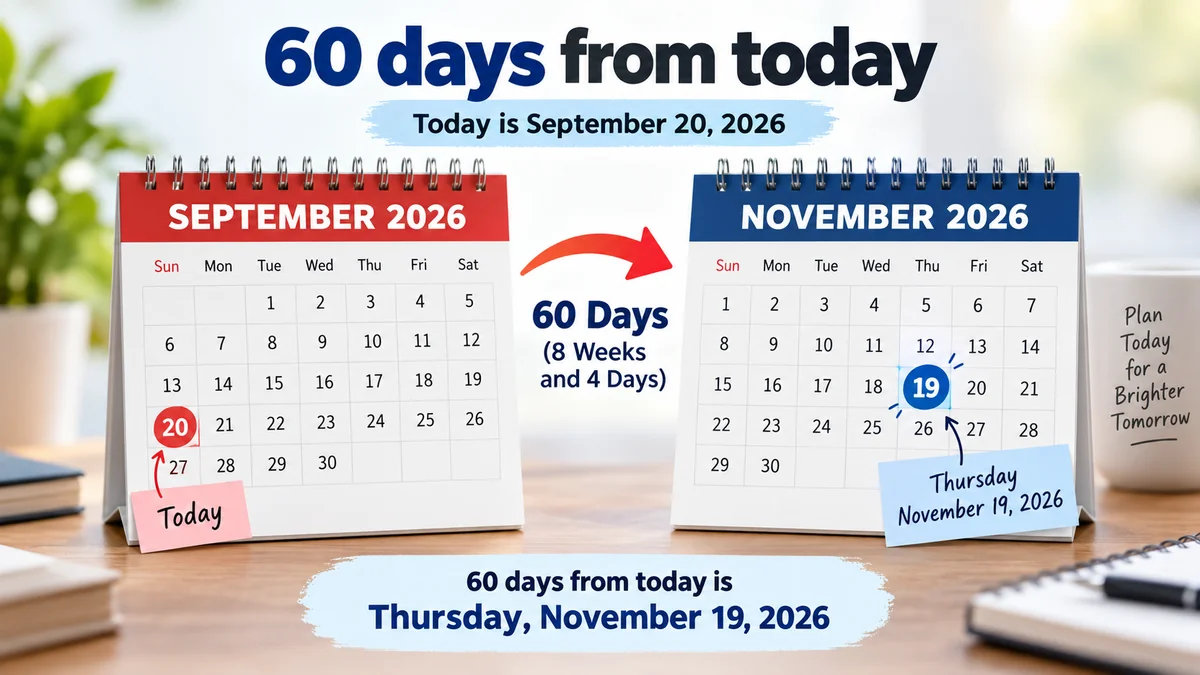
Need the exact date without counting through a calendar? Based on today, Sunday, September 20, 2026, 60 days from today is Thursday, November 19, 2026.
60 days from today is Thursday, November 19, 2026. The calculation adds 60 consecutive calendar days to September 20, treating today as day 0 and September 21 as day 1. Sixty days equals 8 weeks and 4 days, and ordinary calendar-day counting includes Saturdays and Sundays.
| Calculation | Result |
|---|---|
| Today’s date | September 20, 2026 |
| 60 days from today | November 19, 2026 |
| Day of the week | Thursday |
| Time span | 8 weeks and 4 days |
| ISO date | 2026-11-19 |
| Calendar days counted | 60 |
| Year | 2026 |
| Quarter | Q4 |
What date is 60 days from today?
The date 60 days from today is Thursday, November 19, 2026. Multiple current date calculators using September 20, 2026 as the starting date return the same result.
The basic calculation is:
September 20, 2026 + 60 calendar days = November 19, 2026
This calculation uses calendar days, meaning weekends are included. Unless a deadline specifically says “business days,” “working days,” or defines another counting method, a basic days-from-today calculation normally advances through every date on the calendar.
Quick Takeaway
60 days from today = Thursday, November 19, 2026.
The answer can change depending on your local date and time zone. If your location has already moved to September 21 while another location is still on September 20, the resulting date will naturally differ by one day. Some online calculators therefore show different results when their server or cached page is using a different “today.”
How to calculate 60 days from today
Calculating 60 days from today is straightforward once you distinguish calendar days from calendar months.
Start with September 20, 2026 and add 60 complete days. Today is normally treated as day 0, so tomorrow, September 21, becomes day 1. This convention is used by current date-calculation tools.
Here is the month-by-month calculation:
| Month | Days counted | Days remaining |
|---|---|---|
| September 21–30 | 10 days | 50 |
| October 1–31 | 31 days | 19 |
| November 1–19 | 19 days | 0 |
That brings the count to November 19, 2026.
Another easy method: convert days to weeks
Because one week contains seven days:
60 ÷ 7 = 8 weeks with 4 days remaining
So:
60 days = 8 weeks + 4 days
Eight full weeks preserve the weekday because 56 days is exactly eight seven-day cycles. The remaining four days move the weekday forward four positions.
Starting on Sunday:
Sunday → Monday → Tuesday → Wednesday → Thursday
That confirms that the result falls on Thursday, November 19, 2026.
Does 60 days from today include weekends?
Yes. A standard 60 days from today calculation uses calendar days, so Saturdays and Sundays count just like weekdays. Public holidays also remain part of the 60-day period unless the rule, agreement, or deadline you are following explicitly excludes them.
For example, if a 60-calendar-day period crosses four Saturdays and four Sundays, those dates are still included. You do not pause the count each Friday and restart it on Monday.
This distinction matters for deadlines.
Calendar days generally means every consecutive date:
- Monday
- Tuesday
- Wednesday
- Thursday
- Friday
- Saturday
- Sunday
Business days or working days generally exclude weekends. Depending on the context, public or bank holidays may also be excluded.
A date calculator that says “60 days” and one that says “60 business days” can therefore produce substantially different end dates.
60 days from today vs. 60 business days from today
These two calculations should not be treated as interchangeable.
Starting from September 20, 2026, 60 calendar days takes you to Thursday, November 19, 2026.
If you instead count 60 weekdays, excluding Saturdays and Sundays, the period extends further into the future. Current calculators place 60 weekdays from September 20 at Friday, December 11, 2026 when only weekends are excluded.
| Counting method | Result |
|---|---|
| 60 calendar days | Thursday, November 19, 2026 |
| 60 weekdays, Mon–Fri | Friday, December 11, 2026 |
| Weekends included? | Yes for calendar days |
| Public holidays automatically excluded? | Not necessarily |
There is an important catch with the second result: weekdays and business days are not always identical.
A simple weekday calculation usually removes Saturdays and Sundays but may continue counting public holidays that fall Monday through Friday. A formal business-day deadline may require certain holidays to be removed as well. Inch Calculator, for example, explicitly notes that its weekday result does not account for weekday holidays.
For contracts, court deadlines, employment notices, payment terms, visa requirements, or other formal periods, follow the counting definition provided by the relevant organization or document rather than assuming a generic calendar rule.
Is 60 days the same as two months?
No. 60 days and two calendar months are not necessarily the same length of time.
This is one of the most common mistakes when doing date arithmetic.
Months do not all contain the same number of days:
| Month length | Examples |
|---|---|
| 28 days | February in a common year |
| 29 days | February in a leap year |
| 30 days | April, June, September, November |
| 31 days | January, March, May, July, August, October, December |
Because month lengths vary, adding exactly 60 days can produce a different result from adding two calendar months. Current date-calculation resources specifically distinguish a fixed 60-day interval from calendar-month addition.
For today’s calculation, the difference is easy to see.
Two months from September 20, 2026: November 20, 2026
60 days from September 20, 2026: November 19, 2026
So the two calculations differ by one day in this case.
If a document says “within 60 days,” calculate 60 days. If it says “within two months,” do not automatically replace that period with 60 days.
Why the difference matters
The distinction can affect real deadlines involving:
- return windows
- warranties
- notice periods
- payment terms
- probation periods
- applications
- document submissions
- subscriptions
- appointments
- project milestones
When the wording has legal or financial consequences, use the exact unit stated in the applicable rule.
Does today count as day 1?
For the standard date-addition method used here, today is day 0.
That means:
- September 20 = starting date
- September 21 = day 1
- September 22 = day 2
- September 30 = day 10
- October 31 = day 41
- November 19 = day 60
This produces Thursday, November 19, 2026.
Some situations use inclusive counting, where the starting date itself is labeled day 1. That convention can shift the apparent endpoint, so it is worth checking the instructions whenever you are calculating an official deadline.
The standard “date plus 60 days” interpretation does not count the starting date as the first added day.
60 days from today in weeks, hours, minutes, and seconds
A 60-day period can also be expressed in several other units.
| Unit | Equivalent to 60 days |
|---|---|
| Weeks | 8 weeks and 4 days |
| Hours | 1,440 hours |
| Minutes | 86,400 minutes |
| Seconds | 5,184,000 seconds |
The hour, minute, and second conversions come from multiplying a standard 24-hour day:
60 × 24 = 1,440 hours
1,440 × 60 = 86,400 minutes
86,400 × 60 = 5,184,000 seconds
These conversions describe the nominal duration. When exact timestamps rather than calendar dates are involved, time-zone changes and daylight-saving transitions can affect how clock time is represented locally.
For an ordinary date question, however, the relevant answer remains the calendar date: November 19, 2026.
What day of the year is 60 days from today?
November 19, 2026 falls late in the fourth quarter of the year.
Current calendar calculations identify it as Thursday in week 47 of 2026.
The date can be written in several common formats:
| Format | Date |
|---|---|
| Written date | November 19, 2026 |
| Day-month-year | 19 November 2026 |
| U.S. numeric | 11/19/2026 |
| Day/month/year | 19/11/2026 |
| ISO 8601 date | 2026-11-19 |
| Weekday | Thursday |
Be careful with numeric dates such as 11/19/2026. Date formats vary internationally, so writing the month in words or using the ISO format 2026-11-19 can reduce ambiguity.
Nearby dates around 60 days from today
Sometimes you need to compare a deadline with the day before or after it. Using September 20, 2026 as the starting point, the surrounding dates are:
| Days from today | Date |
|---|---|
| 56 days | Sunday, November 15, 2026 |
| 57 days | Monday, November 16, 2026 |
| 58 days | Tuesday, November 17, 2026 |
| 59 days | Wednesday, November 18, 2026 |
| 60 days | Thursday, November 19, 2026 |
| 61 days | Friday, November 20, 2026 |
| 62 days | Saturday, November 21, 2026 |
| 63 days | Sunday, November 22, 2026 |
| 64 days | Monday, November 23, 2026 |
The same sequence is reflected in current date calculators that show surrounding start and result dates.
Why different websites may show a different date
A search for 60 days from today can occasionally produce conflicting answers. Usually, the arithmetic is not the problem—the websites are simply using different starting dates.
“Today” depends on the date at the moment the calculation is performed.
A page generated when the current date is September 19 will calculate:
September 19 + 60 days = November 18, 2026
A page using September 20 calculates:
September 20 + 60 days = November 19, 2026
Some current search results illustrate exactly this difference: pages using September 20 return November 19, while pages cached or calculated from September 19 return November 18.
Time zones can create the same issue around midnight. One country may already be on the next calendar date while another is still on the previous day.
For an accurate result, always verify the starting date shown by the calculator, not just its final answer.
Common uses for calculating 60 days ahead
A 60-day date calculation can be useful whenever you need to turn a duration into an actual calendar deadline.
Common examples include tracking a return period, setting a project milestone, checking a warranty window, planning an appointment, calculating a notice period, or scheduling a follow-up. Date calculators also commonly mention contract and guarantee deadlines as reasons people calculate future dates.
For personal planning, the simple calendar calculation is usually enough. For formal deadlines, read the underlying terms carefully.
Check three things:
- Does the period use calendar days or business days?
- Is the starting date included or excluded?
- Are weekends or public holidays excluded?
Those details can change the deadline even when everyone starts with the same number—60.
Final answer: 60 days from today
60 days from today is Thursday, November 19, 2026, based on today’s date of Sunday, September 20, 2026.
That period equals 8 weeks and 4 days and uses ordinary calendar-day counting, so weekends are included. If you need 60 working or business days instead, calculate them separately because the resulting date will be later.
For any important deadline, confirm whether the applicable rules require calendar days, weekdays, business days, holiday exclusions, or inclusive counting before relying on the final date.
