

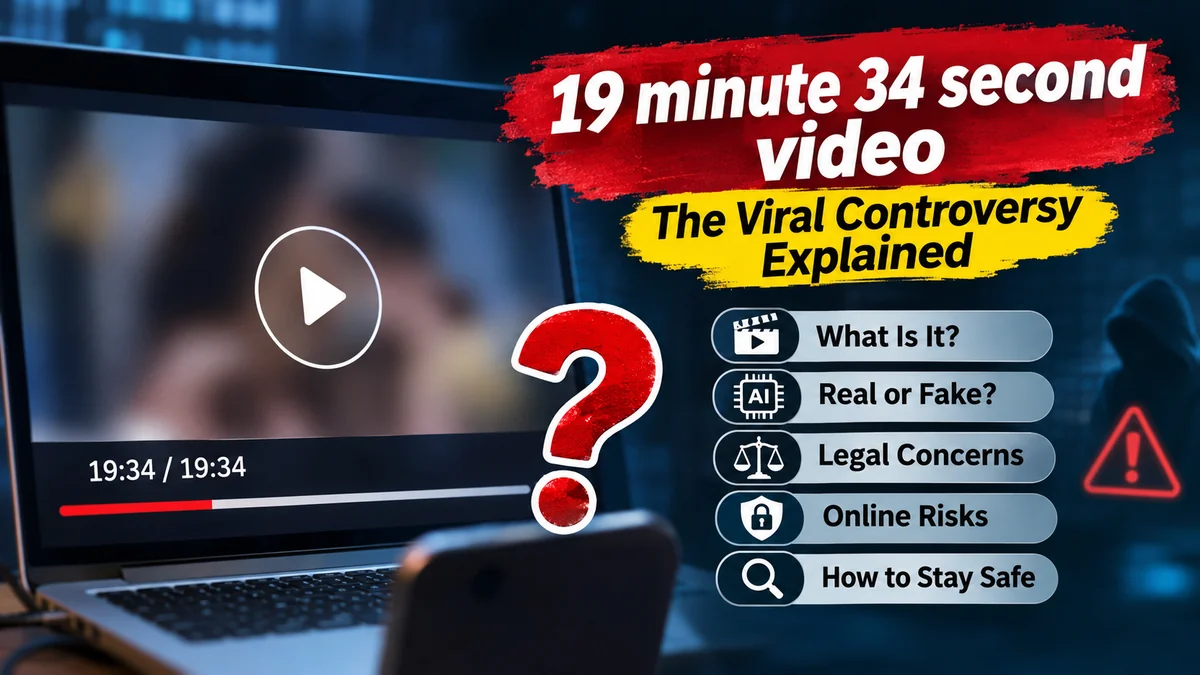
A mysterious video duration became one of the internet’s most discussed search phrases, triggering curiosity, speculation, and concerns about digital privacy.
The 19 minute 34 second video refers to a viral social media controversy involving an alleged private recording that attracted widespread attention in India and other parts of South Asia. Despite numerous claims about its content and the people supposedly involved, the original footage has not been independently authenticated in the reporting reviewed.
The controversy gained attention in late 2025 and continued attracting searches during 2026. What began as an alleged leaked recording developed into a wider discussion about artificial intelligence, online misinformation, cybercrime, and the consequences of sharing unverified material. Trending+2
What Is the 19 minute 34 second video?
The phrase describes an alleged recording lasting exactly 19 minutes and 34 seconds. Social media posts claimed that it showed private moments involving two individuals, leading many internet users to search for its origin and authenticity.
However, a precise running time does not establish that a particular recording is genuine.
Several variations of the story appeared across social networks. Some posts described an original recording, while others promoted supposed additional installments or edited versions.
The key distinction is between what people claimed online and what reliable reporting actually established.
| Viral claim | What is verified |
|---|---|
| A recording lasting exactly 19:34 exists | No independently authenticated original was established in the sources reviewed |
| Specific individuals appear in the recording | Online identity claims remain unverified |
| Additional parts were released | No authenticated connection between supposed installments |
| The footage was created using AI | An officer described circulating material as AI-generated, but not every version has been independently examined |
| Every link leads to the original footage | Links may contain misleading content or security threats |
This uncertainty is central to understanding the controversy. A widely repeated claim can become popular without becoming factual.
How Did the 19 minute 34 second video Become Viral?
Social media curiosity and mysterious captions
The controversy gained momentum through short posts, screenshots, reaction videos, and cryptic captions.
Instead of explaining the subject, many posts mentioned only the unusual duration. This created an information gap that encouraged viewers to search for an explanation.
Platforms associated with discussions included Instagram, X (formerly Twitter), YouTube, WhatsApp, and Telegram.
The exact timestamp made the story appear unusually specific, even though specificity alone provides no evidence of authenticity.
Search trends and reaction content
As curiosity increased, creators published videos discussing the alleged recording.
Some offered commentary, while others used sensational headlines or thumbnails to attract attention.
This created a repeating cycle:
- A mysterious claim appears on social media.
- Users search for the alleged recording.
- Creators publish reactions and explanations.
- New viewers encounter those reactions.
- Additional searches increase the trend’s visibility.
The popularity of the search phrase therefore does not necessarily indicate that large numbers of people viewed an authenticated recording.
Reporting in December 2025 described substantial search interest in Indian states including Bihar, Uttar Pradesh, Rajasthan, Jharkhand, and Chhattisgarh. Trending+1
Why the exact duration matters
A title such as “19 minutes 34 seconds” can appear more convincing than a vague description.
Specific numbers may suggest that someone has measured or examined the original footage. In reality, an exact duration can simply be repeated from one unverified post to another.
This is one reason mysterious timestamps are effective in clickbait campaigns.
Is the 19 minute 34 second video Real or Fake?
The authenticity question has remained one of the most important aspects of the controversy.
Available reporting does not establish a single independently authenticated original recording corresponding to every claim associated with the viral phrase.
In December 2025, Hindustan Times reported that Haryana NCB Cyber Cell officer Amit Yadav described the circulating video as AI-generated and warned against sharing it. Trending+1
That statement is relevant, but it should not be interpreted as forensic verification of every file circulating under the same name.
What are AI-generated videos and deepfakes?
A deepfake is synthetic or manipulated media created using artificial intelligence to alter or generate convincing images, voices, or moving footage.
Modern AI systems can produce content that resembles genuine recordings, making it difficult for casual viewers to distinguish authentic footage from fabricated material.
Common forms of manipulation include:
- Face swapping, in which one person’s face is digitally placed onto another person’s body.
- Voice cloning, which imitates someone’s speech.
- AI-generated scenes that depict events that never happened.
- Conventional editing that removes context or combines unrelated footage.
Not all misleading videos are deepfakes. Some are ordinary recordings presented with false captions, altered timelines, or incorrect identities.
How can viewers check video authenticity?
A practical verification process begins with identifying the original source rather than relying on reposts.
Look for publication history, reliable reporting, consistent visual details, and credible statements from relevant authorities.
Reverse-image searches can sometimes reveal whether a screenshot appeared online before the alleged incident.
Tools such as Google Lens and InVID can assist with visual investigation, although neither provides automatic proof that a recording is genuine.
AI detection tools may offer additional clues, but their results are not conclusive. Both false positives and false negatives are possible.
The absence of obvious editing artifacts does not prove that a video is authentic.
Why Are People Searching for the 19 minute 34 second video Link?
Many people searching the phrase are attempting to understand the controversy. Others encounter posts advertising an alleged full recording.
Searches may include variations such as “19:34 viral video,” “19 minute viral video,” or references to supposed additional parts.
These phrases frequently appear in posts that promise access to exclusive material.
The problem with original video links
A link advertised as an original recording may instead lead to a website containing unrelated material, misleading advertisements, or malicious downloads.
Common warning signs include requests to:
- Install an unfamiliar video player or APK file.
- Enter a social media password to unlock footage.
- Complete repeated verification steps.
- Provide payment information.
- Join unknown messaging groups.
- Download files from unfamiliar websites.
These behaviors are not evidence that a genuine video exists.
They may indicate phishing, malware distribution, or attempts to collect personal information.
Are Part 2 and Season 3 claims genuine?
Several reports describe supposed follow-up installments using labels such as Part 2, Part 3, Season 2, or Season 3.
However, those labels do not establish that separate recordings exist or that they relate to the same incident.
The claims can be reused by accounts seeking traffic and engagement. DocumentaryTube+1
What Did Police Say About the Viral Video?
The controversy prompted warnings about the consequences of distributing intimate or manipulated media.
In December 2025, Indian news outlets reported comments from Haryana NCB Cyber Cell officer Amit Yadav concerning the viral recording.
His warning focused on the potential legal consequences of circulating such material and the possibility that the footage was AI-generated. Trending+1
Legal concerns surrounding private recordings
India’s Information Technology Act, 2000, contains provisions addressing certain forms of obscene and sexually explicit electronic content.
Sections 67 and 67A concern publishing or transmitting specified categories of prohibited material in electronic form.
Whether a particular action violates the law depends on the content, circumstances, applicable provisions, and legal interpretation.
Private recordings can also raise questions involving consent, privacy, harassment, and impersonation.
Sharing manipulated intimate imagery can cause serious harm even when the depicted event never occurred.
Why identifying people without evidence is harmful
One particularly damaging aspect of viral controversies is the tendency to associate unrelated people with alleged footage.
Hindustan Times reported that women were wrongly linked to the controversy and that one social media creator publicly rejected claims connecting her to the recording. Trending
False identification can lead to harassment, reputational damage, and persistent misinformation.
A person’s resemblance to someone in a low-quality clip is not reliable identification.
Likewise, a name repeated in comments or hashtags does not establish involvement.
Online Privacy and Cybersecurity Risks
The controversy illustrates how curiosity about viral content can expose users to security threats.
Scammers sometimes exploit popular search terms because they know that many people are actively seeking information.
Phishing websites
Phishing pages imitate legitimate services to collect sensitive information.
A page claiming to provide access to a viral recording might ask visitors to log in using their Google, Facebook, or another account.
Entering credentials on an unfamiliar page can expose the account to unauthorized access.
Malware and suspicious downloads
Some websites may instruct users to download an application before viewing content.
Unknown applications can request excessive permissions or contain malicious code.
Particular caution is warranted with Android APK files distributed outside trusted application stores.
Financial fraud
Other pages may demand a small payment, subscription, or identity verification fee.
A seemingly minor charge can expose card details or initiate unwanted recurring payments.
What to do after opening a suspicious link
Opening a suspicious page does not automatically mean a device has been compromised. The appropriate response depends on what happened.
- Close the page without entering additional information.
- If you entered a password, change it through the service’s official website or application.
- Enable multi-factor authentication where available.
- Remove unfamiliar applications or browser extensions.
- Run a security scan if you downloaded or executed a suspicious file.
- Contact your bank promptly if financial information was exposed.
For suspected cybercrime in India, the official National Cyber Crime Reporting Portal is available at cybercrime.gov.in.
Why Viral Video Rumors Spread So Quickly
The popularity of the 19 minute 34 second video phrase demonstrates several characteristics of online misinformation.
Curiosity gaps
A curiosity gap occurs when a headline provides enough information to attract attention but withholds the explanation.
An unusual timestamp without context creates exactly this situation.
Readers want to resolve the mystery, making them more likely to search, comment, or share.
Social proof
People sometimes interpret popularity as evidence of credibility.
When thousands of comments discuss a recording, newcomers may assume the recording has already been verified.
However, engagement metrics measure interaction, not factual accuracy.
Repetition and familiarity
Repeated exposure to a claim can make it feel increasingly believable.
This is especially problematic when the same allegation appears across multiple platforms without independent evidence.
Ten accounts repeating one unsupported claim do not represent ten separate confirmations.
Algorithmic amplification
Social media recommendation systems may surface content that attracts significant engagement.
Controversial or mysterious posts can generate comments and repeat viewing, potentially increasing distribution.
This does not mean platforms have confirmed the underlying information.
It means the content has generated signals associated with user interest.
How to Respond Responsibly to Viral Video Claims
A responsible response begins by separating verified information from speculation.
When a recording allegedly involves private individuals, there is an additional obligation to consider the harm caused by unnecessary circulation.
Verify before sharing
Check whether a reputable news organization has independently confirmed the underlying event.
Avoid treating screenshots, anonymous posts, or reaction videos as primary evidence.
Where a claim involves law enforcement, look for official statements or accurately attributed reporting.
Protect personal privacy
Do not publish names, photographs, or identifying details based on unverified allegations.
Avoid forwarding intimate footage, even when the intention is to ask whether it is real.
Sharing material for verification can unintentionally extend its reach.
Report misleading or abusive content
Major social platforms provide reporting mechanisms for impersonation, harassment, intimate privacy violations, and harmful content.
Users can generally access these options through a post’s menu.
When reporting, provide the platform with the relevant post rather than redistributing the material to additional people.
Recognize the difference between discussion and distribution
Discussing a viral controversy does not require reproducing the alleged recording.
A factual explanation can address what is known, what remains unverified, and why the story matters without exposing anyone’s private information.
That approach is particularly useful for journalists, bloggers, educators, and social media users attempting to explain online trends.
What the 19 minute 34 second video Controversy Teaches Us
The broader significance of this story extends beyond one unusual timestamp.
It demonstrates how an unverified allegation can become a recognizable internet trend through repeated posts, search interest, and reaction content.
It also highlights the growing challenge of distinguishing genuine recordings from manipulated media.
Artificial intelligence has expanded the possibilities for realistic synthetic content, while traditional misinformation techniques such as misleading captions and fabricated claims remain common.
The most reliable response combines source verification, privacy awareness, and basic cybersecurity precautions.
As of November 2026, the reporting reviewed for this article does not establish one independently authenticated original recording behind the widespread 19:34 claims. The exact identity and origin assertions associated with the trend should therefore remain unconfirmed rather than presented as facts.
The 19 minute 34 second video is best understood as a viral online controversy involving alleged private footage, disputed authenticity, and significant misinformation risks. Readers seeking an explanation can understand the phenomenon through credible reporting without accessing, downloading, or circulating the alleged material.
