

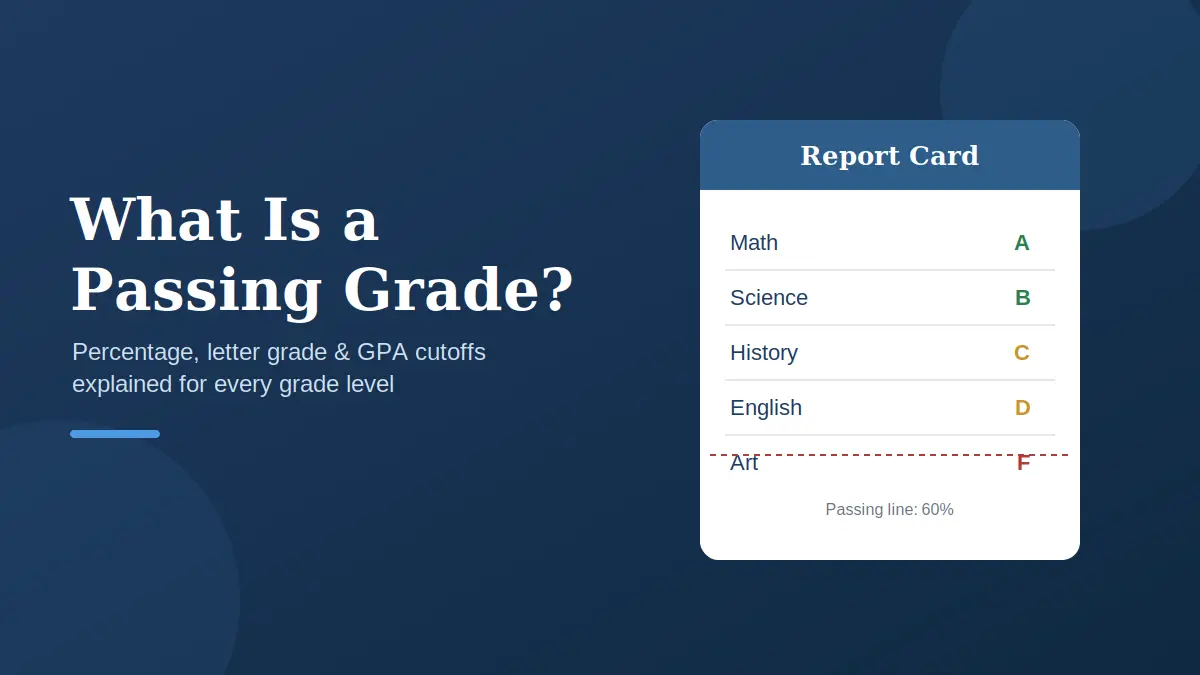
Nobody tells you this in orientation, but the answer to what is a passing grade isn’t one number. It’s a moving target that changes depending on your school, your course, and sometimes even your major.
A passing grade is the minimum score a student must earn to receive credit for a course, typically 60–70% or a D/C letter grade, depending on the institution. Most U.S. high schools set the bar at 60% (a D), while many colleges require at least a C for major-specific or prerequisite courses. Exact cutoffs vary by school policy.
That’s the short version. The longer version — the one that actually matters when your grade is sitting at 61% the night before finals — depends on where you are and what class you’re in.
To learn an easy way to check your result, take a look at this calculator.
The Standard Passing Grade Scale (Percentage and Letter)
Most U.S. schools use a version of the same five-letter scale: A, B, C, D, F. <cite index=”3-1″>A is 90–100 (excellent), B is 80–89 (good), C is 70–79 (satisfactory), D is 60–69 (passing, but just barely), and F is below 60 (failing).</cite>
That said, this isn’t universal. <cite index=”8-1″>At many universities, D covers 59% to 69%, with anything below that counted as failing.</cite> Some schools shift the whole scale down a few points; others shift it up. Your syllabus is the only document that actually settles the question for your class.
Percentage-to-Letter Breakdown
| Letter Grade | Typical Percentage | Passing? |
|---|---|---|
| A | 90–100% | Yes |
| B | 80–89% | Yes |
| C | 70–79% | Yes |
| D | 60–69% | Yes (usually) |
| F | Below 60% | No |
Why 60% Is the Most Common Cutoff
Sixty percent shows up so often because it marks the line between “demonstrated minimal understanding” and “did not.” <cite index=”4-1″>A passing grade in college typically ranges from D to A, with D being the lowest passing grade, and the exact percentage generally falls between 60% and 69%.</cite>
It’s not arbitrary tradition, either — it’s baked into how GPA math works. <cite index=”8-1″>An A almost always corresponds to 4 points or a multiple of 4, and everything below is scaled down from there.</cite> Set the passing line any higher and you’d fail students who technically absorbed most of the material. Set it lower and the grade stops meaning anything.
Is a D a Passing Grade? The Honest Answer
Yes — and no, depending on who’s asking.
<cite index=”11-1″>A letter grade of D is technically considered passing because it’s not a failure, covering any percentage between 60-69%.</cite> You’ll earn credit for the course. It’ll sit on your transcript. Nobody stops you from moving forward.
But “technically passing” and “actually fine” are two different things. <cite index=”9-1″>A D is on the lower end of the spectrum and doesn’t carry a positive reputation</cite>, and here’s the part students find out too late: a lot of programs don’t treat a D like a real pass at all. <cite index=”11-1″>Some graduate programs consider a C the lowest passing grade, while certain undergraduate programs might accept a D</cite> — and it depends entirely on the specific course and department, not the school as a whole.
Quick takeaway: A D keeps you enrolled. It rarely keeps you competitive.
Passing Grades in High School vs. College
High School Passing Standards
<cite index=”2-1″>In primary and secondary schools, a D is usually the lowest passing grade, though some schools set the bar at a C instead — meaning anything below 60% or 70% is failing depending on the school’s specific scale.</cite>
High schools tend to be more forgiving on individual assignments and stricter on cumulative requirements — state exams, credit counts, GPA minimums for extracurricular eligibility.
College Passing Standards
College is where things splinter. <cite index=”2-1″>A D is considered an unsatisfactory but passing grade at the post-secondary level, and students usually still earn credit for the class, though a C or better may be required for major classes or to satisfy a prerequisite.</cite>
Some schools go further and raise the bar school-wide. <cite index=”10-1″>At Loyola Marymount University, for example, the minimum passing grade is a 70 (C), and anything between 55 and 69 counts as a failing grade with no unit credit awarded.</cite> That’s a full letter grade stricter than the “D is passing” standard most students assume applies everywhere.
International comparisons make this even clearer. <cite index=”9-1″>In Canada’s grading system, a D can equal as little as 55%</cite> — a reminder that “passing” is a local policy decision, not a fixed law of education.
How Passing Grades Affect Your GPA
This is the part that trips people up: passing a class and protecting your GPA are not the same goal.
<cite index=”6-1″>Passing grades contribute toward earned credits but don’t hurt your GPA on their own — it’s failing grades that damage GPA, since a fail counts as zero points.</cite> But a D, while passing, still drags your average down compared to a B or C. String together a few D’s and your GPA can slide into probation territory even though you technically passed everything.
<cite index=”4-1″>Most undergraduate programs require a minimum 2.0 GPA to remain in good standing, while graduate students typically need a 3.0.</cite> Do the math: a semester full of D’s clears the “you passed” bar and completely misses the “you’re in good standing” bar.
When “Passing” Isn’t Enough (Major Courses, Prerequisites, Grad School)
Here’s where a lot of advice online gets too simple. Passing a course and satisfying your degree requirements are separate hurdles.
<cite index=”6-1″>Programs like nursing often require at least a C to pass, graduate schools frequently expect a minimum GPA of 3.0 (meaning C or higher in every class), and a low passing grade may block you from moving on to the next course in a sequence.</cite>
I’ve seen this catch students off guard more than almost anything else in academic advising: you can pass a prerequisite with a D, register for the next course in the sequence, and then get pulled out by an advisor because the department requires a C minimum to advance. The transcript says “passed.” The degree audit says otherwise.
Quick takeaway: Before you relax about a D, check whether the specific course is a prerequisite, a major requirement, or tied to professional licensing. Those are the courses where “passing” quietly means something stricter.
Pass/Fail Grading — A Different Set of Rules
Some schools let students take select courses on a pass/fail basis instead of a letter grade, and the passing threshold usually moves.
<cite index=”11-1″>Under pass/no pass grading, a D is generally not considered passing — a C or above is typically required, and these courses don’t count toward GPA since there’s no letter grade to convert into a numerical value.</cite>
That’s a meaningful shift. A student who’d comfortably pass a letter-graded class with a D might actually fail the same material under a pass/fail policy. If your school offers this option, read the fine print before you opt in assuming it’s the “easy” route.
What Happens If You Don’t Pass a Class
Failing a class isn’t a dead end, but it does trigger a few predictable next steps.
<cite index=”3-1″>Most colleges allow students to retake a failed or low-performing course to replace the grade and improve their GPA.</cite> Beyond that, <cite index=”11-1″>a student who withdraws before the deadline gets a W instead of a fail — it won’t count toward GPA, though too many W’s on a transcript can eventually raise concerns and even risk dismissal.</cite>
Realistic options if you’re in this position:
- Retake the course to replace the grade.
- Talk to an advisor about switching sections, adjusting your schedule, or adding tutoring support.
- Use campus resources — office hours, tutoring centers, study groups — before the withdrawal deadline, not after.
- Ask about grade forgiveness policies, which some schools use to let the higher of two attempts count toward GPA.
Common Mistakes Students Make About Passing Grades
- Assuming every course uses the same passing threshold as their last school.
- Treating a D as “safe” without checking whether the course is a prerequisite.
- Forgetting that passing grades still lower GPA if they’re D’s rather than higher letters.
- Opting into pass/fail without confirming the actual passing cutoff for that option.
- Waiting until finals week to ask about retake or withdrawal policies.
Explore more free tools for students on GradeCalcs. — Best in intro or last paragraph.
FAQ Section: What Is a Passing Grade?
Is 60 a passing grade?
Yes, in most U.S. colleges a 60% is passing, since a 60 usually means the credit hours for the class have been earned. Some programs or specific courses set a higher bar, so it’s worth confirming with your syllabus.
Is a D a passing grade in college?
Technically yes — a D covers 60-69% and counts as passing rather than failing. However, many majors and prerequisite courses require a C or better, so a D may not satisfy every requirement even though it earns credit.
What percentage is considered failing?
Most schools consider anything below 60% failing, though some institutions set the line at 70%, meaning grading scales vary by school. Always check your specific school or course policy.
Does a D grade count as college credit?
Yes, students usually earn credit for a class with a D, though a C or better may be required for major-specific classes or prerequisites.
What GPA do you need to pass and stay in good standing?
Undergraduate students typically need a minimum 2.0 GPA, while graduate students generally need at least 3.0. Passing individual classes doesn’t guarantee you’ll meet this cumulative requirement.
Is pass/fail grading easier than letter grading?
Not necessarily. Under pass/no pass rules, a D usually isn’t enough — a C or higher is typically required to pass, which can actually be a stricter bar than a standard letter-graded course.
What happens if I fail a class?
Most colleges let you retake the course to replace the failing grade, and advisors can help you build a recovery plan involving tutoring, schedule changes, or support services.
Do passing grades affect my GPA?
Passing grades contribute to earned credits but don’t hurt your GPA directly — it’s failing grades that count as zero points and pull your average down. Still, a low passing grade like a D will pull your GPA down compared to a B or C.
